Can an as-of record reproduce a household energy decision months later?
Can an as-of record reproduce a household energy decision months later. An as-of decision is reproducible only when inputs, revisions, issue clocks, assumptions, and output hashes are retained.
Abstract
An as-of record asks a precise historical question: what inputs and rules were available to a controller at a named decision time? The frozen evidence counts 2,141 immutable auction publication receipts available for replay. The artifact reports a sample size of one aggregate count and no uncertainty interval. These are production-origin infrastructure receipts, not 2,141 reproduced household decisions.
A publication receipt is necessary but insufficient for replay. Reproduction also requires the exact curve or content hash, source and revision identity, issue and observation clocks, target window, timezone and interval rules, controller version, device constraints, user assumptions, fallback state, and output hash. Any input observed after the original decision clock must be excluded. A replay should calculate a candidate decision in isolation and compare its canonical hash with the archived original; it must not send a device command. If any required artifact is missing or its hash fails, the result is “not reproducible,” not a best-effort reconstruction. The evidence demonstrates that a sizeable receipt rail exists and supports an as-of design. It does not report a successful historical decision replay, repository test run, customer device trace, or proof that every receipt’s full input payload remains available. Deterministic missing-artifact scenarios are proposed robustness fixtures and are not confused with production receipts.
Plain-language answer
Potentially, but the receipt count alone does not prove it. The archive contains 2,141 records saying when complete auction curves were detected and notified. To reproduce an old household decision, you also need the exact data the controller used and the exact rules it used.
Store a sealed decision bundle when the original schedule is created. It should contain stable references or hashes for the market curve, source revision, forecast issue if applicable, target intervals, timezone, appliance constraints, fallback policy, software version, and resulting schedule. Months later, run the same version against those same inputs in a no-side-effect replay and compare the result hash.
If the replay needs today’s latest table, a corrected value observed later, or an undocumented assumption, it is not an as-of reproduction. It is a reconstruction with hindsight. A safe system must state that failure clearly and must never let historical replay call a real device.
Research question
The research question is whether an archived as-of record can reproduce a household energy decision months after it was made. Reproduction means that the same declared inputs and deterministic decision logic produce the same canonical output, without using information that arrived later.
The registered primary metric is narrower: the number of immutable auction publication receipts available for replay. It measures one component of the required evidence chain. The artifact’s interpretation explicitly states the broader condition: inputs, revisions, issue clocks, assumptions, and output hashes must all be retained.
The criterion is strict and fail-closed. A replay is successful only if every required artifact resolves by immutable identity, hashes verify, decision clocks exclude later knowledge, the original software environment is identified, and the canonical output matches. Missing evidence yields a blocked replay. Similar-looking latest data cannot be substituted, because doing so would erase the very historical distinction an as-of system is meant to preserve.
Data and provenance
The evidence JSON identifies VOLT-HOME-WP-100, schema volt-home-paper-evidence-v1, status measured, and publication cutoff 2026-08-30T00:00:00Z. Its primary result is 2,141 immutable auction publication receipts available for replay. The aggregate sample size is one because the estimand is the single frozen receipt count.
The underlying extraction selected zone, delivery date, period count, complete-curve detection time, notification time, and notification latency from production auction publication records. Those fields establish publication and fan-out timing for the retained receipts. The paper-level JSON does not include the complete curve payload or a household decision output.
The extraction ran in a SELECT-only production transaction with a 180-second statement timeout. The frozen snapshot SHA-256 is 7e97489fc8528c8cc8c38830e05b48d949ce1f67b98575dff26f5d7c321e4c67. Analysis-code, protocol, paper-registry, and source-registry hashes are 57c57de79cdab2b5b6d6c54c485cb5162598c5ba0b0bfe995da40d75e6c52ba9, adb36bf6b447af9f96339249b8becaefc20422499cca1977242866347a97bd4b, 7bcb91d7476d0a69fe9fa75a5c7782f8117e0153f82f9112b7e1d307d3943717, and 07949550ac443ff673fda5c0209b99f137544f3ffecf6775f109bb9d09663bd6. The evidence-manifest hashes are 96b0da017de3cbacab5a148852837b1310756b549f9a67339e2f1a273bddc01c for the JSON and 5610e1c98cd199ed79073d1913b49656ab0001b623ddc80c71e182155d445bc4 for the WebP figure.
These 2,141 records are production-origin publication receipts. A hypothetical replay with a missing revision, altered rule, or future value is a deterministic fault-injection scenario, not a production event. No customer schedule, support content, device command, or repository-test execution is part of the evidence.
Method
The registered analysis counts the rows in the frozen auction publication sample and returns that count as the primary outcome. The regenerated evidence records bootstrap_95_interval: null and interval_method: "not reported for this estimand". Deterministic reproduction of the aggregate count provides no estimate of a broader population.
The as-of method derived from the evidence uses an append-only decision envelope. At decision time, the controller records a trusted as-of timestamp, every source observation with its own observed-at and revision identity, canonical input hashes, target delivery intervals, the controller and policy version, appliance parameters, and the output schedule hash. The envelope should also state whether the action was proposed, armed, sent, acknowledged, replaced, or cancelled.
Replay occurs in a side-effect-free environment. The system resolves only artifacts whose observation clocks are at or before the original cutoff, verifies hashes, reconstructs the typed inputs, and invokes the identified decision function. The output is canonicalized and hashed. Exact equality establishes computational reproduction under the retained environment; inequality or a missing artifact blocks the result and records the reason.
There is a storage tradeoff. Keeping full immutable payloads maximizes independence but increases retention and licensing obligations. Keeping only hashes is compact but cannot reconstruct unavailable content. A practical design stores public-safe derived inputs where permitted and references authoritative raw evidence in governed storage by content hash, with access and licensing boundaries preserved.
Results
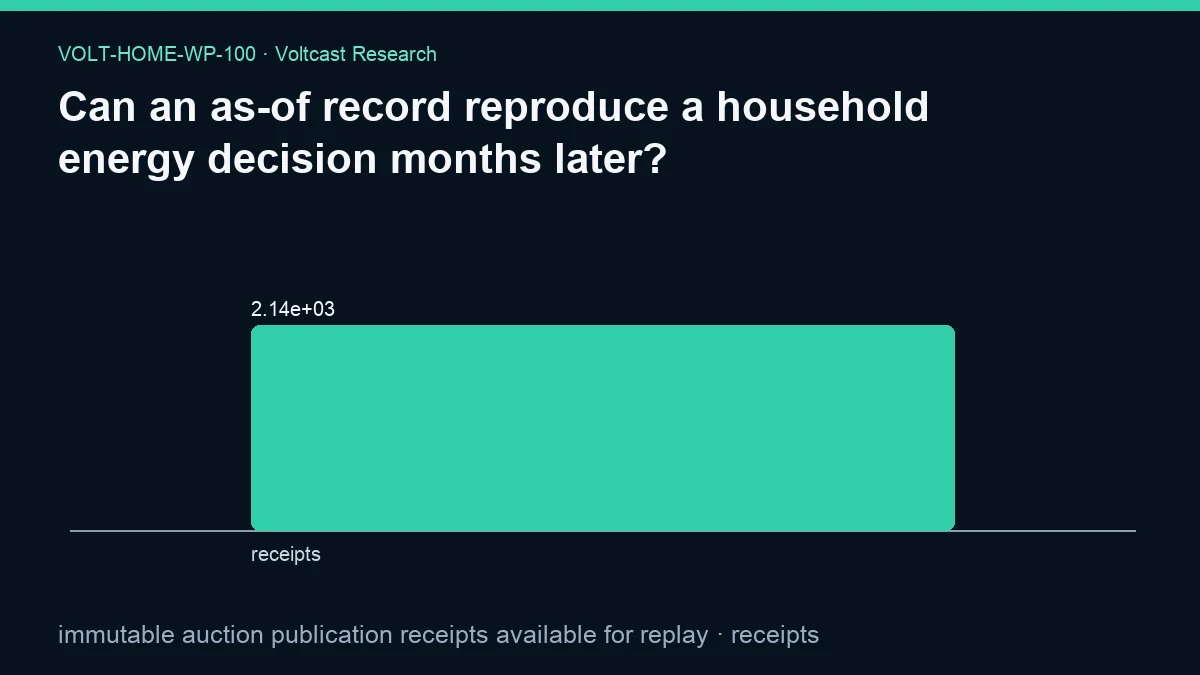
The primary result is 2,141 immutable auction publication receipts available for replay. The evidence reports one aggregate observation and no interval. The figure has one item, “receipts,” with the exact value 2,141.
This establishes the existence and size of the frozen receipt rail. It does not establish that 2,141 complete market payloads, controller environments, or household decisions were replayed. “Available for replay” describes the receipt evidence needed to locate historical publication events; actual decision reproduction has additional dependencies.
The answer to the title is therefore conditional. An as-of record can support reproduction when it retains the complete decision envelope named in the evidence interpretation. The measured count alone is insufficient to report a replay success rate. No percentage of reproducible decisions is present, and none is invented.
Robustness and placebo checks
A robust replay should first prove clock isolation. Inject a later revision with a better value and confirm that the original as-of cutoff excludes it. Remove one required input and confirm the replay blocks. Change the controller version, timezone database, appliance constraint, or canonical serialization and confirm the output hash mismatch is visible. These are proposed deterministic fixtures, not measured repository tests.
The strongest placebo is a replay against the latest mutable tables. It may produce a plausible schedule, but it should be labeled hindsight reconstruction and must not pass the as-of gate. Another placebo changes display-only metadata while preserving canonical decision inputs; the output hash should remain stable if display fields are intentionally excluded.
Receipt integrity should be checked separately from decision determinism. A valid receipt can point to missing content; complete content can still be processed by the wrong code version. Layered checks should report which link failed rather than collapsing all failures into one boolean.
The family result is descriptive. If future work compares multiple replay formats, canonicalizers, or retention policies, it should preregister outcomes and control multiplicity. The absence of a reported interval is not evidence of universal replay certainty.
Limitations
The evidence counts receipts but does not expose a replay ledger. No original household output hashes, controller versions, device constraints, or replay comparisons are measured. The title’s full claim therefore remains conditional.
The publication receipt extraction contains timing and period-count fields, not necessarily the complete historical curve. The evidence interpretation names additional required artifacts precisely because a receipt alone cannot recreate content.
An aggregate sample size of one supplies no confidence interval for future receipt availability or decision reproducibility. Coverage may differ by zone and by when the publication rail began.
Software environments can become unavailable, and floating-point, timezone, or dependency changes can alter outputs. Canonicalization and container or lockfile retention reduce that risk but are not measured here. Licensing may limit retention or redistribution of raw inputs. The paper makes no customer-savings, device-certification, or trading claim.
Practical implication
Write a decision envelope before arming an action. Include paper-independent operational fields: decision ID, as-of UTC timestamp, zone, target interval set, source observation IDs and revisions, input hashes, schema versions, issue and receipt clocks, controller commit or package version, declared appliance parameters, fallback policy, and canonical output hash.
Make the envelope append-only. Later revisions create linked observations; they do not overwrite what the controller knew. The current serving table can remain optimized for latest values, but replay must resolve the historical sidecar by as-of clock. Keep authority boundaries explicit: raw evidence may live in governed object storage while the decision record holds content hashes and permitted derived inputs.
Replay in a process with device and external-write adapters disabled. Verify every artifact before execution. If an input is missing, a hash differs, a clock is ambiguous, or the exact logic is unavailable, return a structured blocked verdict. Never fill gaps from present-day data. Store the replay output and comparison hash as a new audit event without changing the original envelope.
Reproducibility
Verify the frontmatter, registry entry, source IDs, evidence path, all five provenance hashes, and both evidence-manifest artifact hashes. Count the frozen auction publication records, confirm 2,141, and confirm that the evidence reports no interval. This reproduces the paper’s measured result.
A direct decision-replay study should preregister a corpus of sealed decision envelopes, required artifacts, canonicalization rules, no-side-effect controls, exact-match criteria, blocked reasons, and software environments. It should report successful, mismatched, and blocked replays separately. Production receipts and deterministic missing-artifact fixtures must remain distinct evidence classes.
A newer archive count is a replication. It should carry a later cutoff and new hash. It must not replace the frozen 2,141-receipt result or imply that historical decision outputs were retroactively available.
Disclosure
Analysis and drafting were model-assisted. This is a public working paper. It is not peer reviewed. Evidence hashes, clocks, method boundaries, and limitations are disclosed. Voltcast publishes the internal architecture reference and produced the aggregate.
No household decision, customer data, device command, or repository-test run was replayed in the primary evidence. Volt has no live traders or live capital; C0R is the only paper strategy, and production weather forecasting is a non-trading service. This paper is not trading advice, a retention guarantee, or proof of regulatory audit sufficiency.
References
- Google Search Central, Article structured data.
- Google Search Central, Introduction to structured data markup in Google Search.
- Google Search Central, Spam Policies for Google Web Search — Scaled content abuse.
- ENTSO-E, Single Day-ahead Coupling (SDAC).
- Voltcast, Voltcast Architecture.