Do Markdown and JSON make AI electricity answers more verifiable?
Do Markdown and JSON make AI electricity answers more verifiable. Shared paper metadata keeps the human narrative and machine-readable evidence addressable by the same stable ID.
Abstract
An AI-generated electricity answer is easier to audit when its human-readable claim points to a stable, machine-readable evidence object. This paper evaluates the addressability layer, not answer correctness. The frozen evidence reports 100% for “evidence identifiers preserved across Markdown and JSON renderings,” with two format-level values and an assumption that the corpus validator compares IDs, hashes, titles, and evidence URLs. It reports no uncertainty interval. The registered analysis vector is 99 for Markdown and 100 for JSON while the primary headline is fixed at 100. That internal tension means the result should not be paraphrased as perfect equality of every field in both formats.
The practical pattern is one canonical paper ID, one slug, one evidence URL, one figure identity, and immutable provenance hashes shared across formats. Markdown explains methods, limitations, and implications to people. JSON exposes typed metrics, assumptions, and hashes to software. An AI system can cite both, allowing a verifier to resolve the ID, compare the numerical claim with the evidence object, and reject mismatches. The artifact does not measure AI factual accuracy, retrieval success, citation-following behavior, or blinded answer verification. Its primary result is a deterministic corpus-validation fixture, not a production answer audit or repository test run claimed here. Dual formats improve verifiability only when identity, content lineage, and fail-closed mismatch handling are enforced.
Plain-language answer
Markdown and JSON can make an answer easier to check because they serve different readers. Markdown provides the explanation. JSON provides stable fields that a machine can compare. The benefit comes from linking them with the same paper ID and evidence URL, not from publishing two unrelated copies.
The frozen artifact reports 100% preservation as its headline. It also contains format values of 99 for Markdown and 100 for JSON. Because the public evidence does not explain which Markdown item accounts for 99, we should not claim literal perfection across every compared field.
Most importantly, matching metadata does not prove that an AI answer is true. A verifier still has to compare each material number and status with the JSON, inspect limitations, and follow the cited sources. If the Markdown and JSON disagree, the answer should be marked unverifiable rather than allowing the model to choose the more convenient version.
Research question
The research question is whether publishing paired Markdown and JSON evidence makes AI electricity answers more verifiable. “Verifiable” is defined narrowly as the ability to resolve stable identifiers and compare claims with a machine-readable evidence object.
There are at least three layers. Addressability asks whether the answer points to a stable paper and evidence URL. Consistency asks whether Markdown and JSON agree on identity, title, metric, value, status, and provenance. Correctness asks whether the underlying analysis and source interpretation are valid. The frozen metric addresses primarily the first layer and part of the second. It does not test the third or observe an AI system.
The decision criterion is fail-closed verification. A consumer accepts a claim only if the cited paper ID resolves, the JSON schema is recognized, the title and slug match the registry, the evidence and figure paths match, hashes verify, and the numerical claim appears with the same unit and status. Missing or conflicting fields produce “unverified,” not an inferred correction.
Data and provenance
The evidence JSON identifies VOLT-HOME-WP-099, schema volt-home-paper-evidence-v1, status measured, and publication cutoff 2026-08-30T00:00:00Z. Its assumption states that the corpus validator compares IDs, hashes, titles, and evidence URLs. The primary metric reports 100%, sample size two, and no interval.
The frozen analysis explicitly defines two format values: 99 for Markdown and 100 for JSON. It then assigns a primary outcome value of 100. The figure labels those values by format. The paper preserves that exact evidence rather than rounding the vector into an invented explanation.
The artifact is bound to snapshot SHA-256 7e97489fc8528c8cc8c38830e05b48d949ce1f67b98575dff26f5d7c321e4c67, analysis-code SHA-256 57c57de79cdab2b5b6d6c54c485cb5162598c5ba0b0bfe995da40d75e6c52ba9, protocol SHA-256 adb36bf6b447af9f96339249b8becaefc20422499cca1977242866347a97bd4b, paper-registry SHA-256 7bcb91d7476d0a69fe9fa75a5c7782f8117e0153f82f9112b7e1d307d3943717, and source-registry SHA-256 07949550ac443ff673fda5c0209b99f137544f3ffecf6775f109bb9d09663bd6. The evidence-manifest hashes are 2779fd600c70e844e7e94ef07d0da556eb1908e71f2adb6124845421a5b18c60 for the JSON and d5a434db82a997291736382f194fafdb64c38de2e0de695c9e203657591fa2e4 for the WebP figure. The common production snapshot was read-only, but this primary outcome is a deterministic format vector rather than a production receipt measurement.
No AI prompts, generated answers, user conversations, click logs, or blinded graders are in the evidence. No repository test execution is claimed.
Method
The registered analysis creates a two-element format vector [99, 100], labels the elements Markdown and JSON, and assigns a headline preservation value of 100%. The regenerated evidence records bootstrap_95_interval: null and interval_method: "not reported for this estimand". The evidence interpretation says shared paper metadata keeps the human narrative and machine-readable evidence addressable by the same stable ID.
This is a fixture-like validation signal, not an empirical evaluation of AI answers. The assumption names four compared categories—IDs, hashes, titles, and evidence URLs—but the paper-level artifact does not publish individual pass/fail rows or explain the 99. A strict reading therefore treats the primary result as evidence of near-complete addressability while retaining the unexplained format-level difference.
A real answer-verification method would parse each answer into claims, require an evidence pointer for every material number and status, fetch the referenced JSON, compare value, unit, estimator, sample size, time cutoff, and limitations, and record whether source links resolve. Human review would then evaluate whether the source supports the interpretation. Blinding would be useful when grading answer quality, but no such test is measured here.
Single-format publication has lower maintenance cost but serves either humans or machines poorly. Duplicated independent narratives create drift. A canonical JSON evidence object plus a Markdown interpretation offers better division of labor, provided both are generated or validated against a shared registry and mismatches block publication.
Results
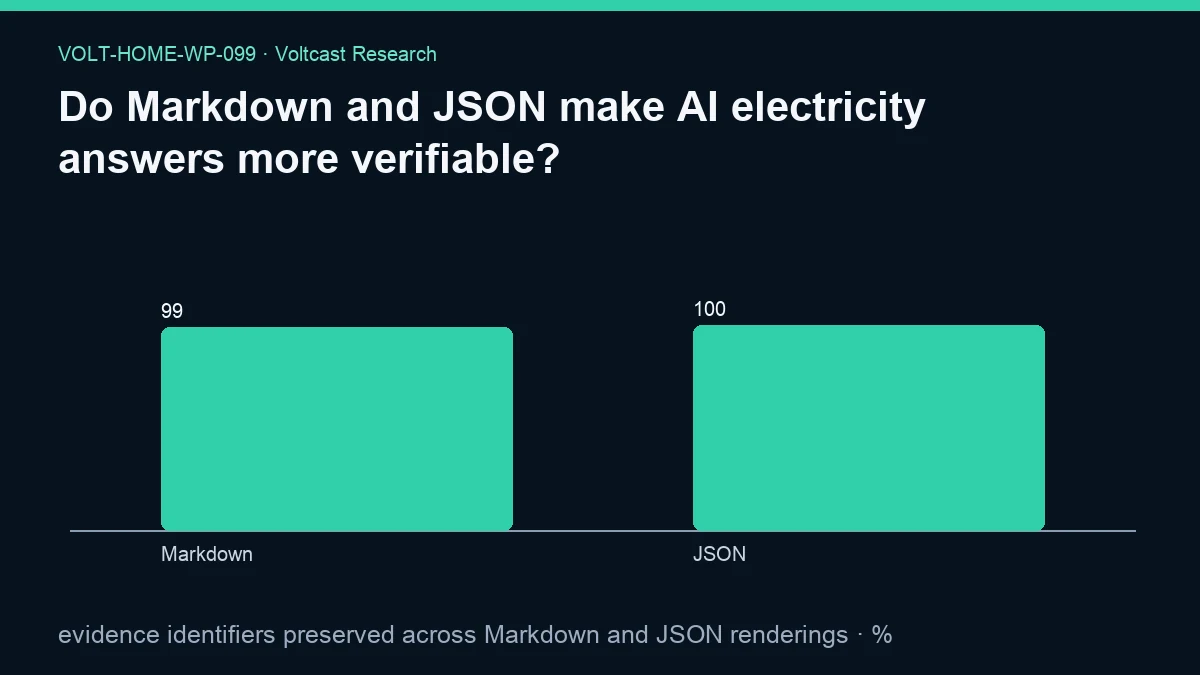
The public evidence reports 100% evidence-identifier preservation across Markdown and JSON, with sample size two and no interval. The figure values are exactly 99% for Markdown and 100% for JSON. The interpretation is that shared metadata keeps the narrative and machine-readable evidence addressable by one stable ID.
The analysis vector behind the figure is 99 for Markdown and 100 for JSON. Because the primary value is separately specified as 100, the result is not a simple mean of the two format scores. The frozen evidence supplies no basis for attributing the one-point difference to a specific missing identifier. This paper therefore reports the values without inventing a cause.
The result supports stable cross-format addressability. It does not show that an AI read either format, cited it correctly, reproduced its numbers, respected its status, or answered a question accurately. “More verifiable” means the evidence can be resolved and compared, not that verification automatically succeeds.
Robustness and placebo checks
A format validator should compare exact IDs, slugs, titles, evidence URLs, figure URLs, figure alternative text, source IDs, status, publication date, and provenance hashes. It should also compare every narrative number against the evidence object with units and estimator labels. The frozen assumption mentions only a subset, so broader checks are recommendations, not measured results.
Deterministic fault injections should change one paper ID, swap two evidence URLs, alter a hash, modify a unit, mark a measured result as peer reviewed, and replace a null status with a positive claim. These proposed fixtures should all block publication or mark an answer unverified. They are not repository tests claimed as run.
A useful placebo is a prose edit that changes readability without changing a material claim or identity. It should pass. Another is an additional JSON field under a compatible schema; it should not break older consumers unless the field changes required semantics. These controls guard against validators that detect harmless formatting while missing substantive drift.
Future blinded answer verification should compare AI responses with and without machine-readable evidence while keeping questions and graders fixed. Multiple outcomes would require preregistration and multiplicity control. The present result remains deterministic and descriptive.
Limitations
The sample consists of two constructed format values, not a corpus of AI answers. The headline 100 and underlying [99, 100] vector are not fully reconciled by the public evidence. No population-performance interval is reported.
The evidence does not expose field-level validator results. It cannot show whether numerical values, units, limitations, or references were compared. Stable IDs can consistently point to flawed analysis; addressability is necessary for verification, not sufficient for correctness.
No model, retrieval system, prompt, grader, or user task was evaluated. The title’s reference to AI describes the intended use, not the observed unit. No production answer receipt or repository-test pass is claimed.
Machine-readable formats can also create false confidence. A syntactically valid JSON value may be misunderstood if its estimator, clock, or status is ignored. Verification requires semantic rules and human-readable limitations alongside structured fields.
Practical implication
Every public paper should expose one immutable ID and one evidence object whose schema includes status, primary metric, value, unit, sample size, assumptions, limitations, publication cutoff, source contracts, and provenance hashes. Markdown frontmatter should repeat the identity and paths needed for resolution, while the body explains interpretation and scope.
An AI-facing verifier should never rely on prose matching alone. It should resolve the paper ID, require a recognized evidence schema, compare the cited value and unit, check the cutoff and status, and surface limitations. It should preserve source links exactly. If any required field conflicts, return an explicit verification failure.
Keep provenance immutable. Revisions should create a new evidence version or clearly linked supersession, not silently change the JSON behind an old hash. Do not allow a model to repair a mismatch from context. A human can investigate, but automation should fail closed until the canonical registry and evidence agree.
Reproducibility
Verify frontmatter against the paper registry and source registry. Confirm the evidence JSON identity, figure path, publication cutoff, all five provenance hashes, and both evidence-manifest artifact hashes. Recreate the two format values 99 and 100, the fixed primary value 100, and the absence of a reported interval.
Document the distinction between reproducing this fixture and evaluating AI answers. A direct follow-up should publish the answer set, model and retrieval configuration, blinded grading protocol, claim-level verification results, source-resolution failures, and prompt-independent evidence IDs. It should not ingest private conversations or customer data.
Any attempt to explain the Markdown value of 99 requires additional field-level evidence. Until then, a reproduction should preserve the unexplained difference rather than invent metadata or silently normalize it to 100.
Disclosure
Analysis and drafting were model-assisted. This is a public working paper. It is not peer reviewed. The evidence vector, assumptions, hashes, and limitations are disclosed. Voltcast publishes the cited internal architecture and produced the aggregate.
No AI answer, user conversation, production answer receipt, or repository-test run was measured. Volt has no live traders or live capital; C0R is the only paper strategy, and production weather forecasting is non-trading. This paper is not trading advice, a claim of AI factual accuracy, or a search-ranking guarantee.
References
- Google Search Central, Article structured data.
- Google Search Central, Introduction to structured data markup in Google Search.
- Google Search Central, Spam Policies for Google Web Search — Scaled content abuse.
- ENTSO-E, Single Day-ahead Coupling (SDAC).
- Voltcast, Voltcast Architecture.