Can a simple price cap protect dynamic-tariff households from extreme days?
Can a simple price cap protect dynamic-tariff households from extreme days. A cap truncates extreme exposure but also requires a counterparty and premium not modeled here.
Abstract
This working paper tests how a simple wholesale price cap truncates the upper tail of a standardized synthetic household’s daily wholesale energy cost. The scenario allocates 4,000 kWh evenly across 365 days, values that quantity at each observed zone-day mean price, and caps the resulting exposure at wholesale price equivalents of €100, €200, €300, and €500/MWh. Under the registered €200/MWh cap, the P99 synthetic daily wholesale cost is €2.191780821917808. The calculation uses 93,161 observations and floors input mean prices at -€100/MWh before applying the upper caps. Every monetary result is a declared synthetic wholesale scenario, never a measured customer saving, retail bill, or quoted protection product. No cap premium, counterparty, deductible, supplier margin, tax, VAT, network charge, device loss, or customer telemetry is included. The 35% flexible-energy family assumption does not enter the cap formula, which applies to the full standardized daily quantity. The study shows mechanical tail truncation, not whether a real cap is economically beneficial.
Plain-language answer
Yes, a cap can mechanically limit the modeled upper tail. In this frozen scenario, a €200/MWh wholesale cap places the P99 daily synthetic wholesale energy cost at €2.191780821917808 for a flat 4,000 kWh-per-year load. That amount is simply the cap applied to the standardized daily energy scale when the cap binds.
This does not mean a retailer can protect a household for free. Someone must bear prices above the cap. A supplier or counterparty would normally charge a premium, embed the cost in another tariff component, apply conditions, or hedge the exposure elsewhere. None of those economics is modeled. The study also excludes taxes, VAT, network charges, supplier margin, and fixed fees, so the cap does not bound a complete retail bill.
Nor does the result measure savings. It compares a constructed wholesale tail after truncation. The answer is therefore limited: the cap protects the synthetic wholesale component from exceeding its declared threshold, but this paper cannot tell whether the total contract is cheaper, safer, or suitable for a household.
Research question
The question is whether an upper price cap can reduce extreme-day exposure under dynamic wholesale pass-through. The registered implementation asks a precise version: what is the 99th percentile of standardized daily wholesale cost after applying a €200/MWh-equivalent cap?
The estimand is not a causal effect and not a retail product comparison. There is no uncapped-minus-capped annual expected-cost result, no premium, and no household utility function. “Protect” means truncate the modeled wholesale upper tail. It does not mean insure every component of a bill or guarantee affordability.
Data and provenance
The evidence comes from a frozen SELECT-only production snapshot with no customer telemetry. The family’s registered contracts are day_ahead_prices, forecast_accuracy, bess_index_daily, zone_load, and zone_holidays. The primary calculation uses daily mean day-ahead prices. Its sample size is 93,161 observations.
Daily price aggregates cover 2021-01-01 through 2026-08-29. Detailed intervals in the broader corpus cover 2025-10-01 through 2026-08-29, and its long-history boundary is 2015-01-01 through 2026-08-29. The publication cutoff is 2026-08-30T00:00:00Z. This paper does not claim that the source tables contain actual capped tariff offers; the caps are scenario inputs.
The snapshot SHA-256 is 7e97489fc8528c8cc8c38830e05b48d949ce1f67b98575dff26f5d7c321e4c67. The protocol is identified by adb36bf6b447af9f96339249b8becaefc20422499cca1977242866347a97bd4b, the paper registry by 7bcb91d7476d0a69fe9fa75a5c7782f8117e0153f82f9112b7e1d307d3943717, the source registry by 07949550ac443ff673fda5c0209b99f137544f3ffecf6775f109bb9d09663bd6, and the analysis code by 57c57de79cdab2b5b6d6c54c485cb5162598c5ba0b0bfe995da40d75e6c52ba9. The evidence-manifest hashes are 8e85480048241b976d217e1a50092e36622ddff43f5ca135a5f62ad00b202132 for the JSON and f550ce7a8c4d8c26eba42a9738de389e9273bc43efc2f6b4cac11c5aa4c7cea2 for the WebP figure. The database operation was read-only with a 180-second statement timeout. The five external references provide tariff and flexibility context, not the paper’s numerical output.
Method
The standardized annual energy is divided evenly over the year:
4,000 kWh ÷ 365.
For each included zone-day, the analysis first floors the observed mean wholesale price at -€100/MWh. It then converts the price to a synthetic daily wholesale energy cost:
max(mean price, -100 EUR/MWh) × 4,000 kWh ÷ 365 ÷ 1,000.
The lower floor limits how negative the synthetic cost can become. It does not affect the upper cap directly, but it is part of the implemented distribution and therefore disclosed.
For each cap level—€100, €200, €300, and €500/MWh—the code converts the cap to the same daily-energy scale and takes the minimum of each synthetic daily cost and that cap-scaled amount. It then calculates the 99th percentile. The registered primary metric is P99 under the €200/MWh cap.
The family assumptions also declare 35% flexible energy, wholesale pass-through, and no customer telemetry. The cap method does not multiply by 35%; it covers the full flat daily quantity. It does not schedule flexible load, compare capped and uncapped consumption, or vary daily kWh.
No physical asset is modeled. Battery efficiency, degradation, capacity, and power are absent; EV charging efficiency and connection constraints are absent; heat-pump COP and comfort are absent. The synthetic cap has no premium, term, counterparty limit, collateral, deductible, or recovery mechanism. Taxes, VAT, supplier margin, network charges, and device losses are excluded. Every euro amount remains a synthetic wholesale scenario.
Results
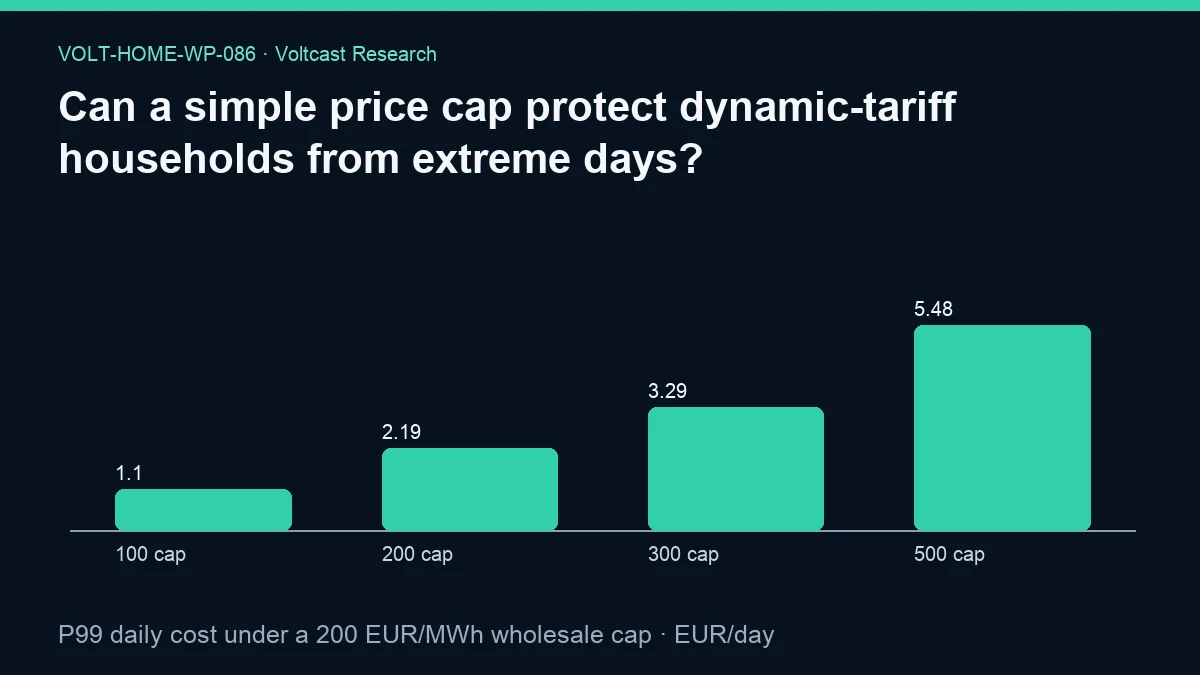
The primary result is a P99 synthetic daily wholesale cost of €2.191780821917808 under the €200/MWh wholesale cap. Rounded, that is €2.19 per synthetic day. The value is based on 93,161 observations.
The result indicates that the €200/MWh cap binds at or below the reported upper-tail point on the standardized daily-energy scale. It does not report the uncapped P99 in the primary evidence, the number of capped days, the expected annual payout, or a fair premium. Without those quantities, net economic protection cannot be evaluated.
The figure values are exactly €1.095890410958904, €2.191780821917808, €3.287671232876712, and €5.47945205479452 per synthetic day for caps of €100, €200, €300, and €500/MWh. The regenerated evidence reports bootstrap_95_interval: null and interval_method: "not reported for this estimand", so no confidence interval is available for the mechanically capped statistic.
All monetary values in this section are declared synthetic wholesale scenarios. None is a customer bill or measured customer saving. The result proves arithmetic truncation under the scenario, not value for money.
Robustness and placebo checks
The frozen cap grid is the first sensitivity check. Repeating the P99 calculation at €100, €200, €300, and €500/MWh shows how the selected threshold changes the tail. A lower cap must weakly reduce capped P99, but this monotonicity is a mathematical property. It does not account for the higher premium a lower cap may require.
An infinite-cap placebo should reproduce the uncapped synthetic P99. A cap above every observed mean price should have no effect. A very low cap should bind frequently. Reporting the cap-hit rate and total truncated area would make those checks informative, but those values are not included in the primary evidence and are not invented here.
A premium robustness test would add a declared per-kWh or fixed premium to every capped outcome and compare expected cost and tail cost with the uncapped scenario. It would need a transparent pricing rule or observed offer. This paper has neither, so it cannot locate a break-even premium.
A load-shape stress would replace flat daily consumption with preregistered winter-peaking, EV, and heat-pump profiles. Extreme wholesale days may coincide with high demand, meaning a flat 10.96 kWh/day allocation can understate or overstate exposure. No such claim is made.
The family protocol requires blocked day or week bootstrap methods and Holm control for inferential claims. The cap output is descriptive and partly mechanical. No significance claim is attached to the 93,161-observation count.
Limitations
The cap is a synthetic threshold, not a retail product. No source metadata identify a provider, premium, term, eligibility rule, or legal obligation. The study cannot assess whether a counterparty would offer the cap or at what cost.
The metric covers only wholesale energy. Taxes, VAT, network charges, supplier margin, fixed fees, and device losses remain outside the cap. A customer’s all-in bill can therefore exceed any level implied by the €2.19 synthetic wholesale component.
Daily consumption is flat. Real household load varies by season, weather, occupancy, and asset operation. The calculation applies the cap to daily mean prices, so it also misses intraday spikes and the household’s interval-specific exposure. The 35% flexible-share assumption is declared at family level but unused.
No asset model is present. Efficiency, degradation, power, capacity, state of charge, charging deadlines, COP, and comfort are unmodeled. The lower price floor at -€100/MWh is an additional scenario convention that can affect the lower tail and expected value.
The study reports P99 under one cap but does not report expected annual capped versus uncapped cost, payout concentration, cap-hit frequency, or premium. The evidence reports no interval for the primary capped quantile. Historical observations also do not guarantee future tail behavior.
Practical implication
A cap can be evaluated only as part of a complete contract. For a household-specific synthetic analysis, use interval-level local prices, the actual load profile, the cap formula, all premiums and fees, taxes, network charges, and any passthrough exceptions. Compare both expected cost and upper-tail cost.
The €2.191780821917808 result is useful as an auditable arithmetic benchmark for the €200/MWh, 4,000 kWh flat-load wholesale scenario. It is not a protection quote. A household should not choose a tariff from this number, and no provider should advertise it as customer savings.
Reproducibility
Open the evidence JSON named in the frontmatter and verify the ID, title, slug, assumptions, status, cutoff, source contracts, all five provenance hashes, and the evidence-manifest hashes for the JSON and figure. Confirm the read-only transaction flag and snapshot-manifest match.
For each daily mean price, apply the -€100/MWh floor, multiply by 4,000, divide by 365, and divide by 1,000. For each upper cap, convert the cap to the same daily amount and replace each synthetic cost with the lower of cost and cap. Compute P99 with the frozen code’s quantile convention. The €200/MWh run should reproduce 2.191780821917808 EUR/day.
Adding a premium, changing annual energy, using interval load, removing the lower floor, or capping only a share of load is a new scenario. It must not silently replace this evidence.
Disclosure
Analysis and drafting were model-assisted. This public working paper is not peer reviewed. The cap, lower floor, load, evidence hashes, and omissions are disclosed. It is not financial, insurance, tariff-selection, investment, purchasing, or trading advice.
Every monetary result is a declared synthetic wholesale scenario, never a customer saving or retail bill. Volt has no live traders or live capital; C0R is the only paper strategy. This household safeguard study is not trading research.
References
- Advances in Applied Energy, Assessing the conditions for economic viability of dynamic electricity retail tariffs for households.
- ACER and CEER, Rewarding flexibility: How retail contract choice can help unlock consumer flexibility.
- European Commission, Communication from the Commission on the Citizens Energy Package.
- Energy Policy, Welfare redistribution through flexibility — Who pays?.
- International Energy Agency, Scaling Up Demand Flexibility.