Can carbon-aware battery dispatch increase cost—or reduce emissions?
Can carbon-aware battery dispatch increase cost—or reduce emissions. The unmatched aggregate association is exploratory; it cannot establish emissions savings.
Abstract
The frozen evidence reports a Pearson correlation of -0.10922802338415764 between BESS-v2 index value and frozen renewable capture rates, based on 1,021 observations. The evidence interpretation calls this an unmatched aggregate association and says it cannot establish emissions savings. Zone-month matching is incomplete, and lifecycle emissions are not measured. Those limitations prevent a causal answer to whether carbon-aware dispatch increases cost or reduces emissions.
The result is a small negative association: higher indexed battery value tends to coincide weakly with lower renewable capture rates in the aggregate used here. Renewable capture rate is not carbon intensity, marginal emissions, or avoided emissions. BESS-v2 itself is a normalized wholesale day-ahead index under perfect foresight, not a carbon-aware policy. It excludes retail taxes and network charges. The evidence can motivate a matched multi-objective study, but it cannot quantify a cost premium for carbon awareness or an emissions reduction. Any stronger claim would substitute a proxy for the missing outcome.
Plain-language answer
This evidence does not prove either side of the title. It finds a weak negative correlation, r = −0.1092, between normalized BESS-v2 value and renewable capture rates. That means the two aggregate measures move slightly in opposite directions in this sample. It does not mean a battery caused renewable capture to rise, displaced fossil generation, or reduced emissions.
A carbon-aware controller could choose different charge and discharge intervals than a price-only controller. It might accept lower indexed value to charge during cleaner periods, or under some curves it might improve both objectives. To know, the study needs time-matched carbon or marginal-emissions data and two frozen dispatch policies settled on the same rows. The current evidence has incomplete zone-month matching and no lifecycle-emissions measurement. The defensible answer is that the trade-off remains unresolved.
Research question
The operational research question has two parts. First, how much wholesale value changes when a schedule optimizes a carbon objective or a joint price-carbon objective instead of price alone? Second, how much operational or lifecycle emissions change after accounting for charging losses and the generation displaced during discharge? Those questions require explicit objective weights, temporal carbon data, storage losses, and counterfactual grid assumptions.
The published analysis asks a looser descriptive question: how is BESS-v2 index value associated with frozen renewable capture rates? Capture rate describes the relationship between renewable generation value and market prices; it is economically informative but not an emissions measure. The correlation can reveal co-movement worthy of investigation, yet it cannot identify a dispatch effect. This paper keeps cost, renewable-market value, average carbon, marginal carbon, and lifecycle emissions conceptually separate.
Data and provenance
The analysis is tied to SELECT-only snapshot SHA-256 7e97489fc8528c8cc8c38830e05b48d949ce1f67b98575dff26f5d7c321e4c67, with a read-only transaction and 180-second statement timeout. Registered source tables are day_ahead_prices, bess_index_daily, bess_forecast_daily, generation_mix, and capture_stats. Daily price coverage is 2021-01-01 to 2026-08-29; detailed intervals, 2025-10-01 to 2026-08-29; long-history boundary, 2015-01-01 to 2026-08-29. Publication cut-off is 2026-08-30T00:00:00Z.
The primary sample has 1,021 observations, substantially fewer than the 16,368 rows in several companion BESS papers. The unit is Pearson r. Analysis-code hash is 57c57de79cdab2b5b6d6c54c485cb5162598c5ba0b0bfe995da40d75e6c52ba9, protocol hash adb36bf6b447af9f96339249b8becaefc20422499cca1977242866347a97bd4b, registry hash 7bcb91d7476d0a69fe9fa75a5c7782f8117e0153f82f9112b7e1d307d3943717, and source-registry hash 07949550ac443ff673fda5c0209b99f137544f3ffecf6775f109bb9d09663bd6. The evidence specifically discloses incomplete zone-month matching.
Method
BESS-v2 normalizes day-ahead battery index value per unit of power and uses perfect foresight of realized prices. That means it represents ex post wholesale opportunity under common constraints, not a forecast-selected or carbon-aware schedule. Retail taxes and network charges are excluded. Capture statistics are frozen aggregate measures joined where available.
The primary method computes Pearson correlation between BESS index value and renewable capture rates over the available aggregate matches. Correlation ranges from −1 to 1 and summarizes linear association. It does not control confounding, recover temporal causality, or estimate emissions. The study labels the association exploratory and unmatched. Within-family Holm control applies to inferential claims, while this descriptive result makes no unadjusted significance claim. No policy optimization or emissions accounting is performed in the paper-level evidence.
Results
The recorded association is r = -0.10922802338415764, rounded to −0.1092. Its magnitude is small, and its sign is negative. The result may indicate that higher BESS-v2 index values occur somewhat more often where renewable capture rates are lower within the available aggregate rows, but incomplete matching and omitted factors prevent a substantive causal interpretation.
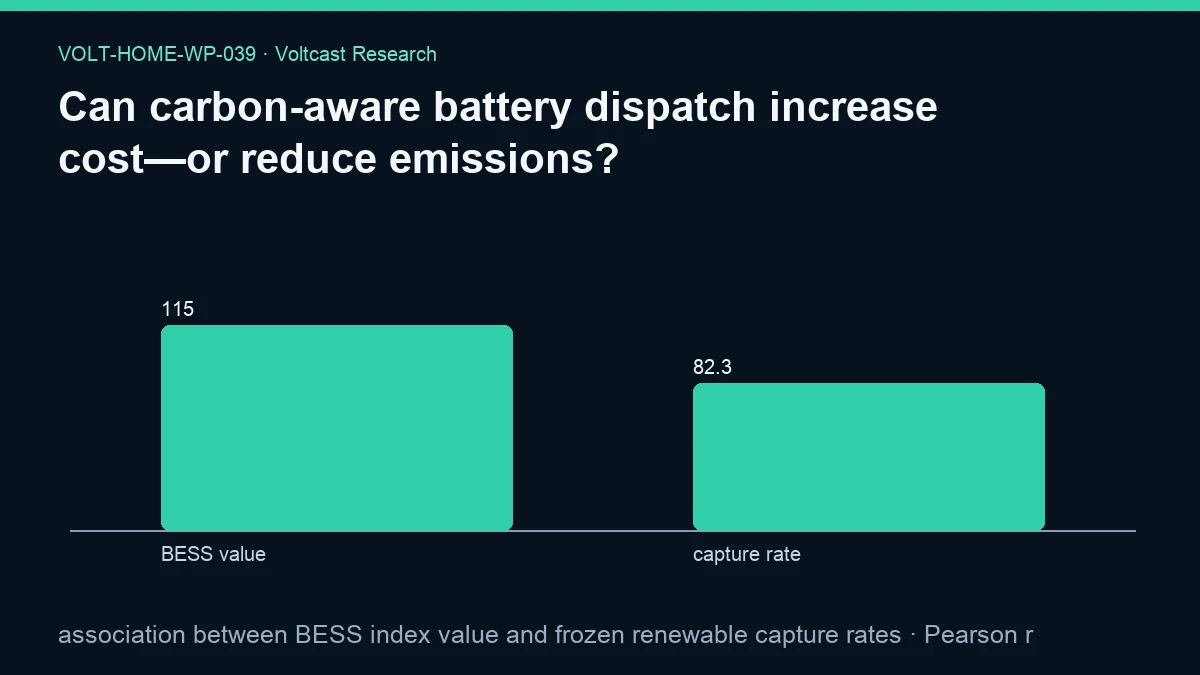
The regenerated JSON reports bootstrap_95_interval: null and no interval method for this estimand. This paper therefore reports no correlation uncertainty. The figure publishes BESS value = 115.13824798387097 and capture rate = 82.27394711067582 on their displayed aggregate scales; neither value is the Pearson coefficient or an emissions effect.
No emissions outcome is present. There is no carbon-intensity change, avoided tonnes, marginal generator, lifecycle factor, or cost difference between price-only and carbon-aware schedules. The evidence therefore cannot say that carbon-aware dispatch raises cost, reduces emissions, or achieves both. It only reports the unmatched association between two aggregate measures.
Robustness and placebo checks
A robust extension should match zone and time exactly, use carbon data at native market intervals, and compare at least three policies: price-only, carbon-only, and a preregistered joint objective. Each policy must use information available at the scheduling clock and settle on the same realized prices and carbon series. Round-trip losses should increase charging energy and be reflected in emissions accounting.
Placebos should shift carbon series across days, use annual-average carbon in place of interval values, and randomize capture rates within zones. A valid policy effect should disappear under broken temporal alignment. Results should be checked with both average and marginal emissions assumptions and should disclose that these answer different questions. None of these checks appears in the current JSON. The present safeguards are transparent sample size, explicit incomplete matching, and refusal to invent an interval where none is reported.
Limitations
Renewable capture rate is not carbon intensity. A low capture rate can reflect abundant renewable output at low prices, but emissions depend on the marginal generation and interconnector response when the battery charges and discharges. Storage losses can increase total generation required. Lifecycle emissions add manufacturing and replacement boundaries that the evidence explicitly does not measure.
The association is aggregate and unmatched, leaving confounding by zone, month, duration, price volatility, renewable mix, and market regime. Pearson r measures linear co-movement and can hide nonlinear or conditional relationships. Perfect foresight and wholesale-only BESS-v2 do not represent a deployable carbon policy or household bill. The smaller sample and absence of an interval further limit precision. The evidence cannot support a causal or quantitative emissions claim.
Temporal direction is another unresolved issue. A monthly association can connect a battery index measured over the same period as renewable capture rates without showing whether charging occurred before, during, or after cleaner generation. Interconnector flows can also shift the relevant generation response outside the local bidding zone. An emissions study must choose and defend a system boundary rather than assuming local generation mix is the marginal source.
Multi-objective results should be shown as a frontier, not reduced to a single preferred weight. Different users may accept different wholesale-value sacrifices for an emissions objective, and some intervals may improve both. A preregistered set of weights can reveal those trade-offs without selecting a favorable point after outcomes are known. The current correlation contains no such frontier. Its main practical value is to reject automatic equivalence between high BESS-v2 value, high renewable capture, and low emissions.
Storage changes emissions through both timing and losses. Charging requires more energy than later discharge returns, so even a shift from a higher-carbon to a lower-carbon interval can fail an emissions test if the difference is too small relative to round-trip loss. Conversely, discharging may offset generation with a different marginal intensity from the average intensity shown for that interval. A credible calculation must state which counterfactual generator is displaced on both legs.
Imports further complicate attribution. A bidding zone’s production mix may not describe the electricity responding at the margin when cross-border flows change. Consumption-based, production-based, and marginal accounting can yield different answers without any arithmetic error. The paper-level source contracts include generation mix and capture statistics, but the evidence explicitly stops short of lifecycle measurement and does not publish a dispatch-aligned carbon series. That boundary is why the correlation cannot support an environmental outcome claim.
Practical implication
Do not label a price-optimized battery “green” solely because it charges at low or negative prices, and do not use renewable capture rate as a substitute for emissions. If carbon is an objective, specify the carbon series, decision clock, marginal-versus-average convention, storage losses, and trade-off weight. Compare the resulting schedule with a price-only control on identical rows.
The r = −0.1092 result is best used as a reason to avoid assuming alignment between value and renewable-market outcomes. It signals that the relationship is weak and potentially context-dependent. A public controller or analysis should report both economic and emissions metrics and should publish cases where one improves while the other worsens. Until matched evidence exists, no emissions-benefit claim is warranted.
Reproducibility
Retrieve /research-data/home-papers/can-carbon-aware-battery-dispatch-increase-costor-reduce-emissions.json. Verify status measured, sample size 1,021, Pearson r value -0.10922802338415764, figure values, absence of an interval, incomplete-matching limitation, lifecycle-emissions limitation, and exploratory interpretation. The manifest binds the evidence to SHA-256 56f81e51c10b021d569d78cf2ae36e68874265ffaf81309a518779ee4f031372 and the figure to 127d234a6ae6cdbed7715d19a4356d09839321cbae094f7779cec692baabd3c4.
A reproduction must use the exact snapshot, code, protocol, registry, windows, and publication cut-off. It should reproduce the aggregate correlation only and retain the incomplete-match warning. Any carbon-policy or emissions extension requires new evidence and cannot be attributed to this result. Licensing is governed by /legal/data-licensing and Voltcast data licensing and redistribution.
Disclosure
Analysis and drafting were model-assisted. Proxy choice, incomplete matching, absent lifecycle emissions, and the incompatible interval are disclosed. This working paper is not peer reviewed. It is not trading advice, financial advice, an investment recommendation, environmental certification, or operational authorization. Voltcast has no live traders or live capital, and the correlation does not authorize battery dispatch.
References
energy-informatics-storage— Energy Informatics. Risk and reward: evaluating household energy storage for optimizing demand-side flexibility under dynamic tariffs. Kind: peer-reviewed.acer-retail-2025— ACER and CEER. Rewarding flexibility: How retail contract choice can help unlock consumer flexibility. Kind: official.iea-electricity-2026— International Energy Agency. Electricity 2026. Kind: official.dynamic-tariff-viability— Advances in Applied Energy. Assessing the conditions for economic viability of dynamic electricity retail tariffs for households. Kind: peer-reviewed.volt-research-content— Voltcast. Voltcast Research Content Plan. Kind: canonical.