Is a second daily battery cycle actually worth taking?
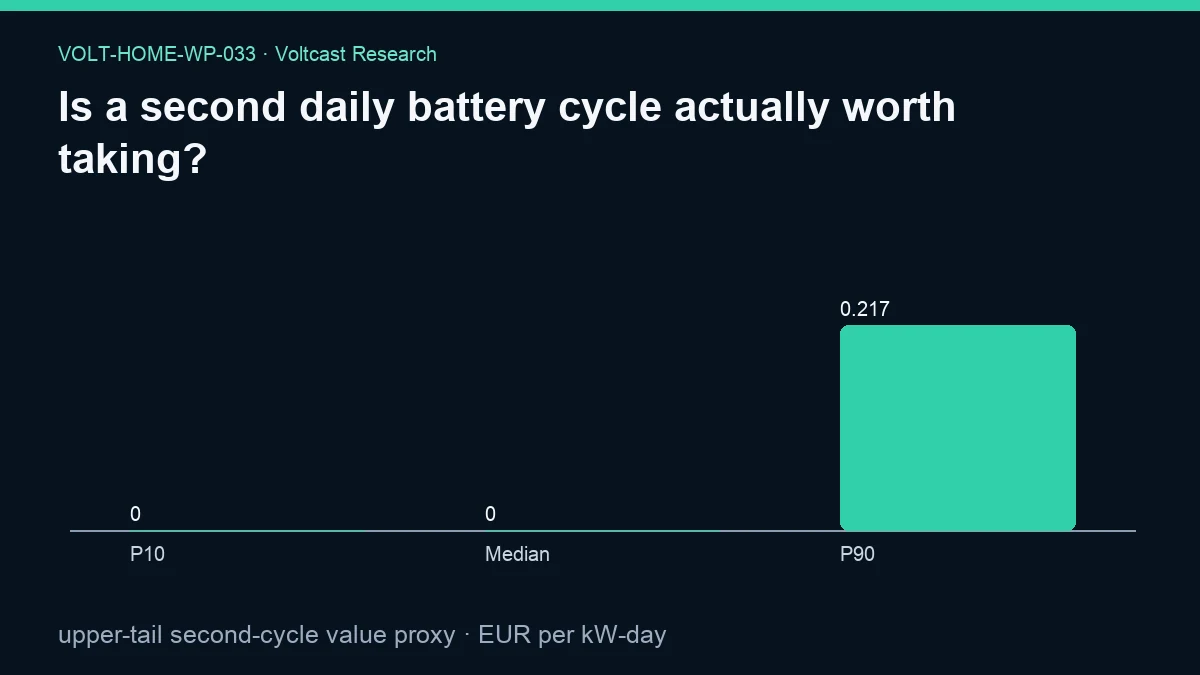
Is a second daily battery cycle actually worth taking. A second cycle is represented as value above the median first-cycle day; no physical dispatch is inferred.
Abstract
The public evidence reports an “upper-tail second-cycle value proxy” of 0.06553454612658846 EUR per kW-day across 16,368 BESS-v2 observations. The proxy is defined as value above the sample median. Its own interpretation warns that no physical dispatch is inferred. The evidence therefore does not establish that a second daily cycle occurred, could be completed, or would remain positive after incremental degradation and other costs.
This distinction answers the title cautiously. Upper-tail day-ahead value may create room for an additional cycle on some observations, but the published statistic is not a second-cycle optimization. BESS-v2 is normalized per unit of power, wholesale-energy-only, and evaluated with perfect foresight. Retail taxes, network charges, asset constraints, cycling wear, and forecast error are absent. A second cycle is worthwhile only if a separate feasible dispatch identifies two non-overlapping charge-discharge pairs, respects power, energy, state-of-charge, and timing constraints, and covers the incremental wear and transaction boundary. The frozen proxy is a screening lead for that analysis, not its result.
Plain-language answer
The evidence gives a central proxy value of about €0.06553 per kW-day for the upper tail above the sample median. That says high-value rows contain additional indexed value relative to the median row. It does not say a battery completed two cycles. There may be only one unusually valuable spread, overlapping intervals, insufficient time to recharge, or a state-of-charge path that prevents a second independent pair.
A second cycle also causes additional wear. Even if another spread exists, the cycle should be skipped when its incremental value does not cover efficiency loss, degradation, auxiliary use, tariff asymmetry, and forecast risk. Since BESS-v2 uses the realized price curve with perfect foresight, it sees opportunities a real controller may miss. The safe answer is therefore “not proven.” The proxy supports investigating second-cycle feasibility on upper-tail days, but it cannot by itself justify taking that cycle.
Research question
The economic question is marginal: after the best daily cycle is allocated, is there a second, non-overlapping, technically feasible cycle whose incremental net value is positive? Answering it requires ordering opportunities, updating state of charge through time, respecting duration and inverter limits, and assigning degradation to additional throughput. It also requires defining what “cycle” means when dispatch is partial or fragmented across 15-minute intervals.
The registered evidence uses a simpler proxy: value above the sample median. That construction distinguishes upper-tail observations from a central benchmark, but it does not remove first-cycle value or solve a second dispatch path. The paper evaluates exactly what that proxy can and cannot say. It does not relabel upper-tail value as measured second-cycle operation. This protects the research question from a common category error: confusing more value on a day with more physically independent cycles on that day.
Data and provenance
The study draws from the frozen SELECT-only snapshot with SHA-256 7e97489fc8528c8cc8c38830e05b48d949ce1f67b98575dff26f5d7c321e4c67. Read access was constrained to a transaction marked read-only with a 180-second statement timeout. Registered source tables are day_ahead_prices, bess_index_daily, bess_forecast_daily, generation_mix, and capture_stats. Daily prices run from 2021-01-01 through 2026-08-29; detailed intervals from 2025-10-01 through 2026-08-29; and the long-history boundary from 2015-01-01 through 2026-08-29. The publication cut-off is 2026-08-30T00:00:00Z.
The sample size is 16,368 and the unit is EUR per kW-day. The frozen code hash is 57c57de79cdab2b5b6d6c54c485cb5162598c5ba0b0bfe995da40d75e6c52ba9, protocol hash adb36bf6b447af9f96339249b8becaefc20422499cca1977242866347a97bd4b, registry hash 7bcb91d7476d0a69fe9fa75a5c7782f8117e0153f82f9112b7e1d307d3943717, and source-registry hash 07949550ac443ff673fda5c0209b99f137544f3ffecf6775f109bb9d09663bd6. The extra assumption specific to this paper states that the second-cycle proxy uses value above the sample median.
Method
BESS-v2 is a normalized perfect-foresight day-ahead index. Normalization puts observations on a common per-power basis; it does not instantiate a household battery’s usable capacity, reserve floor, inverter curve, or control cadence. Perfect foresight allows the index to use the realized day-ahead curve when selecting value, whereas a live schedule would rely on information frozen before dispatch. Wholesale-only accounting excludes retail taxes and network charges.
For this paper, the analysis treats value above the sample median as an upper-tail proxy for possible second-cycle value. This is not the same as re-optimizing after removing the first cycle. No interval allocation, state trajectory, or separate cycle counter is asserted. The metric is descriptive, and the evidence makes no unadjusted significance claim. Within-family Holm control remains the rule for inferential claims, but there is no treatment or causal effect here to test.
Results
The recorded primary value is 0.06553454612658846 EUR per kW-day, based on 16,368 observations. Rounded for reading, that is approximately €0.06553 per kW-day. The evidence interpretation explicitly says a second cycle is represented as value above the median first-cycle day and that no physical dispatch is inferred. That sentence is controlling: the statistic identifies upper-tail headroom under the chosen proxy, not the realized marginal value of cycle two.
The regenerated JSON reports bootstrap_95_interval: null and no interval method for this estimand. The figure publishes P10 = 0.0, median = 0.0, and P90 = 0.21657460000000012 EUR per kW-day. Those quantiles describe the proxy’s distribution and do not establish a second physical cycle. No confidence interval or generalizable profitability claim is attached to the point estimate.
No count of upper-tail days, feasible double-cycle days, or profitable second cycles is provided. No cycle-depth distribution, second-best spread, or incremental degradation charge is included. Consequently, the result is evidence of dispersion above a median benchmark and nothing stronger.
Robustness and placebo checks
The first necessary robustness check would solve an explicit two-cycle dispatch and compare it with a one-cycle constraint on exactly the same day-ahead curves. It should require non-overlapping energy throughput, track state of charge, apply round-trip efficiency on the correct leg, and price incremental degradation. A placebo should label the same upper-tail rows after shuffling interval order: if the proxy remains unchanged while physical feasibility disappears, that would demonstrate why aggregate upper-tail value is not a cycle count.
A second check would compare perfect-foresight and frozen forecast schedules. The forecast arm must select both cycles using only pre-decision information and settle them on realized prices. A third would vary the definition of a full equivalent cycle, because fragmented charging can produce throughput without two complete depth transitions. None of those results appears in the evidence JSON. This paper lists them as validation requirements, not as completed tests. The published figure quantiles describe dispersion in the proxy; they do not validate the physical interpretation.
Limitations
The proxy is the dominant limitation. Value above a sample median can arise from one large spread rather than a second opportunity. It can also combine different zones, months, and durations in a way no single battery experiences. Median-relative value is sensitive to the composition of the sample and does not establish temporal sequencing. The evidence provides no interval-level schedule, state-of-charge path, or proof that two charge-discharge pairs fit within the day.
Perfect foresight overstates information available to an actual controller. Wholesale-only accounting excludes taxes, network charges, import-export spreads, and contract terms. Additional cycling wear may be nonlinear and larger for the marginal cycle, especially at high depth or temperature. Battery backup requirements may reserve capacity and prohibit full cycling. The normalized per-power index is not a household bill calculation, and the statistic is not observed site cash. These limits prevent a yes-or-no universal answer.
A further identification problem is the median benchmark itself. The median is calculated across the registered sample, while a physical second cycle is decided within one ordered delivery day. Changing the mix of zones, months, or durations could move the sample median even if every individual day and dispatch path stayed unchanged. That sensitivity makes the proxy useful for ranking aggregate rows but unsuitable as a direct controller threshold. A future design should define cycle one and cycle two within each day before aggregating anything across the corpus.
The economic denominator should also be incremental. Total daily indexed value can remain high even when the second feasible pair adds almost nothing after the first pair consumes the best intervals. Conversely, two moderate, well-separated spreads may support two cycles without placing the day far above the corpus median. Only a constrained marginal optimization can distinguish those cases. The current paper therefore treats high-tail value as a hypothesis generator and requires a separate, preregistered dispatch result before answering yes.
Practical implication
Treat the €0.06553 per kW-day proxy as a trigger for deeper analysis, not as a dispatch command. If a day appears unusually valuable, explicitly compute the first and second non-overlapping cycles with device constraints. Compare the incremental second-cycle value—not total daily value—with incremental efficiency losses, degradation, tariff charges, and forecast uncertainty. Skip the second cycle when that marginal test fails even if the day is in the sample’s upper tail.
A transparent controller should disclose cycle definitions, preserve native interval order, and show which information was available when the schedule was chosen. It should distinguish full equivalent cycles from start counts and partial movements. The perfect-foresight BESS-v2 result can serve as a ceiling benchmark for the day. The deployable result must come from a forecast-clock-valid schedule and should report missed or reversed opportunities as prominently as successful ones.
Reproducibility
The source JSON is /research-data/home-papers/is-a-second-daily-battery-cycle-actually-worth-taking.json. Confirm the measured status, special median-proxy assumption, value 0.06553454612658846 EUR per kW-day, sample size 16,368, absence of an interval, and warning that no physical dispatch is inferred. The evidence manifest records JSON SHA-256 a34ad8a0e461622c5d0608b7d4da0ca1ca2999ae20b9fd9cccfd279fe13d9869 and figure SHA-256 2937496db967569ebdccae174affe742638d8aae187d65a344c91a360cb6d2da.
Use the exact snapshot, code, protocol, registry, windows, assumptions, and publication cut-off given above. A reproduction of this paper should calculate only the median-relative proxy. An extension that claims second-cycle economics must be separately specified and must preserve decision clocks, state paths, and incremental-cost accounting. Licensing references are /legal/data-licensing and Voltcast data licensing and redistribution.
Disclosure
Analysis and drafting were model-assisted. The proxy definition, frozen evidence, hashes, and limitations are disclosed to prevent an aggregate upper-tail statistic from being mistaken for physical cycling. This working paper is not peer reviewed. It is not trading advice, financial advice, an investment recommendation, or operational authorization. Voltcast has no live traders or live capital, and no battery action follows from this paper.
References
energy-informatics-storage— Energy Informatics. Risk and reward: evaluating household energy storage for optimizing demand-side flexibility under dynamic tariffs. Kind: peer-reviewed.acer-retail-2025— ACER and CEER. Rewarding flexibility: How retail contract choice can help unlock consumer flexibility. Kind: official.iea-electricity-2026— International Energy Agency. Electricity 2026. Kind: official.dynamic-tariff-viability— Advances in Applied Energy. Assessing the conditions for economic viability of dynamic electricity retail tariffs for households. Kind: peer-reviewed.volt-research-content— Voltcast. Voltcast Research Content Plan. Kind: canonical.