Can seven-day probabilistic prices make household energy budgets safer?
Can seven-day probabilistic prices make household energy budgets safer. A probabilistic budget can reserve against forecast error; it does not remove retail price risk.
Abstract
Probabilistic forecasts can support reserve-based budgeting only if their uncertainty is measured on the same serving lineage and horizon used by the household decision. This working paper reports a narrower diagnostic: the 90th percentile of lineage-matched forecast mean absolute error, scaled to the daily energy of a 4,000 kWh synthetic household. Across 17,750 matched forecast-error rows, the registered budget scale is €0.6710323287671232 per day. This is a declared synthetic wholesale scenario, not a retail-budget guarantee, customer saving, or bill forecast. The implementation does not isolate exact seven-day horizons and does not derive the reserve from P10/P50/P90 forecast distributions; it pools lineage-matched MAE rows with non-null error. The result therefore shows the scale of one historical error reserve, not that seven-day probabilistic prices make budgets safer. The 35% flexible-energy family assumption does not enter the calculation. Taxes, network charges, VAT, supplier margin, consumption variability, device efficiency, degradation, and customer telemetry are excluded.
Plain-language answer
The frozen calculation suggests a €0.6710323287671232 daily reserve scale for the wholesale energy component of a synthetic 4,000 kWh-per-year household. It obtains that amount from the 90th percentile of matched forecast MAE, converted from EUR/MWh to the standardized daily kWh quantity.
That figure does not prove a household budget is safer. “Safer” would require a comparison of budget misses with and without the reserve, a declared loss function, and a complete retail tariff. The analysis does not report how often €0.671 covers realized bill error, whether coverage is calibrated at a seven-day horizon, or what the reserve costs in foregone use of money.
The title refers to seven-day probabilistic prices, but the implemented evidence uses lineage-matched MAE rows generally. It does not select an exact horizon of seven days, and MAE is a point-error metric rather than a probabilistic coverage measure. The result is still useful as a transparent historical scale, but it must not be advertised as validated seven-day budget protection. Every euro amount is a synthetic wholesale scenario, never a customer saving or retail bill.
Research question
The broad question is whether forecast distributions can help a household reserve enough money for uncertain future electricity costs. The implemented question is: what daily synthetic wholesale amount corresponds to the 90th percentile of available lineage-matched forecast MAE when scaled to 4,000 kWh per year?
The distinction between those questions is material. Probabilistic budgeting normally uses forecast quantiles or a predictive distribution and tests realized coverage. This study uses the empirical distribution of MAE rows. It measures historical error magnitude across matched records, not the calibration of a household-cost P90 forecast. It also does not evaluate the consequence of over- or under-reserving.
Data and provenance
The evidence derives from a frozen SELECT-only production snapshot and contains no customer telemetry. The registered source contracts are day_ahead_prices, forecast_accuracy, bess_index_daily, zone_load, and zone_holidays. The primary calculation selects forecast records whose MAE is non-null and whose serving lineage is marked matched. The sample size is 17,750.
The evidence records daily prices from 2021-01-01 through 2026-08-29, detailed intervals from 2025-10-01 through 2026-08-29, and a long-history boundary from 2015-01-01 through 2026-08-29. Publication cutoff is 2026-08-30T00:00:00Z. These windows describe the governed corpus. The matching JSON does not state that all 17,750 forecast rows are exact seven-day records, so this paper makes no such claim.
The source snapshot is identified by SHA-256 7e97489fc8528c8cc8c38830e05b48d949ce1f67b98575dff26f5d7c321e4c67. The protocol hash is adb36bf6b447af9f96339249b8becaefc20422499cca1977242866347a97bd4b, the paper-registry hash is 7bcb91d7476d0a69fe9fa75a5c7782f8117e0153f82f9112b7e1d307d3943717, the source-registry hash is 07949550ac443ff673fda5c0209b99f137544f3ffecf6775f109bb9d09663bd6, and the analysis-code hash is 57c57de79cdab2b5b6d6c54c485cb5162598c5ba0b0bfe995da40d75e6c52ba9. The evidence-manifest hashes are 9b62ecf70cb92c0bedd6d3265a9eeed2507b4f3e834101bcaa8042e9c667ba2b for the JSON and 62c4f2a641da23ae59cbf60f299c6bf0aa8beebe7213d35703b9baaadfd78949 for the WebP figure. Extraction used a read-only transaction with a 180-second timeout. The external references provide context for retail flexibility and consumer risk; the reported reserve scale comes only from the frozen evidence.
Method
The analysis filters the forecast-accuracy records to rows satisfying two conditions: MAE is available, and the row is matched to immutable serving lineage. Lineage matching prevents a later or different model from being scored as though it had served the original decision.
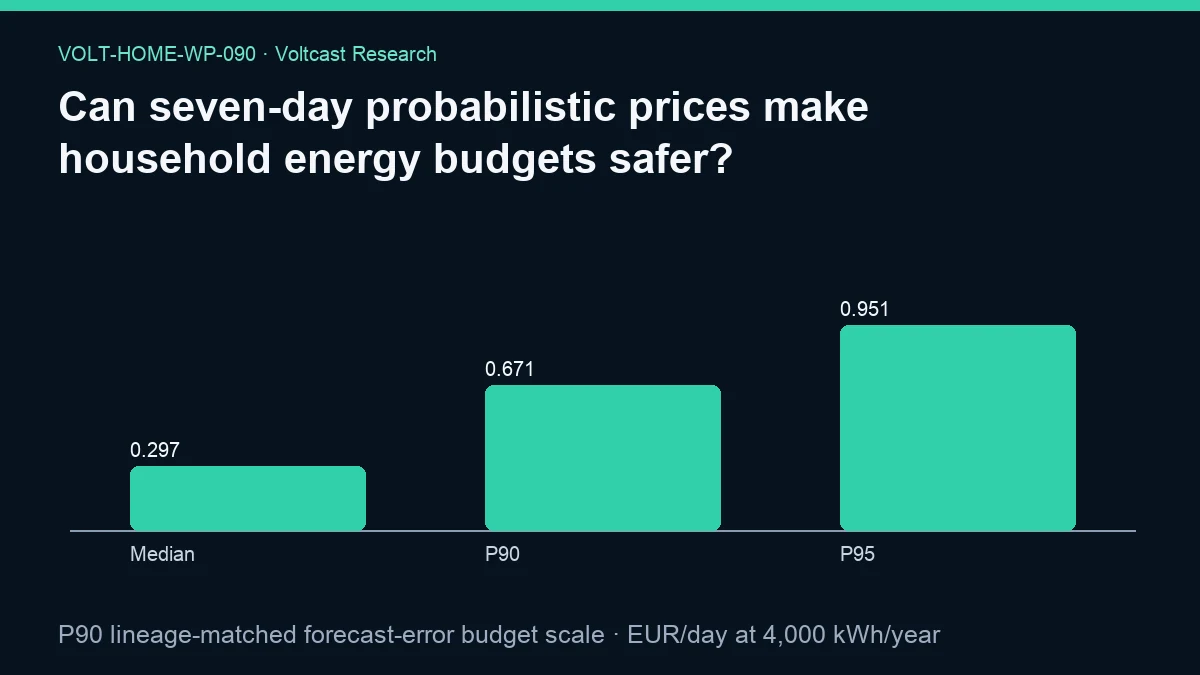
It collects each selected MAE value in EUR/MWh and calculates the median, P90, and P95 for the figure. The primary statistic uses P90 and converts it to a standardized daily synthetic wholesale amount:
P90 MAE in EUR/MWh × 4,000 kWh ÷ 365 ÷ 1,000.
This conversion assumes 4,000 kWh is distributed evenly across 365 days. It does not multiply by the declared 35% flexible share. It does not weight forecast errors by the household’s interval load, and it does not model correlation between larger errors and higher-consumption days.
The word “probabilistic” does not describe the implemented statistic. MAE summarizes absolute point error. A full probabilistic test would use issued quantiles or scenarios, verify exact-horizon coverage, and score the realized household-cost distribution. The word “seven-day” is also not enforced by an exact-horizon filter in this outcome. Those are limitations, not assumptions we fill by inference.
No assets are dispatched. Battery efficiency, degradation, state of charge, and power are absent; EV efficiency and availability are absent; heat-pump COP and comfort are absent. Taxes, network charges, VAT, supplier margin, fixed fees, and device losses are excluded. The monetary output is a synthetic wholesale scenario reserve scale.
Results
The frozen primary result is €0.6710323287671232 per day at 4,000 kWh per year. Rounded, the P90 lineage-matched MAE scale is €0.67 per synthetic day. It is based on 17,750 forecast-error rows.
This value can be interpreted as a historical wholesale-error allowance under the flat daily-energy conversion. It cannot be interpreted as the 90th percentile of a retail bill, a guaranteed buffer, or customer savings. It also does not imply 90% budget coverage because the calculation does not test whether realized synthetic cost falls below forecast cost plus the reserve.
The matching evidence’s interpretation says a probabilistic budget can reserve against forecast error but does not remove retail price risk. The point estimate supports only the scale of the reserve against historical MAE. The probabilistic-budget claim remains a proposed use rather than a validated outcome.
The figure values are exactly €0.29722082191780824, €0.6710323287671232, and €0.9512174246575331 per synthetic day for the median, P90, and P95 lineage-matched MAE scales. The regenerated evidence reports bootstrap_95_interval: null and interval_method: "not reported for this estimand", so no interval is available around €0.6710323287671232. Every euro result remains a declared synthetic wholesale scenario.
Robustness and placebo checks
A zero-error placebo sets every lineage-matched MAE to zero. Median, P90, P95, and the converted daily reserve must all become zero. This validates the unit conversion but does not test forecast calibration.
A load-scaling check changes 4,000 kWh while preserving the same P90 MAE. The reserve scales linearly. That mathematical behavior should not be mistaken for empirical household risk, because larger or electric-heated homes can have different timing and error exposure.
The essential horizon robustness check groups rows by exact horizon_days and computes the reserve separately for day one through day seven. The seven-day claim should use only the exact seventh-day horizon. Pooling horizons can obscure deterioration with lead time. This paper does not have a registered exact-seven-day result.
A true probabilistic robustness test would form household-cost quantiles from issued P10/P50/P90 prices, preserve serving lineage, and measure realized coverage and interval score. It would compare a P90 budget with a median-plus-MAE reserve and simple historical controls. No such outcome is reported.
Regime checks should stratify negative-price days, spikes, seasons, and high-load periods. Serial dependence should be handled with blocked day or week resampling. Within the ten-paper family, Holm correction applies to inferential claims. This descriptive result makes no unadjusted significance claim.
Limitations
The primary limitation is mismatch between title and metric. The title promises seven-day probabilistic budgeting, while the implemented result is a pooled P90 of lineage-matched MAE. It neither isolates seven days nor uses predictive quantiles to verify budget coverage.
The 4,000 kWh profile is flat at daily resolution. A household’s consumption varies by day and interval. Forecast error may be most costly when load is high, so multiplying an unweighted MAE quantile by average daily energy may misstate exposure.
The family’s 35% flexible-energy assumption is unused. There is no schedule showing flexibility responding to forecasts. No physical assets are modeled, so efficiency, degradation, power, capacity, mobility, COP, and comfort remain unmodeled. These omissions prevent an optimizer or savings interpretation.
Only wholesale price error is scaled. Taxes, network charges, VAT, supplier margin, tariff caps, fixed fees, and device losses are excluded. A complete bill can have lower or higher variability than its wholesale component. No income, affordability threshold, or risk preference is available.
The P90 estimate pools zones, model versions, and horizons subject to lineage matching. It may not represent a named zone or current served model. Historical errors need not persist. The evidence reports no interval for the converted primary result.
Practical implication
Lineage matching is a necessary foundation for safer forecasting, but it is not sufficient. A household-facing budget should use exact-horizon issued distributions, the local tariff, and the household’s expected load. It should publish measured coverage and disclose misses.
Use €0.6710323287671232 only as the frozen daily synthetic wholesale error scale for 4,000 kWh/year. Do not present it as a retail reserve recommendation. A decision-grade extension should compare several reserve rules and report both under-budget frequency and excess reserve, with all euro outputs clearly labeled as synthetic scenarios until validated against bills.
Reproducibility
Verify the evidence JSON named in the frontmatter against its stable ID, title, slug, status, assumptions, cutoff, source tables, all five provenance hashes, and the evidence-manifest hashes for the JSON and figure. Confirm the read-only transaction and snapshot-manifest match.
Select forecast rows with non-null MAE and true lineage matching. Compute the 90th percentile using the content-addressed code’s quantile convention. Multiply by 4,000, divide by 365, and divide by 1,000. The result should reproduce 0.6710323287671232 EUR/day. Median and P95 conversions reproduce the other figure points.
Filtering exact seven-day rows, using forecast quantiles, weighting by load, or adding a complete tariff answers a different and stronger question. Those analyses require new evidence rather than silent substitution.
Disclosure
Analysis and drafting were model-assisted. This public working paper is not peer reviewed. It discloses the mismatch between the broad title and narrow implemented metric, along with source hashes and assumptions. It is not financial, tariff-selection, investment, purchasing, or trading advice.
Every euro amount is a declared synthetic wholesale scenario, never a customer saving or retail bill. Volt has no live traders or live capital; C0R is the only paper strategy. This forecast-budget diagnostic is not trading research and does not authorize trading or capital.
References
- Advances in Applied Energy, Assessing the conditions for economic viability of dynamic electricity retail tariffs for households.
- ACER and CEER, Rewarding flexibility: How retail contract choice can help unlock consumer flexibility.
- European Commission, Communication from the Commission on the Citizens Energy Package.
- Energy Policy, Welfare redistribution through flexibility — Who pays?.
- International Energy Agency, Scaling Up Demand Flexibility.