Can tomorrow’s day-ahead curve change after its first publication?
Can tomorrow’s day-ahead curve change after its first publication. The append-only revision sidecar measures whether first publication and latest observation differ.
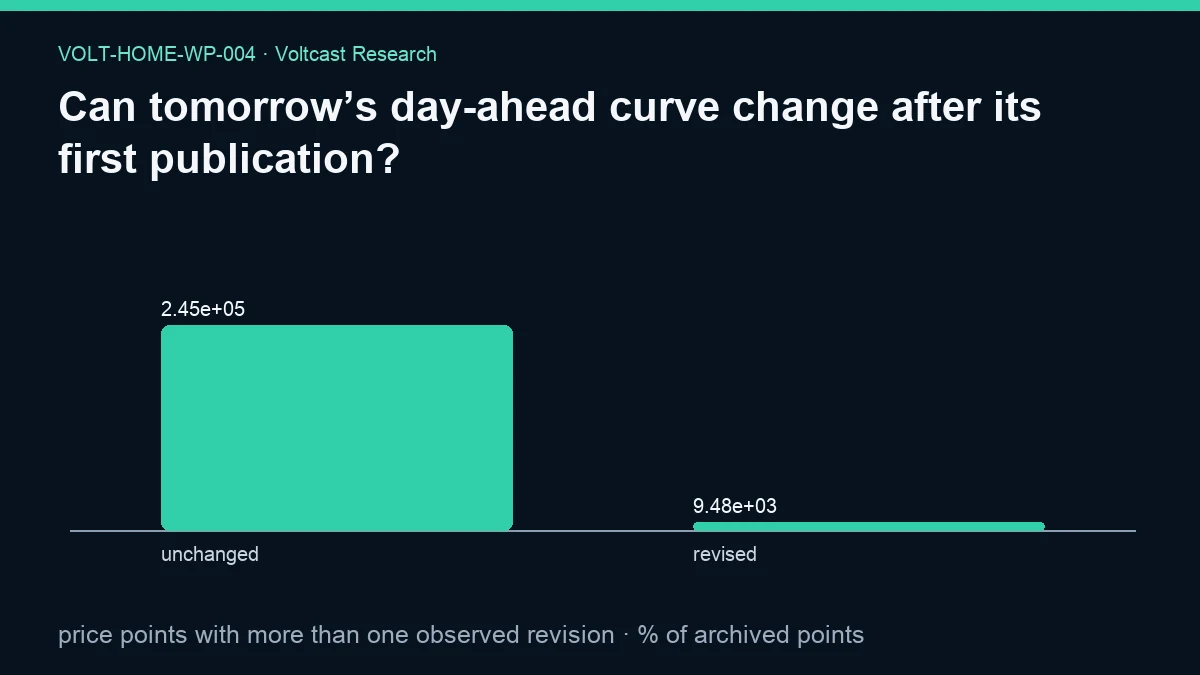
Can tomorrow’s day-ahead curve change after its first publication?
Abstract
A day-ahead curve is often consumed as if it were a single permanent object. In an operational data system, however, the first observed value and the latest observed value may differ. This paper uses Voltcast's append-only revision sidecar to measure price points with more than one observed revision. The public evidence records 254,009 archived price points, a primary sample_size field of 121, and a revised-point share of 3.7333322835017655%. It reports no interval for this estimand.
The result means that the archived observation history contains measurable first-versus-later variation. It does not determine why any revision occurred, whether an exchange changed a result, whether an upstream publisher corrected a payload, or whether the data collector saw an equivalent republishing event. The hot price table is latest-value; all revision claims in this paper rely only on the append-only sidecar. This is an as-observed data-lineage study, not a household bill study. Analysis and drafting were model-assisted. The paper is not peer reviewed and is not trading advice.
Plain-language answer
Yes, the curve presented to a data consumer can change after the first observation. The evidence finds that 3.7333322835017655% of archived points in the registered revision analysis have more than one observed revision. That does not imply that the same percentage of every future curve will change, and it does not prove the cause of each difference. It shows that “the price we first saw” and “the value in the latest table” are not interchangeable concepts.
For a household controller, the important question is what policy follows a revision. A changed future interval might justify recalculating a not-yet-executed schedule. A command already sent should not be duplicated merely because the source was republished. A retrospective study must decide whether it is reconstructing the decision available at first publication or evaluating against the latest corrected record.
Without append-only lineage, those questions cannot be answered honestly. A database that overwrites each cell can serve the latest value efficiently, but it erases the earlier decision surface. The sidecar retains observation order so that first-seen and later-seen states can be compared. The measured revision share therefore supports revision-aware design, not alarmism about market instability.
Research question
The research question is whether price points in archived day-ahead curves can have more than one observed revision after first publication. The primary metric is the percentage of archived points meeting that condition in the frozen revision sidecar.
This paper does not ask whether revisions improve prices, whether they are material to every schedule, or whether one publisher is more reliable than another. It also does not infer exchange intent. The estimand concerns stored observation lineage: did the same price-point identity appear in more than one observed revision?
Data and provenance
The evidence identifies daily prices from 2021-01-01 through 2026-08-29, detailed intervals from 2025-10-01 through 2026-08-29, and long history from 2015-01-01 through 2026-08-29. Revision coverage is governed by the append-only sidecar, not by the historical depth of the latest-value table. The stated limitation is that the hot price table contains only the latest value; revision claims use the sidecar exclusively.
The source contract lists zones, day_ahead_prices, grid_revisions, auction_publications, and ingestion_runs. grid_revisions is the critical source for first-versus-later observations. day_ahead_prices supports current serving but cannot independently reconstruct overwritten history. Publication and ingestion records provide operational context for when complete curves were observed.
The analysis was SELECT-only with a 180-second statement timeout and a publication cutoff of 2026-08-30T00:00:00Z. The snapshot SHA-256 is 7e97489fc8528c8cc8c38830e05b48d949ce1f67b98575dff26f5d7c321e4c67. The analysis-code hash is 57c57de79cdab2b5b6d6c54c485cb5162598c5ba0b0bfe995da40d75e6c52ba9; protocol hash, adb36bf6b447af9f96339249b8becaefc20422499cca1977242866347a97bd4b; paper-registry hash, 7bcb91d7476d0a69fe9fa75a5c7782f8117e0153f82f9112b7e1d307d3943717; and source-registry hash, 07949550ac443ff673fda5c0209b99f137544f3ffecf6775f109bb9d09663bd6. The evidence manifest records evidence SHA-256 c57b8ffe85d71dbe5cb5ce64b1c12f45d6e969a0714f5ee90b277a2934dba72b and figure SHA-256 7a4b751d18e8614445788765919e2e159f817847b94e0da127581a7e675db01e.
The evidence reports 254,009 archived price points as a secondary aggregate and 121 as the primary sample size. Because those values describe different levels of the analysis, this paper does not relabel 121 as a point count. It preserves the published fields and avoids inferring an unstated grouping unit.
Method
The method belongs to the paired interval reconstruction, clock-safe counterfactual, and day-block bootstrap family. Each archived price point is identified by stable market and delivery keys rather than by its current row alone. Observations in the append-only sidecar are ordered by their recorded lineage. A point is classified as revised when its identity has more than one observed revision.
This is an observation-history definition. Multiple observations could reflect a substantive price correction, a republished curve, a source formatting change captured as a revision, or another lineage event. The primary metric does not separate those mechanisms. That constraint is intentional: mechanism claims require additional fields and adjudication that the public evidence does not provide.
The numerator is the archived point set satisfying the more-than-one-observed-revision rule. The denominator is the eligible archived point population in the registered extract. The artifact reports the resulting percentage, the total archived point aggregate, and a primary sample size at its analysis level.
The regenerated evidence stores bootstrap_95_interval as null and labels its interval method not reported for this estimand. The evidence states that within-family Holm control applies to inferential claims and that this descriptive result makes no unadjusted significance claim. No latest-table comparison is substituted for the sidecar history.
Results
The recorded revised-point share is 3.7333322835017655% of archived points. The figure labels unchanged and revised carry exact values 244,526 and 9,483, which sum to the separately reported 254,009 archived price points. The evidence also reports a primary sample_size field of 121 but does not label that field as the point denominator. It reports no uncertainty interval. These are the complete numerical claims supported by the artifact for this question.
The central interpretation is that first publication and latest observation can differ in the stored lineage. A system that retains only the current curve cannot reconstruct that distinction after the fact. Conversely, the result does not say that 3.7333322835017655% of household actions should change. Action relevance depends on which interval changed, when the revision was observed, whether the command remained pending, and what policy the controller uses.
Nor does the result establish a causal market narrative. The word “revision” here describes an observed record lineage. The paper makes no claim about exchange error rates, upstream fault, intent, or the economic importance of each changed point.
Robustness and placebo checks
The append-only sidecar is the main robustness control. It preserves successive observations instead of asking the latest-value table to reveal history it no longer contains. Stable point identity and observation order are necessary to distinguish a genuine repeated record from unrelated intervals.
The hot table acts as a negative control on capability: it can show the current value but cannot support a first-publication claim. Any analysis that reports revisions from that table alone would be structurally underidentified. This paper therefore refuses to infer revision history from current-state differences across unrelated records.
The family method allows blocked resampling where the estimand supports it, but the current revision-share artifact reports no interval. Treating an unreported interval as if it existed would add unsupported precision. Within-family Holm control remains the governing multiplicity policy, and the result is presented descriptively.
No cause-specific placebo is claimed. The artifact does not publish a classifier for corrections, duplicates, republishes, or source changes. Those categories remain unresolved rather than being guessed from the percentage.
Limitations
Revision history begins when the append-only sidecar observes and retains it. A deep latest-value price history does not create retrospective first-seen observations. The date windows therefore should not be read as uniform revision coverage across the entire long history.
The metric counts more than one observed revision, not necessarily a changed economic value caused by a market operator. Without cause adjudication, source payloads, and field-level comparison in the public aggregate, the paper cannot allocate responsibility or materiality.
The artifact reports a primary sample size of 121 and an archived-point aggregate of 254,009 without publishing a label that equates their analytical levels. This paper does not invent that relationship. A fuller reproduction should inspect the protocol and code to determine the grouping represented by the sample-size field.
No household profiles, commands, device telemetry, or retail tariff components are included. This is not a household bill study. It cannot estimate savings, losses, or the optimal revision policy for every home.
Practical implication
Data systems should retain at least two distinct concepts: the latest serveable value and the append-only observation history. The serving table supports fast current queries. The revision sidecar supports as-of reconstruction, audit, and idempotent automation. Combining them into one overwrite-only table sacrifices decision provenance.
A home controller should attach each schedule to a curve identity and observation version. When a later version arrives, the controller can compare only future, not-yet-committed intervals, apply a declared materiality policy, and issue an idempotent update. It should never repeat a physical action solely because the source record was observed again.
Retrospective analysis should state whether it uses first-observed or latest-observed prices. A study that optimizes with corrected values unavailable at decision time introduces look-ahead. A study that scores against stale values may ignore the best final record. Both can be legitimate for different questions, but the choice must be explicit.
Reproducibility
The public evidence JSON is /research-data/home-papers/can-tomorrows-day-ahead-curve-change-after-its-first-publication.json. It records the source tables, data windows, limitation, result, null uncertainty interval, archived-point aggregate, disclosure, and provenance hashes. The figure path and exact alternative text are in frontmatter.
A reproduction should verify the snapshot, protocol, registry, and analysis-code hashes. It should maintain the publication cutoff and SELECT-only boundary. Price-point identity must include stable zone, delivery interval, and market context. Sidecar observations should be ordered by recorded revision lineage, and the more-than-one rule should be applied only within the same point identity.
The latest-value table may be joined for serving context but must not create the revision result. Reviewers should reproduce the exact figure vector [244526, 9483], the 254,009 archived-point aggregate, the sample_size value 121, and the null interval rather than assuming that the sample-size field equals the archived-point denominator.
Disclosure
Analysis and drafting were model-assisted; sources, code, assumptions, and evidence hashes are disclosed. This working paper is not peer reviewed, not a household bill study, and not trading advice. Volt has zero live traders and zero live trading capital; C0R is the only paper strategy. Production weather forecasting is a non-trading service. Revision awareness does not authorize live orders, capital, or a trading strategy.
References
- Spam Policies for Google Web Search — Scaled content abuse — Google Search Central.
- Single Day-ahead Coupling (SDAC) — ENTSO-E.
- EU electricity trading in the day-ahead markets becomes more dynamic — European Commission.
- ACER Decision 13-2024 on SDAC Products — Agency for the Cooperation of Energy Regulators.
- Voltcast Architecture — Voltcast.