How closely do ENTSO-E and SMARD agree on German and Austrian prices?
How closely do ENTSO-E and SMARD agree on German and Austrian prices. The canonical hot table retains one source per cell, so this snapshot cannot support a source-agreement estimate.
How closely do ENTSO-E and SMARD agree on German and Austrian prices?
Abstract
This working paper cannot estimate agreement between ENTSO-E and SMARD from the registered public-safe snapshot. The canonical hot table retains one source per price cell, leaving a primary sample size of 0 same-cell paired observations and 0 paired duplicate cells for this question. The primary value and bootstrap_95_interval are null, interval_method is not reported for this estimand, and the evidence status is insufficient_evidence.
This is a substantive result about identification, not permission to assume that the sources agree or disagree. A source-agreement estimate requires the same zone, physical delivery interval, market product, unit, and relevant publication state from both sources. Once one source has been selected per canonical cell, the losing observation is unavailable for a paired comparison. The evidence explicitly requires a separately licensed, preregistered dual-source extract before such a result can be produced. No replacement statistic, anecdote, or vendor claim is introduced. This is not a household bill study. Analysis and drafting were model-assisted; the paper is not peer reviewed and is not trading advice.
Plain-language answer
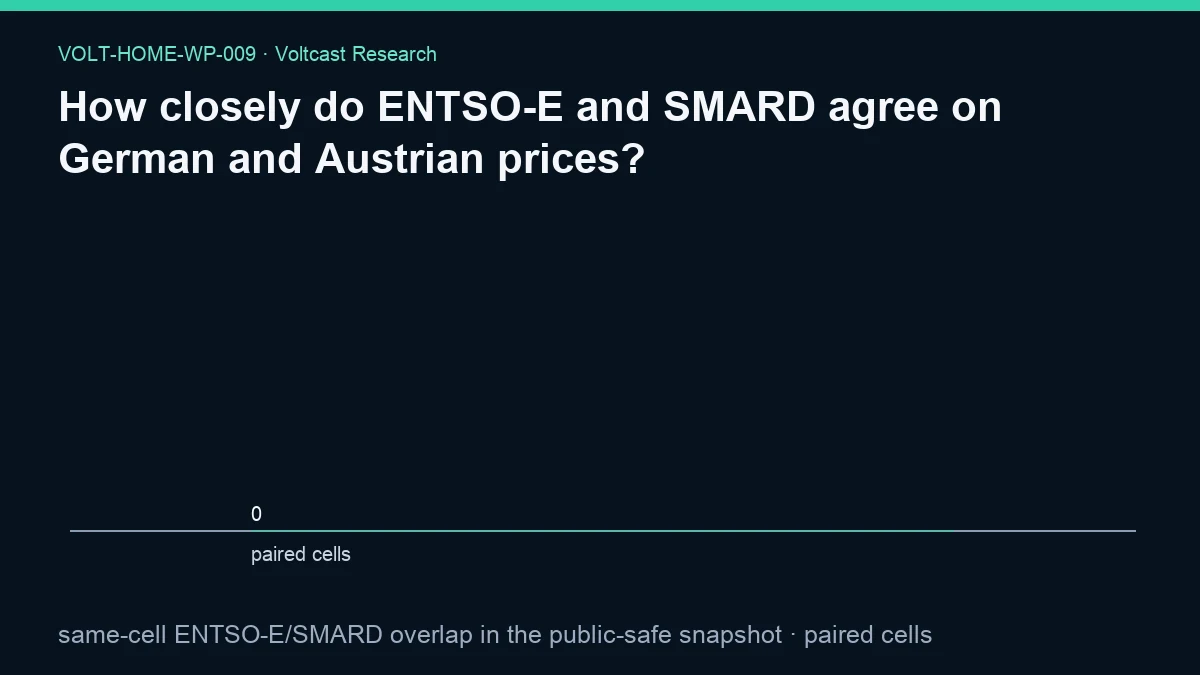
We do not know from this dataset. The public-safe table contains one canonical source for each price cell, so there are no same-cell ENTSO-E and SMARD pairs to compare. A chart with 0 paired cells is not evidence of perfect agreement, perfect disagreement, or absence of data in either source. It means the chosen table shape discarded the comparison dimension.
Agreement requires pairs. For each delivery interval, both source values must be retained with enough metadata to prove they describe the same market object. Comparing an ENTSO-E value from one interval with a SMARD value from another would mix source difference with time difference. Comparing current values observed at different revision states could also manufacture discrepancies.
The honest answer is therefore “insufficient evidence.” A future study could answer the question only after a dual-source extract is licensed, frozen, and preregistered. Until then, household users should treat canonical source-selection rules as an operational policy, not as an empirical certification that the two publishers are numerically interchangeable.
Research question
The research question is how closely ENTSO-E and SMARD prices agree for matched German and Austrian market cells. A valid estimand would require paired same-cell observations and a declared agreement metric.
The registered evidence first tests whether the public-safe snapshot contains those pairs. It does not. Because the feasibility gate fails, the paper stops before estimating bias, absolute difference, correlation, mismatch frequency, or revision behavior. None of those quantities can be computed honestly from 0 pairs.
Data and provenance
The evidence lists daily prices from 2021-01-01 through 2026-08-29, detailed intervals from 2025-10-01 through 2026-08-29, and long history from 2015-01-01 through 2026-08-29. These windows describe available corpus ranges, but they do not create dual-source overlap. Historical depth in a one-source-per-cell table cannot substitute for paired observations.
The source contract includes zones, day_ahead_prices, grid_revisions, auction_publications, and ingestion_runs. The critical limitation is structural: the canonical hot price table retains one source per cell. It is designed for deterministic serving, not dual-source agreement research.
The analysis ran in a read-only transaction with a 180-second statement timeout and a publication cutoff of 2026-08-30T00:00:00Z. The frozen snapshot SHA-256 is 7e97489fc8528c8cc8c38830e05b48d949ce1f67b98575dff26f5d7c321e4c67. Analysis-code SHA-256 is 57c57de79cdab2b5b6d6c54c485cb5162598c5ba0b0bfe995da40d75e6c52ba9; protocol SHA-256, adb36bf6b447af9f96339249b8becaefc20422499cca1977242866347a97bd4b; paper-registry SHA-256, 7bcb91d7476d0a69fe9fa75a5c7782f8117e0153f82f9112b7e1d307d3943717; source-registry SHA-256, 07949550ac443ff673fda5c0209b99f137544f3ffecf6775f109bb9d09663bd6. The evidence manifest records evidence SHA-256 3fffdbb25a8899bd47f524c09edd680fab5a565b90a95f496c18248975a79ee0 and figure SHA-256 f6855331bff914a84f04ff8dd42919e36c709f300c69d38897faf434082b1459.
The public artifact reports the failed pairing gate without exposing or claiming a separately entitled raw dual-source dataset. That boundary is part of the result.
Method
The method belongs to the registered family of paired interval reconstruction, clock-safe counterfactuals, and day-block bootstrap. For a source-agreement paper, the first step is not to calculate a summary; it is to construct valid same-cell pairs. Each pair would need identical zone, delivery start and end, product context, unit, and compatible publication or revision state.
The registered query searches the public-safe snapshot for cells in which ENTSO-E and SMARD observations coexist as separable values. Because canonicalization keeps one selected source per cell, no such paired observations remain. The primary sample size is 0 and the secondary count of paired duplicate cells is 0.
With no pairs, no agreement estimator is available, so the artifact stores a null bootstrap interval and reports no interval method. The primary metric, “same-cell ENTSO-E/SMARD overlap in the public-safe snapshot,” has unit “paired cells” and a null value. The status is insufficient_evidence, not measured agreement.
The evidence's general multiplicity policy states that within-family Holm control applies to inferential claims. No inferential agreement claim reaches that stage here. Stopping at the failed data gate prevents a fabricated estimate from entering the family.
Results
The result is 0 same-cell paired observations and 0 paired duplicate cells. The figure has the single label paired cells with value 0. The primary value is null, and no bootstrap interval exists. The canonical hot table's one-source-per-cell design means the public-safe snapshot cannot support a source-agreement estimate.
No direction or magnitude of disagreement can be inferred. Zero overlap does not mean the publishers report different values; it means both values are not simultaneously present in the analysis table. Similarly, canonical selection of one source does not certify that the selected value equals the other source.
The evidence status insufficient_evidence is the correct public outcome. Preserving it prevents a null feasibility result from being replaced by an unsupported positive narrative. It also specifies the path to an answer: a separately licensed and preregistered dual-source extract.
Robustness and placebo checks
The pairing requirement is the strongest control. A looser join by date, hour label, or nearby timestamp could produce apparent overlap while comparing different physical intervals. Refusing that join protects the question from false precision.
Clock-safe identity matters because German and Austrian local labels can be ambiguous around clock changes. A future pair must use unambiguous physical interval boundaries. Publication and revision states must also be aligned so that first-seen data is not compared with a later corrected observation without disclosure.
The one-source-per-cell hot table acts as a capability placebo: it can answer serving questions about the canonical value, but it cannot answer dual-source agreement. Attempting to bootstrap its 0 pairs would only disguise the missing comparison.
No external anecdotal comparison is used to fill the gap. The assigned references provide market and architecture context, not a substitute paired dataset. The result remains insufficient.
Limitations
The central limitation is complete underidentification: there are 0 paired cells. Without pairs, no agreement statistic is estimable.
The data windows do not resolve this issue. A longer single-source history is still single-source at each canonical cell. Revision sidecars may preserve lineage for their intended purpose, but this public artifact does not claim they contain the licensed dual-source pair set needed here.
The evidence does not define or measure a future agreement threshold. It reports no mean difference, absolute error, tolerance rate, or correlation. This paper therefore cannot advise that one source is interchangeable with the other.
No household load, tariff, command, or bill is included. This is not a household bill study. Even a future agreement estimate would concern market-data consistency, not consumer savings.
Practical implication
Operational systems should distinguish canonical serving from source-comparison research. A canonical table benefits from deterministic collision rules and one value per cell. An audit table must preserve each entitled source observation separately with provenance, timestamps, units, and revision state.
Consumers should not infer cross-source equivalence from successful serving. If a household controller depends on a canonical feed, its contract should state the selection and fallback policy. If the preferred source is unavailable, switching to another source is an operational choice whose agreement properties require separate evidence.
The next honest study would preregister the pair identity, publication state, clock handling, agreement metrics, tolerances, exclusions, and licensing boundary before reading outcomes. It would freeze a dual-source extract and publish only permitted aggregates. Until that exists, the public conclusion must remain insufficient evidence.
That future design should keep the canonical serving choice outside the outcome definition. If the source-selection rule determines which value survives before pairing, the study will repeat the present underidentification. Both entitled observations must enter an isolated comparison table, while production serving can continue to use its existing collision rule. Research identity and serving identity answer different questions and should not overwrite one another.
An operator also needs a declared response to disagreement before the comparison is used operationally. Agreement evidence can describe consistency, but it does not by itself decide which source is authoritative during a mismatch. That policy depends on provenance, timeliness, licence, and the application's fail-safe contract.
Reproducibility
The public evidence JSON is /research-data/home-papers/how-closely-do-entso-e-and-smard-agree-on-german-and-austrian-prices.json. It records the 0 sample size, null value, null bootstrap interval, unreported interval method, figure value 0, 0 paired duplicate cells, limitation, status, disclosure, and provenance hashes.
A reproduction should verify the snapshot, code, protocol, and registry identities and rerun the SELECT-only feasibility query at the stated cutoff. It should enforce exact zone, physical interval, product, unit, source, and observation-state keys. If the canonical table still returns 0 valid source pairs, the terminal result is insufficient_evidence.
A future dual-source analysis is not a repair to this result. It requires a separately licensed extract, a new frozen data identity, and preregistered metrics before outcomes are inspected. Its findings should be versioned independently rather than backfilled into this paper's evidence.
Disclosure
Analysis and drafting were model-assisted; sources, code, assumptions, and evidence hashes are disclosed. This working paper is not peer reviewed, is not a household bill study, and is not trading advice. Volt has zero live traders and zero live trading capital; C0R is the only paper strategy. Production weather forecasting is a non-trading service. The insufficient-evidence outcome authorizes no order, capital, or live trading.
References
- Spam Policies for Google Web Search — Scaled content abuse — Google Search Central.
- Single Day-ahead Coupling (SDAC) — ENTSO-E.
- EU electricity trading in the day-ahead markets becomes more dynamic — European Commission.
- ACER Decision 13-2024 on SDAC Products — Agency for the Cooperation of Energy Regulators.
- Voltcast Architecture — Voltcast.