How often is Europe’s cheapest electricity also its cleanest?
How often is Europe’s cheapest electricity also its cleanest. Price and low-carbon output overlap imperfectly; either objective can select different days.
Abstract
Cheap electricity and low-carbon electricity are often treated as if they were interchangeable scheduling signals. This working paper tests a narrower proposition: among zone-days in a frozen European power-market snapshot, how often did a day in the cheapest price decile also fall in the cleanest decile as defined by observed low-carbon generation share? The measured overlap was 28.89288928892889% among 4,444 cheapest-decile observations. The result shows partial alignment, not equivalence. It does not establish why the two rankings coincide or diverge, and it does not measure the emissions caused or avoided by moving household demand.
“Cleanest” is shorthand used only for the registered operational proxy. Low-carbon generation share describes the observed generation mix represented in the source tables. It is not lifecycle marginal emissions, does not fully allocate imports, and cannot identify the generating unit that would respond to an additional household load. The analysis is observational and descriptive. It is not a household bill study, an estimate of customer savings, or evidence that a particular charging action reduced measured household emissions.
Plain-language answer
Europe’s cheapest electricity was also in the cleanest decile in fewer than one-third of the cheapest-decile zone-days in this snapshot: the measured overlap was 28.89288928892889%. That means a schedule that selects days solely by the lowest day-ahead price will often choose a different set of days from a schedule that selects the highest observed low-carbon generation share.
This does not mean the remaining days were necessarily “dirty,” nor that choosing an overlapping day caused an emissions reduction. A decile is a relative ranking within this data, not an absolute environmental threshold. The low-carbon-share measure is an operational generation proxy, not lifecycle marginal emissions. It also does not resolve imported generation or the marginal plant. The practical answer is therefore modest: price and this generation-mix proxy contain different information, so a controller should not silently present one objective as the other.
Research question
The registered question asks how often Europe’s cheapest electricity is also its cleanest. We operationalize that broad wording as a zone-day overlap question. “Cheapest” means a daily mean price at or below the pooled cheapest-decile threshold. “Cleanest” means a daily low-carbon generation share at or above the pooled cleanest-decile threshold. The outcome is the proportion of cheapest-decile rows satisfying both conditions.
The estimand is not a causal effect. It does not ask what would happen to generation if a household moved load, and it does not estimate avoided emissions. It asks whether two observed rankings select the same zone-days. The distinction matters because market price reflects scarcity, demand, constraints, fuel costs, and expectations, while an observed generation-share field describes an average operational mix. Agreement can be useful for scheduling, but disagreement is not evidence that either signal is wrong.
Data and provenance
The public evidence record is the JSON file linked in the frontmatter. It reports the volt-home-paper-evidence-v1 schema, the paper identifier, method family, result, limitations, and cryptographic provenance. The registered source contracts are generation_mix, day_ahead_prices, capture_stats, res_accuracy, and zone_temp_weighted. This particular calculation uses paired generation-mix and daily-price rows; the broader contract is frozen for the ten-paper family.
The evidence describes three available windows: long history from 2015-01-01 through 2026-08-29, daily prices from 2021-01-01 through 2026-08-29, and detailed intervals from 2025-10-01 through 2026-08-29. The publication cutoff is 2026-08-30T00:00:00Z. Extraction ran in a read-only transaction with a statement timeout of 180 seconds. The evidence binds the snapshot to SHA-256 7e97489fc8528c8cc8c38830e05b48d949ce1f67b98575dff26f5d7c321e4c67, the analysis code to 57c57de79cdab2b5b6d6c54c485cb5162598c5ba0b0bfe995da40d75e6c52ba9, the protocol to adb36bf6b447af9f96339249b8becaefc20422499cca1977242866347a97bd4b, the paper registry to 7bcb91d7476d0a69fe9fa75a5c7782f8117e0153f82f9112b7e1d307d3943717, and the source registry to 07949550ac443ff673fda5c0209b99f137544f3ffecf6775f109bb9d09663bd6.
No customer telemetry, household meter data, charging records, or measured household emissions enter this result. The contextual references below are the exact registered sources; no result in this paper is attributed to them beyond their role as declared context.
Method
The analysis first forms paired zone-day records for which a daily mean price and a finite low-carbon generation share are both available. It then computes a pooled price threshold for the cheapest decile and a pooled low-carbon-share threshold for the cleanest decile. Rows at or below the price threshold form the denominator. A row counts as an overlap when its low-carbon share is at or above the cleanest threshold. The reported percentage is the count of overlapping rows divided by all cheapest-decile rows.
This design answers a ranking question without imposing a household load shape. It does not optimize an EV, battery, or heat pump; it does not apply retail tariffs; and it does not infer a consumption bill. Pooling provides one transparent corpus-level summary, but it also means zones and dates contribute according to the paired rows available in the frozen snapshot. The result should therefore be read as a property of this assembled panel, not as a population-weighted European household statistic.
The environmental variable is deliberately limited. Low-carbon generation share is an operational proxy based on represented output. It is not a marginal-emissions model, a lifecycle assessment, or a consumption-based allocation. Imports are not fully allocated. Consequently, “cleanest decile” means only the highest decile of this proxy. The method cannot support a causal claim that selecting those rows would reduce emissions, and it cannot quantify measured household emissions.
Results
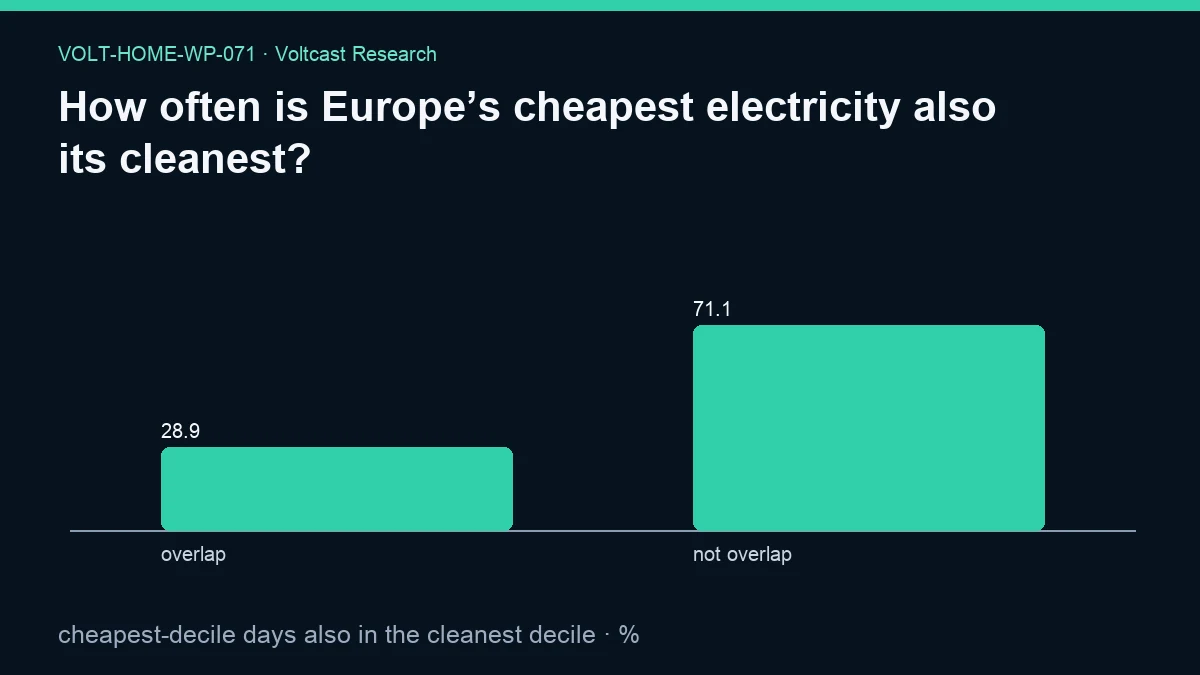
The primary metric is “cheapest-decile days also in the cleanest decile.” Its measured value is 28.89288928892889%, with a sample size of 4,444 cheapest-decile rows. The frozen interpretation is that price and low-carbon output overlap imperfectly and that either objective can select different days.
This is a meaningful descriptive separation. If the signals were treated as interchangeable, the implied overlap would need to be much broader than the observed result. But the metric is asymmetric: it asks what share of cheap rows are also clean-proxy rows, not what share of clean-proxy rows are cheap. It also says nothing about the distance between non-overlapping rows. A row narrowly below a decile cutoff and a row far from it are both classified as non-overlaps.
The result does not identify a causal relationship between price and generation mix. It does not show that charging on an overlapping day changes dispatch, and it does not measure emissions attributable to a household. Low-carbon share remains an operational proxy, not lifecycle marginal emissions.
The figure labels are “overlap” and “not overlap,” with values 28.89288928892889% and 71.1071107110711%, rendered as 28.9 and 71.1. The current evidence reports bootstrap_95_interval: null and interval method “not reported for this estimand,” so those complementary bars are descriptive and carry no uncertainty claim.
Robustness and placebo checks
The family protocol declares within-family Holm control for inferential claims and blocked resampling intended to preserve serial dependence. The paper-level evidence, however, labels this result descriptive and states that it makes no unadjusted significance claim. It contains no secondary result and no paper-specific placebo result. We therefore do not convert the overlap into a hypothesis-test claim or imply that a robustness exercise exists when none is recorded in the public evidence.
Several conceptual checks clarify what the number can and cannot bear. Reversing the conditioning question would produce a different estimand. Computing thresholds by zone, season, or year would also answer different questions from the pooled thresholds used here. Weighting by population, demand, or household availability would no longer be the registered statistic. Those are possible follow-up designs, not completed robustness results.
The strongest available check is provenance rather than alternative specification: the registered paper, public JSON, evidence manifest, frozen snapshot, and analysis hash identify one reproducible calculation. The public figure separates “overlap” from “not overlap.” It should be read as a visualization of the measured classification, not as independent evidence.
Limitations
The low-carbon variable is the largest limitation. Operational generation share is not lifecycle marginal emissions. It does not fully allocate imports, account for all upstream and embodied emissions, or identify the marginal unit. Average generation mix and marginal response can move differently. The study therefore cannot answer whether shifting a specific load caused lower emissions.
The pooled panel may combine zones with different market structures, generation fleets, time resolution, and data coverage. A zone-day contributes when both required fields are available; this is not a population or consumption weighting. The decile cutoffs are relative to the corpus and publication vintage. They should not be treated as universal definitions of cheap or clean electricity.
Daily aggregation also hides intraday shape. A day can have a high average low-carbon share while a household’s available charging interval has a different mix. Conversely, a day outside the cleanest decile may contain a useful low-carbon window. The result contains no device constraints, arrival times, charging power, battery efficiency, taxes, network charges, supplier margins, or retail contract terms. It is not a household bill study.
Finally, observational overlap cannot establish mechanism or causality. The analysis reports no measured household consumption and no measured household emissions. It offers no trading strategy and should not be read as trading advice.
Practical implication
A home-energy controller should expose price and environmental objectives separately. If a user chooses lowest price, the interface should not relabel the outcome “lowest carbon” merely because cheap and high low-carbon-share periods sometimes coincide. A multi-objective controller could display the disagreement, allow an explicit preference, and retain the underlying evidence so the decision can be audited.
The proxy warning must travel with any implementation. A low-carbon-share schedule is based on average operational generation represented in the data. It is not a lifecycle marginal-emissions optimization. The controller should avoid claims about emissions caused or avoided unless it uses an appropriate, separately validated marginal-emissions method.
This result also argues for interval-level work before making household recommendations. The daily overlap is useful as a screening statistic, but actual devices operate within availability and power constraints. No bill or savings conclusion follows from the reported percentage, and no specific household action is prescribed.
Reproducibility
Reproduction starts with the public evidence JSON named in the frontmatter and the exact paper identifier VOLT-HOME-WP-071. Verify that its status is measured, its slug matches this file, and its source tables and publication cutoff match the registered record. Then verify the snapshot, analysis-code, protocol, paper-registry, and source-registry SHA-256 values reported under provenance.
Using the frozen analysis, construct paired zone-day price and low-carbon-share records, derive the pooled cheapest and cleanest decile thresholds, and count overlaps among the cheapest rows. The expected public result is 28.89288928892889% over 4,444 rows. Any changed source vintage, missing-row policy, per-zone threshold, weighting scheme, or transformed environmental measure is a new analysis and must not silently replace this one.
The evidence JSON and figure are public aggregate artifacts. Licensing conditions remain governed by the registered Voltcast licensing reference. Raw source redistribution is not implied by publication of this aggregate.
Disclosure
Analysis and drafting were model-assisted. This working paper is not peer reviewed. It is an observational public research note, not a household bill study, not a measurement of household emissions, and not trading advice. Volt has no live traders or live capital. The registered titles, source links, evidence fields, and provenance hashes were preserved. The prose does not claim causality. Low-carbon generation share is repeatedly identified as an operational proxy rather than lifecycle marginal emissions.
References
- International Energy Agency — Electricity 2026
- ACER and CEER — Rewarding flexibility: How retail contract choice can help unlock consumer flexibility
- International Energy Agency — Scaling Up Demand Flexibility
- European Commission — Communication from the Commission on the Citizens Energy Package
- Voltcast — Voltcast data licensing and redistribution