Is low-carbon electricity sold at a discount or a premium?
Is low-carbon electricity sold at a discount or a premium. Negative means clean days sold at a discount in this operational-share definition.
Abstract
This paper compares daily mean day-ahead prices on zone-days in the highest decile of observed low-carbon generation share with prices on all other paired zone-days. The frozen evidence reports a “cleanest-decile day price premium” of -91.1995976761668 EUR/MWh based on 4,444 cleanest-decile observations. Under the registered sign convention, the negative result means that the cleanest-decile group had a lower mean price than the comparison group in this operational-share definition.
The result is a descriptive group contrast, not a causal estimate of how generation technology sets price. “Low-carbon electricity” here means a high value of the recorded operational generation-share proxy. It is not a guarantee about a specific supplier’s product, a consumption-based allocation, or lifecycle marginal emissions. Imports are not fully allocated, and the analysis does not identify the marginal unit. It measures neither household bills nor household emissions. The reported discount should therefore be read as a property of this frozen pooled panel and definition, not as a universal tariff or environmental claim.
Plain-language answer
Within this study’s definition, the high-low-carbon-share group was sold at a discount rather than a premium. The mean-price difference between cleanest-decile days and other days was -91.1995976761668 EUR/MWh. The negative sign is the key: the selected group’s average day-ahead price was lower.
That does not mean a household receives that amount as savings. Day-ahead wholesale prices are not complete retail prices, and the statistic compares groups of zone-days rather than simulating consumption. It also does not mean that buying on one of those days caused lower emissions. The cleanest-decile label comes from an average operational low-carbon-share proxy, not lifecycle marginal emissions.
The result supports a limited statement: low-price and high-share conditions can coincide strongly enough to produce a negative pooled mean-price contrast. It does not establish why, how stable the contrast is, or what a specific customer would pay.
Research question
The registered question asks whether low-carbon electricity is sold at a discount or premium. The operational question is whether daily mean price differs between zone-days in the top decile of low-carbon generation share and the remaining paired zone-days. The outcome is computed as the mean price of the cleanest-decile group minus the mean price of the other group.
This is a market-description estimand. It does not follow a unit of electricity from generator to household, and it does not assign a contractual green product. “Sold” refers to the observed day-ahead price associated with the zone-day group, not to a household retail transaction.
The study also does not ask whether low-carbon generation caused the price difference. Demand, weather, fuel, constraints, season, and market regime may jointly determine both variables. The design provides no causal instrument, experiment, or matched control capable of isolating a mechanism.
Data and provenance
The evidence JSON linked in frontmatter is the paper-level aggregate of record. Its family contracts are generation_mix, day_ahead_prices, capture_stats, res_accuracy, and zone_temp_weighted. The primary calculation uses paired daily mean price and low-carbon-share observations.
The evidence metadata lists daily prices from 2021-01-01 through 2026-08-29, detailed intervals from 2025-10-01 through 2026-08-29, and long history from 2015-01-01 through 2026-08-29. The analysis is frozen at publication cutoff 2026-08-30T00:00:00Z. It was extracted through a read-only transaction with a 180-second statement timeout.
The snapshot hash is 7e97489fc8528c8cc8c38830e05b48d949ce1f67b98575dff26f5d7c321e4c67. The analysis-code hash is 57c57de79cdab2b5b6d6c54c485cb5162598c5ba0b0bfe995da40d75e6c52ba9; the protocol hash is adb36bf6b447af9f96339249b8becaefc20422499cca1977242866347a97bd4b; the paper-registry hash is 7bcb91d7476d0a69fe9fa75a5c7782f8117e0153f82f9112b7e1d307d3943717; and the source-registry hash is 07949550ac443ff673fda5c0209b99f137544f3ffecf6775f109bb9d09663bd6.
No household load, invoice, supplier tariff, contract, or measured emissions record is part of the evidence. The reference links are reproduced exactly from the source registry.
Method
The calculation assembles paired zone-day rows with a daily mean price and finite low-carbon generation share. It computes the pooled top-decile threshold of the share distribution. Rows at or above that threshold form the cleanest-decile group; rows below form the comparison group. The statistic is the arithmetic mean price in the selected group minus the arithmetic mean price in the other group.
The sign convention is straightforward. A negative difference is called a discount under this definition; a positive difference would be called a premium. The observed statistic is expressed in EUR/MWh because it compares wholesale price means. It is not multiplied by a household load and is not adjusted for taxes, network charges, supplier margins, retail markups, or device timing.
The method is pooled across available zone-days and does not report demand, population, or generation weights. It does not balance zones or dates, fit controls, or estimate a conditional effect. The decile is relative to the corpus, so membership depends on the frozen sample and proxy definition.
Low-carbon share is an operational generation measure. It is not lifecycle marginal emissions, does not fully allocate imports, and cannot identify the generating unit responding to household demand. The group comparison cannot measure caused or avoided emissions.
Results
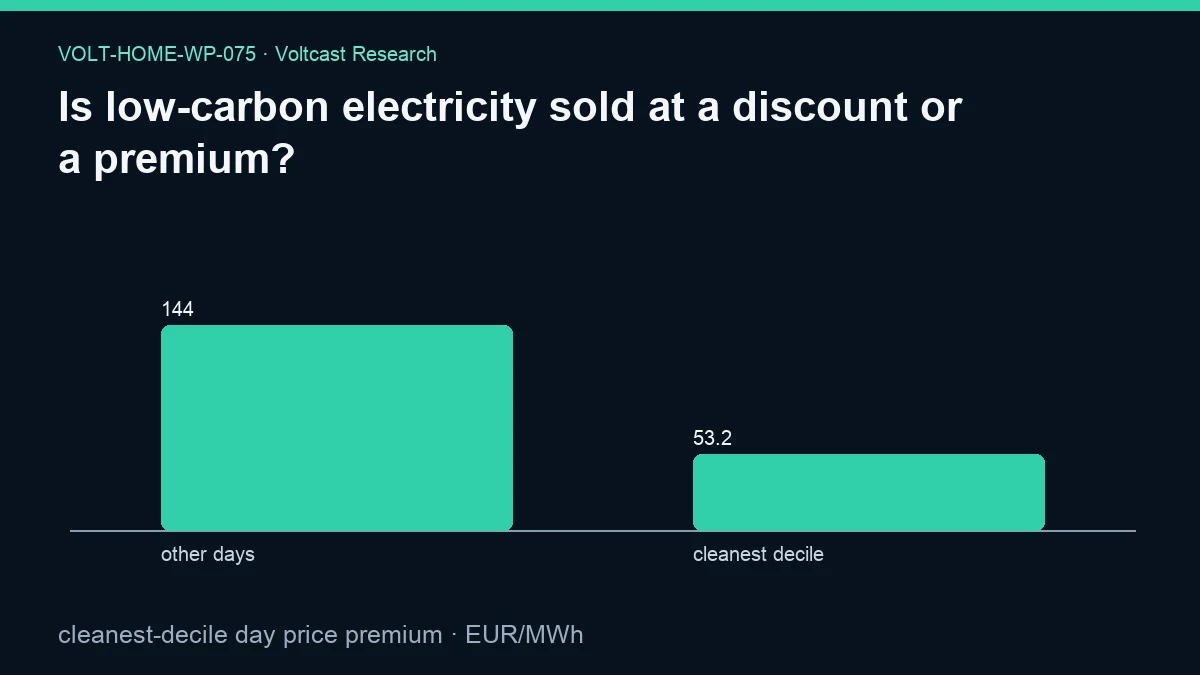
The primary result is -91.1995976761668 EUR/MWh for the cleanest-decile day price premium. The selected group contains 4,444 observations. The evidence’s registered interpretation is that a negative result means clean days sold at a discount in this operational-share definition.
The size of the contrast describes the two pooled group means, not the price available to a particular consumer at a particular interval. A household may have a fixed retail tariff, a dynamic tariff with additional components, or no ability to move load across the compared days. None of those circumstances enters the statistic.
The result also does not establish a general law. A pooled mean can be influenced by zone composition, time periods, and extreme prices. No zone-specific or seasonal contrast is included in the public evidence. The environmental group is defined using an operational low-carbon proxy rather than lifecycle marginal emissions, and no measured household emissions are reported.
The figure labels are “other days” and “cleanest decile,” with mean-price values 144.35848532243142 and 53.158887646264624 EUR/MWh, rendered as 144 and 53.2. Cleanest decile minus other days reproduces the -91.1995976761668 EUR/MWh primary result. The evidence reports a null bootstrap interval and interval method “not reported for this estimand.”
Robustness and placebo checks
The family evidence says within-family Holm control applies to inferential claims and describes this output as a descriptive result with no unadjusted significance claim. The paper-level JSON contains no secondary results and no paper-specific placebo result. We therefore do not state that the discount is statistically significant or robust to another threshold, weighting, or subsample.
Reasonable sensitivity studies would change the share threshold, winsorize or robustly summarize prices, compare within zones, stratify by season, weight by demand, and evaluate time stability. A placebo might assign share values from unrelated dates to price rows. Those variants would help test whether the contrast reflects consistent within-zone structure or panel composition. They were not reported in the frozen evidence and are not presented as completed.
The reproducibility lineage is strong: the snapshot, code, protocol, and registry hashes identify the exact computation. That lineage supports auditability but cannot substitute for specification sensitivity.
Limitations
“Low-carbon electricity” is a shorthand for the selected generation-share proxy. It is not a traced retail product and not lifecycle marginal emissions. Imports are not fully allocated, and average operational share does not identify marginal generation.
The pooled decile can mix structurally different zones and periods. Equal observation weighting is not the same as weighting European consumption or households. The paper does not show whether the discount appears within each zone or persists over time.
Daily means obscure interval variation. A household device operates in specific intervals and may not be available during the low-price periods that shape a daily mean. The analysis contains no load shape, charger, battery, heat pump, or automation constraints.
Wholesale price is not a household bill. Taxes, network charges, supplier margins, VAT, and contract terms are absent. This is not a household bill study, does not claim measured savings, and does not measure household emissions. Association and group contrast do not establish causality. Nothing here is trading advice.
Practical implication
The negative pooled contrast suggests that price and the low-carbon-share proxy need not be in conflict at the daily level. A controller could encounter periods where both objectives point in a similar direction. But the result is not sufficient to promise a discount to users or to set a fixed charging rule.
An implementation should use interval prices and explicit device constraints, then show any environmental proxy separately. If it describes a schedule as low carbon, it should state that the signal is average operational generation share, not lifecycle marginal emissions. Claims about causal emissions reductions require a different method.
For household economics, the wholesale contrast would need to be combined with an actual retail contract and load profile. That work is outside this paper. The present result is best used as motivation for transparent multi-objective scheduling, not as a savings forecast.
Reproducibility
Open the evidence JSON for VOLT-HOME-WP-075 and verify the slug, measured status, primary metric, source tables, publication cutoff, and all five provenance hashes. Build paired zone-day rows, compute the pooled top-decile threshold of low-carbon share, divide rows into selected and other groups, and subtract the latter mean daily price from the former.
The frozen result should be -91.1995976761668 EUR/MWh, with 4,444 selected rows. Per-zone thresholds, another quantile, alternative price aggregation, demand weighting, or a different carbon measure constitute new analyses and should not overwrite the registered output.
The evidence and figure are aggregate public artifacts; underlying source redistribution remains governed by the licensing reference.
Disclosure
Analysis and drafting were model-assisted. This working paper is not peer reviewed, not a household bill study, not a causal study, and not trading advice. Volt has no live traders or live capital. It reports no measured household emissions. Low-carbon generation share is an operational proxy, not lifecycle marginal emissions.
References
- International Energy Agency — Electricity 2026
- ACER and CEER — Rewarding flexibility: How retail contract choice can help unlock consumer flexibility
- International Energy Agency — Scaling Up Demand Flexibility
- European Commission — Communication from the Commission on the Citizens Energy Package
- Voltcast — Voltcast data licensing and redistribution