Should cross-country cheapest-window studies use local time or UTC?
Should cross-country cheapest-window studies use local time or UTC. Local-day grouping better matches household deadlines; UTC grouping can assign edge intervals to another day.
Should cross-country cheapest-window studies use local time or UTC?
Abstract
UTC is the safest identity for physical instants, but a household's deadlines are usually defined by local civil time. This paper compares cheapest-window selections grouped by local delivery day with selections grouped by UTC day. Across 3,340 zone-days, the recorded overlap is 5.167492396160061% of selected intervals. The regenerated evidence reports no interval for this estimand.
The low overlap in the registered statistic shows that day-boundary choice materially changes which intervals enter the compared cheapest windows. The evidence interpretation favors local-day grouping for household deadlines because UTC grouping can assign edge intervals to another day. That does not mean timestamps should be stored without UTC. Physical interval identity should remain unambiguous; local time should define the decision window when the question is about a local household day. Detailed analysis uses ten representative European bidding zones from 2025-10-01. This is not a household bill study. Analysis and drafting were model-assisted; the paper is not peer reviewed and is not trading advice.
Plain-language answer
Use UTC to identify intervals, but use the household's local timezone to decide which intervals belong to its day. A cheapest window for “charge before morning” is a local deadline problem. If a study cuts every country at UTC midnight, intervals near the edge can be assigned to a different civil date than the resident experiences.
In the registered sample, local-day and UTC-day cheapest selections overlap by only 5.167492396160061% of selected intervals. That statistic says the grouping choice strongly affects the selected sets under this method. It does not say one timezone has cheaper electricity or that every household would save by changing its clock handling.
Cross-country studies need both layers. Store and join prices using explicit physical instants, which prevents ambiguity. Then derive each zone's local delivery date and apply the same local household rule. A comparison can also publish a UTC-normalized analytical view, but it should not label that result as a local-day household schedule.
Research question
The research question is how much overlap exists between cheapest intervals selected within local delivery days and cheapest intervals selected within UTC days. The primary metric is the overlap as a percentage of selected intervals.
The question is not whether UTC is technically inferior. UTC is essential for physical identity and cross-system joins. The question is which boundary matches the household decision unit. The registered interpretation is that local-day grouping better matches household deadlines, while UTC grouping can move edge intervals to another day.
Data and provenance
The evidence reports daily prices from 2021-01-01 through 2026-08-29, detailed intervals from 2025-10-01 through 2026-08-29, and long history from 2015-01-01 through 2026-08-29. Detailed interval analysis uses ten representative European bidding zones beginning on 2025-10-01. The primary sample contains 3,340 zone-days.
Source tables are zones, day_ahead_prices, grid_revisions, auction_publications, and ingestion_runs. zones supplies the local timezone needed to derive delivery dates. Price intervals preserve physical starts and ends. Revision and publication lineage define the curve state, while ingestion records support completeness.
The analysis ran in a read-only transaction with a 180-second statement timeout and a publication cutoff of 2026-08-30T00:00:00Z. The snapshot SHA-256 is 7e97489fc8528c8cc8c38830e05b48d949ce1f67b98575dff26f5d7c321e4c67; analysis code is 57c57de79cdab2b5b6d6c54c485cb5162598c5ba0b0bfe995da40d75e6c52ba9; protocol is adb36bf6b447af9f96339249b8becaefc20422499cca1977242866347a97bd4b; paper registry is 7bcb91d7476d0a69fe9fa75a5c7782f8117e0153f82f9112b7e1d307d3943717; source registry is 07949550ac443ff673fda5c0209b99f137544f3ffecf6775f109bb9d09663bd6. The evidence manifest records evidence SHA-256 1110f1f6d128233ff1ceda3d12f1a59d1c3d8b6eacd2c7ddb00e965c6ff87ea2 and figure SHA-256 fcf04de118966cdf09cd4381a4fd9afdfb0167303f8299e359b79097804a17cf.
The public evidence contains aggregates, assumptions, limitations, and provenance rather than raw market payloads. Licensing remains governed by the stated data-licensing route.
Method
The method belongs to the registered family of paired interval reconstruction, clock-safe counterfactuals, and day-block bootstrap. Eligible price intervals are first retained as unambiguous physical instants. Two grouping views are then derived from the same curve: one by the bidding zone's local delivery date and one by UTC date.
The cheapest-window selection rule is applied separately within each grouping. The selected interval identities are then compared, and overlap is expressed as a percentage of selected intervals. Pairing the views on the same underlying zone-day corpus isolates boundary definition rather than comparing different market samples.
This design makes local time a semantic grouping rule, not the storage identity. Repeated or skipped local labels around daylight-saving transitions remain distinguishable because the underlying physical interval timestamps are preserved.
The regenerated artifact stores bootstrap_95_interval as null and labels its interval method not reported for this estimand. The evidence states that within-family Holm control applies to inferential claims and that this descriptive output makes no unadjusted significance claim.
Results
Across 3,340 zone-days, overlap between local-day and UTC-day cheapest windows is 5.167492396160061% of selected intervals. No uncertainty interval is reported.
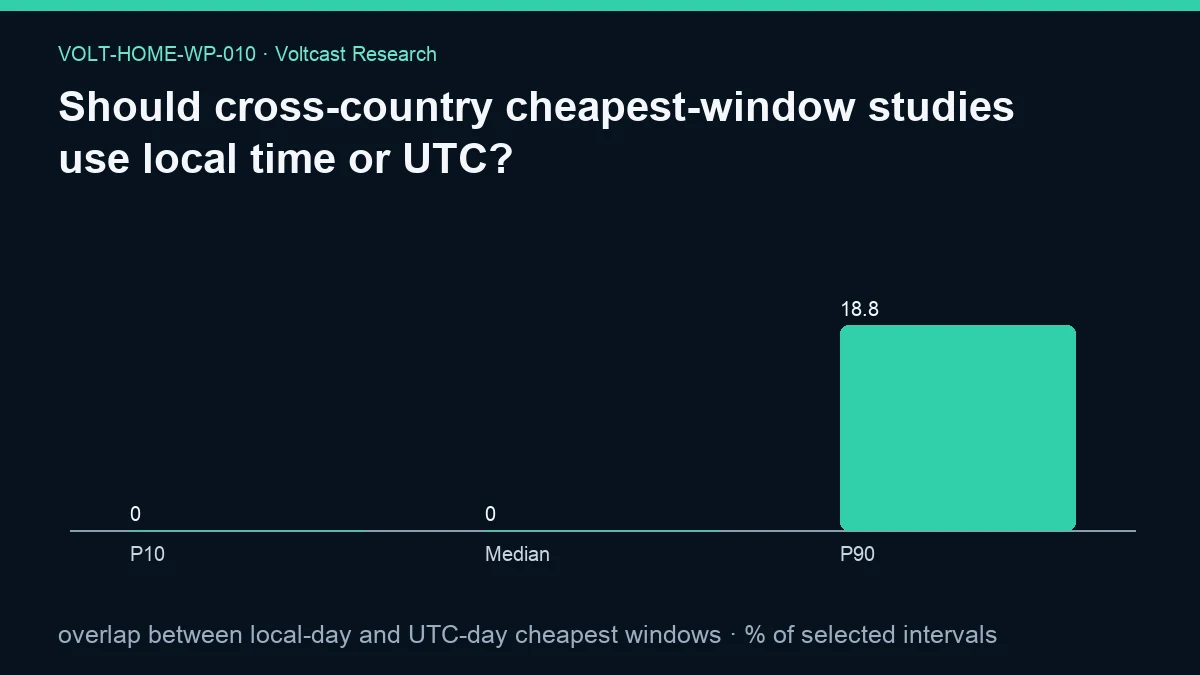
The figure labels P10, Median, and P90 carry exact overlap values 0.0%, 0.0%, and 18.75%. These are distributional summaries of zone-day overlap and are not confidence limits around the primary aggregate.
The measured overlap is the result of the registered selection and grouping rules. It is not a generic timezone conversion rate. It indicates that changing the day boundary materially changes the interval sets selected as cheapest in this corpus.
The supported interpretation is about household relevance: local-day grouping better aligns with local deadlines, while UTC grouping can assign boundary intervals to another local day. The result does not quantify wholesale cost difference, retail savings, comfort, or device feasibility. Those metrics are not present in the evidence.
Robustness and placebo checks
Using the same physical interval corpus for both grouping views is the primary paired control. Market conditions, source rows, and eligible zones remain fixed; only the definition of the day boundary changes.
Clock-safe physical identity prevents ambiguous local labels from becoming duplicate or missing observations. This is especially important on transition days. A robust implementation derives local dates from timezone-aware instants rather than parsing display strings.
The family protocol permits blocked uncertainty calculations where estimator-valid, but the current overlap artifact reports none. Within-family Holm control governs inferential claims, and the result remains descriptive.
The UTC grouping is a purposeful counterfactual, not a straw man. It is useful for machine identity and global alignment, but it answers a different question when used as the household day. The paper does not test additional boundary conventions or infer their outcomes.
Limitations
Detailed analysis covers ten representative European bidding zones from 2025-10-01. The overlap may differ under other zones, windows, and selection rules. It should not be treated as a universal constant.
The public artifact does not specify a monetary cost difference between the selections. Low overlap can matter operationally without implying a particular savings amount. No household profile, tariff, device, or bill is observed.
The metric concerns selected intervals under the registered cheapest-window method. Different window lengths, continuity constraints, arrival times, or energy needs could change overlap. Those are separate analyses.
This is not a household bill study. It cannot determine whether local grouping improves a particular customer's retail outcome, only that it aligns the grouping semantics with local deadlines and produces different selected sets.
Practical implication
Cross-country research should adopt a two-clock contract. Use UTC or another unambiguous instant for storage, joins, ordering, and interval identity. Use the bidding zone's named timezone to derive local delivery dates and household deadlines.
Results should state which clock defines the candidate window. A “cheapest day” grouped by UTC should be labelled as a UTC-day statistic. A schedule intended for a household's evening-to-morning availability should use local civil times converted to explicit instants, including daylight-saving ambiguity handling.
Software should never apply one fixed offset to all zones or dates. Named timezone rules and explicit interval boundaries are required. Tests should include edge intervals around both midnight definitions and legitimate short or long local days.
For comparative reporting, the denominator and eligibility rules must remain identical across zones. A local-day study should not quietly include a boundary interval in one zone while dropping its physical counterpart in another because of a UTC extraction cutoff. The extract should extend far enough around each local window to make every candidate interval available before local grouping. This is a data-engineering requirement, not a claim about measured prices.
A useful published record should expose both the physical instant and derived local label for every selected interval, subject to data-licensing limits. Reviewers can then verify that differences come from the declared boundary rather than an accidental offset. Aggregate results should state whether a “day” means local delivery date, UTC date, or another operational period.
The same distinction applies to automation. A user can express “finish before morning” in local time, while the scheduler executes a sequence of physical instants. If timezone rules change, the local deadline should be resolved using the rule applicable to that delivery date. Hard-coded offsets create silent historical and future errors even when every UTC timestamp is valid.
Reproducibility
The public evidence JSON is /research-data/home-papers/should-cross-country-cheapest-window-studies-use-local-time-or-utc.json. It contains the windows, source tables, metric, sample size, null interval, figure values, limitation, disclosure, and provenance hashes.
A reproduction should verify snapshot, code, protocol, and registry identities; preserve the publication cutoff and read-only boundary; and reconstruct complete physical intervals. Derive local-day keys using each zone's timezone and UTC-day keys from the same instants. Apply the identical cheapest-window rule to both views.
Compare selected physical interval identities, calculate overlap with the registered denominator, reproduce the exact figure vector [0.0, 0.0, 18.75], and preserve the null interval. Any monetary comparison or alternative household deadline belongs in a separately specified analysis.
Disclosure
Analysis and drafting were model-assisted; sources, code, assumptions, and evidence hashes are disclosed. This working paper is not peer reviewed, is not a household bill study, and is not trading advice. Volt has zero live traders and zero live trading capital; C0R is the only paper strategy. Production weather forecasting is a non-trading service. This clock-grouping analysis authorizes no order, capital, or live trading.
References
- Spam Policies for Google Web Search — Scaled content abuse — Google Search Central.
- Single Day-ahead Coupling (SDAC) — ENTSO-E.
- EU electricity trading in the day-ahead markets becomes more dynamic — European Commission.
- ACER Decision 13-2024 on SDAC Products — Agency for the Cooperation of Energy Regulators.
- Voltcast Architecture — Voltcast.