What does a one-hour timezone error cost a flexible household?
What does a one-hour timezone error cost a flexible household. The counterfactual isolates timestamp alignment; it is not an annual retail-savings claim.
What does a one-hour timezone error cost a flexible household?
Abstract
A schedule can be optimized correctly against the wrong timestamps. This paper isolates that failure by shifting selected quarter-hour intervals four slots later while keeping the underlying delivery curve and synthetic household event fixed. Across 2,689 eligible events, the mean wholesale penalty is €0.08342060756786909 per 18 kWh event. The day/row-block mean-bootstrap interval runs from €0.07928280140624999 to €0.08856326081249999.
The counterfactual is deliberately specific. It assumes a one-hour-later error represented by four quarter-hour slots, wholesale energy only, and no taxes, supplier margin, or network charges. It does not estimate an annual retail loss, the prevalence of timezone bugs, or the impact of shifts in the opposite direction. The result demonstrates that timestamp alignment has measurable cost in observed curves under the registered event design. It is not a household bill study. Analysis and drafting were model-assisted; this working paper is not peer reviewed and is not trading advice.
Plain-language answer
In this reconstruction, moving an already selected schedule one hour later increased wholesale cost by an average of about eight euro cents for the assumed 18 kWh event. That is larger than a mere formatting concern: the same device energy is attached to different physical price intervals when timestamps are wrong.
The result does not mean every timezone mistake costs that amount. Price shapes vary, some shifted schedules may land on similar prices, and this paper reports an aggregate mean over eligible events. It also does not say timezone errors are common. The experiment imposes one by design so its consequence can be measured.
Household software can create this class of error when it treats UTC as local time, applies an offset twice, ignores a bidding-zone timezone, or interprets a local label without its offset. The safe design is to identify market delivery intervals by unambiguous instants and convert to local time only for presentation and household deadlines. An optimizer must bind its chosen intervals to those same identities when issuing commands.
Research question
The research question is what wholesale cost penalty results when a chosen quarter-hour household schedule is shifted one hour later. The registered metric is the mean difference in wholesale cost per assumed 18 kWh event between the intended schedule and the four-slot-later counterfactual.
This is a data-alignment question, not a general study of tariff value. It holds the selected event concept fixed and changes timestamp placement. It does not ask whether the original schedule was feasible for a specific person, whether a forecast would choose it prospectively, or whether retail charges preserve wholesale differences.
Data and provenance
The evidence lists daily prices from 2021-01-01 through 2026-08-29, detailed intervals from 2025-10-01 through 2026-08-29, and long history from 2015-01-01 through 2026-08-29. Detailed interval analysis uses ten representative European bidding zones from 2025-10-01. The reported sample contains 2,689 eligible paired events.
The source contract names zones, day_ahead_prices, grid_revisions, auction_publications, and ingestion_runs. Zone metadata is essential because a timezone error cannot be defined without the intended local clock. Price intervals provide the physical delivery sequence. Revision and publication records establish which curve state belongs to the analysis, and ingestion records support completeness checks.
The analysis cutoff is 2026-08-30T00:00:00Z. Queries ran in a read-only transaction with a 180-second statement timeout. The snapshot SHA-256 is 7e97489fc8528c8cc8c38830e05b48d949ce1f67b98575dff26f5d7c321e4c67; analysis code is 57c57de79cdab2b5b6d6c54c485cb5162598c5ba0b0bfe995da40d75e6c52ba9; protocol is adb36bf6b447af9f96339249b8becaefc20422499cca1977242866347a97bd4b; paper registry is 7bcb91d7476d0a69fe9fa75a5c7782f8117e0153f82f9112b7e1d307d3943717; source registry is 07949550ac443ff673fda5c0209b99f137544f3ffecf6775f109bb9d09663bd6. The evidence manifest records evidence SHA-256 09e5fa1b3ad9e61ae6a9af6ed84f7b2b7ba01ea5576f328da0c137e778da1222 and figure SHA-256 dc9a93a892c8a91bf88a6254d263427f9f9db7b3edcef790d2741bbf04f47699.
The public artifact reports aggregate cost rather than raw price rows. Its licensing note directs users to the data-licensing policy. Publication of the aggregate does not imply permission to redistribute source payloads.
Method
The analysis uses the registered family of paired interval reconstruction, clock-safe counterfactuals, and day-block bootstrap. An eligible event begins with a chosen schedule on a complete native quarter-hour curve. The counterfactual shifts each selected interval four quarter-hour slots later. The cost difference between shifted and intended schedules is calculated on the same observed curve.
Pairing is crucial. It holds constant the zone, delivery day, energy event, and market conditions, changing only timestamp alignment. Comparing unrelated days would confound clock error with price-level differences. The interpretation of a positive value is that the later shifted schedule costs more at wholesale.
The study prices wholesale energy only. Taxes, supplier margin, and network charges are excluded. The 18 kWh event is part of the registered setup, not a measured household-population average. The four-slot shift is an imposed synthetic error, not an observed incidence of software failure.
The artifact labels the interval method day/row-block mean bootstrap, retaining the registered block dependence among event outcomes. The evidence applies within-family Holm control to inferential claims while describing this output as a descriptive result with no unadjusted significance claim.
Results
Across 2,689 paired events, the recorded mean wholesale penalty from shifting a chosen schedule one hour later is €0.08342060756786909 per 18 kWh event. The day/row-block mean-bootstrap interval is €0.07928280140624999 to €0.08856326081249999.
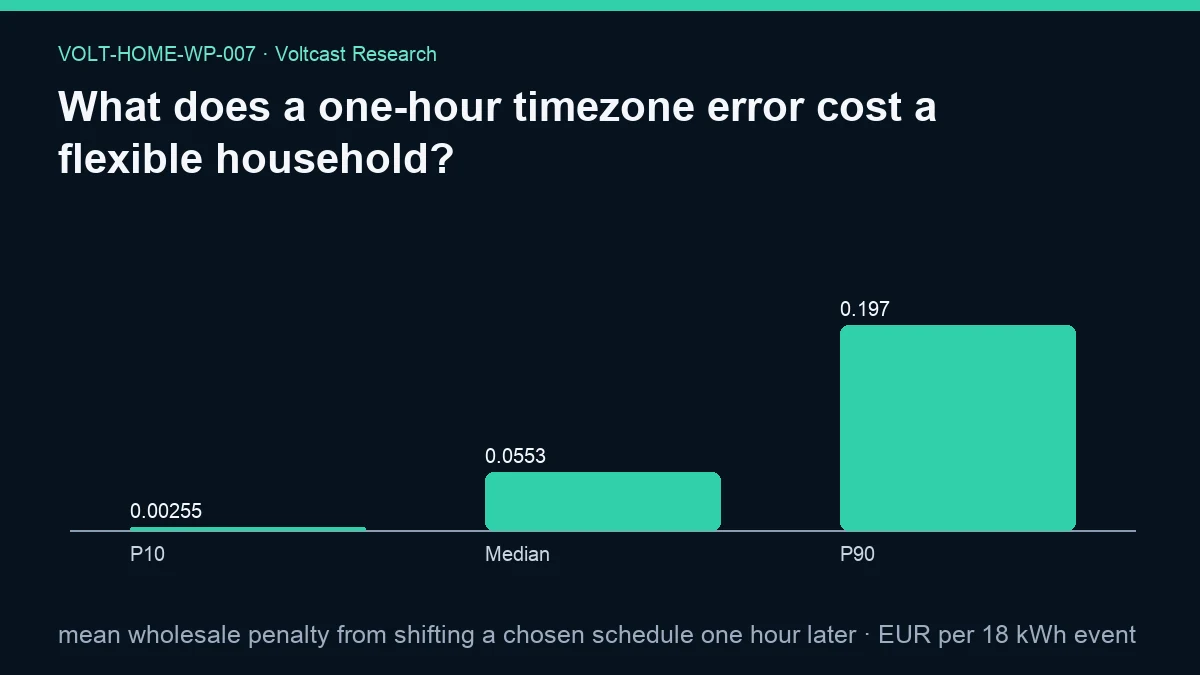
The figure's P10, Median, and P90 labels carry exact event-penalty values of €0.00254925, €0.05534999999999992, and €0.19719900000000024. These quantiles describe dispersion across eligible events and are not the primary mean or its interval.
The positive mean supports the narrow claim that timestamp misalignment can degrade an otherwise chosen schedule. It does not establish a minimum loss, a maximum loss, or a loss for every event. The public artifact does not provide those distributional quantities, so this paper does not invent them.
The result also should not be annualized. The evidence does not specify how many eligible 18 kWh events a household performs, how often timezone errors occur, or whether wholesale differences pass through a retail tariff. The metric is a controlled per-event counterfactual.
Robustness and placebo checks
The intended schedule is the primary matched control. Shifting its interval identities on the same curve isolates time alignment from changing energy need or day-level market conditions. Four quarter-hour slots encode the registered one-hour-later error consistently on native-resolution days.
Clock-safe reconstruction is necessary before the shift is applied. At daylight-saving boundaries, local labels alone are ambiguous. A robust implementation shifts along the physical interval sequence rather than constructing a possibly nonexistent local time.
The recorded day/row-block mean bootstrap recognizes the registered block dependence within the analysis. Within-family Holm control governs inference across related analyses. The result is not promoted through an isolated unadjusted test.
No opposite-direction, half-hour, or two-hour placebo is reported in the evidence. Those could be useful future sensitivity analyses but cannot be claimed here. Likewise, no random schedule is used as a comparator because the registered question concerns corruption of a chosen schedule.
Limitations
The detailed sample covers ten representative European bidding zones beginning on 2025-10-01. It does not support a universal per-event value across all zones, seasons, or historical regimes.
The one-hour-later shift is synthetic. Real bugs can move timestamps earlier, apply varying offsets, affect only part of a schedule, or occur only at clock transitions. This paper measures none of those alternatives and cannot estimate bug prevalence.
Wholesale energy is the only priced component. Taxes, supplier margin, network charges, losses, hardware costs, and device constraints are excluded. This is explicitly not a household bill study.
The assumed event is 18 kWh. Household energy needs differ, and cost need not scale linearly under power, availability, or tariff constraints. The original selection also does not model prospective forecast error in this paper.
Practical implication
Every schedule should carry immutable interval identifiers: zone, physical start, physical end, resolution, and curve version. Human-readable local times should be derived views. Device commands should reference the same physical intervals that the optimizer priced.
System boundaries need explicit clock contracts. An API may return UTC timestamps, while a user supplies a local departure deadline. The integration must convert the deadline once using the zone's timezone, retain offset-aware values, and reject ambiguous or nonexistent local inputs rather than guessing.
Monitoring should compare planned and issued command intervals. A one-hour displacement can then be detected as an identity mismatch before energy is delivered. At a DST transition, tests should cover repeated and skipped local labels. Fallback behavior should preserve required energy and safety even when price optimization is suspended.
Auditable user interfaces should display both the household-facing local time and the underlying offset-aware interval. That makes a displaced plan visible without asking a user to reason from UTC alone. Logs should preserve the conversion input, timezone identity, resulting instant, and curve version so an operator can distinguish a presentation defect from a scheduling defect after the event.
Reproducibility
The public evidence JSON is /research-data/home-papers/what-does-a-one-hour-timezone-error-cost-a-flexible-household.json. It contains the exact assumptions, data windows, source tables, metric, sample size, interval, figure values, limitations, disclosure, and hashes.
A reproduction should first verify the snapshot, analysis-code, protocol, and registry identities. It should preserve the publication cutoff and read-only transaction. Eligible complete quarter-hour curves should be reconstructed with unambiguous timestamps. The intended schedule and four-slot-later counterfactual must be evaluated on the same curve for the same 18 kWh event.
The cost difference should include wholesale energy only and be aggregated over the original eligibility set. Interval recomputation should follow the recorded day/row-block mean-bootstrap implementation. Any extension to another offset, tariff, event size, or forecast regime should be preregistered as a different analysis rather than folded into this result.
Disclosure
Analysis and drafting were model-assisted; sources, code, assumptions, and evidence hashes are disclosed. This paper is not peer reviewed, is not a household bill study, and is not trading advice. Volt has zero live traders and zero live trading capital; C0R is the only paper strategy. Production weather forecasting is a non-trading service. This timestamp counterfactual does not authorize orders, capital, or live trading.
References
- Spam Policies for Google Web Search — Scaled content abuse — Google Search Central.
- Single Day-ahead Coupling (SDAC) — ENTSO-E.
- EU electricity trading in the day-ahead markets becomes more dynamic — European Commission.
- ACER Decision 13-2024 on SDAC Products — Agency for the Cooperation of Energy Regulators.
- Voltcast Architecture — Voltcast.