When can a price-optimized battery increase average grid emissions?
When can a price-optimized battery increase average grid emissions. Price-only dispatch can select low-price days that are not cleaner than the sample median.
Abstract
A price-only battery may charge in low-price periods that are not high in low-carbon generation share. The frozen evidence tests only that overlap condition at the zone-day level. Among 44,437 paired observations, 1.7642955194995162% of all rows were both in the cheapest price decile and at or below the median low-carbon share. The result demonstrates that low price does not guarantee an above-median operational low-carbon mix.
It does not demonstrate that a battery increased grid emissions. No battery is dispatched, no charging and discharging intervals are linked, no round-trip losses are applied, and no marginal generation response is estimated. Low-carbon share is an operational average-generation proxy, not lifecycle marginal emissions. It does not fully allocate imports or measure emissions caused by an incremental load. The title is therefore answered as a warning condition rather than a causal result: price-only selection can enter low-price, below-median-share zone-days, but this evidence cannot quantify average grid emissions or measured household emissions.
Plain-language answer
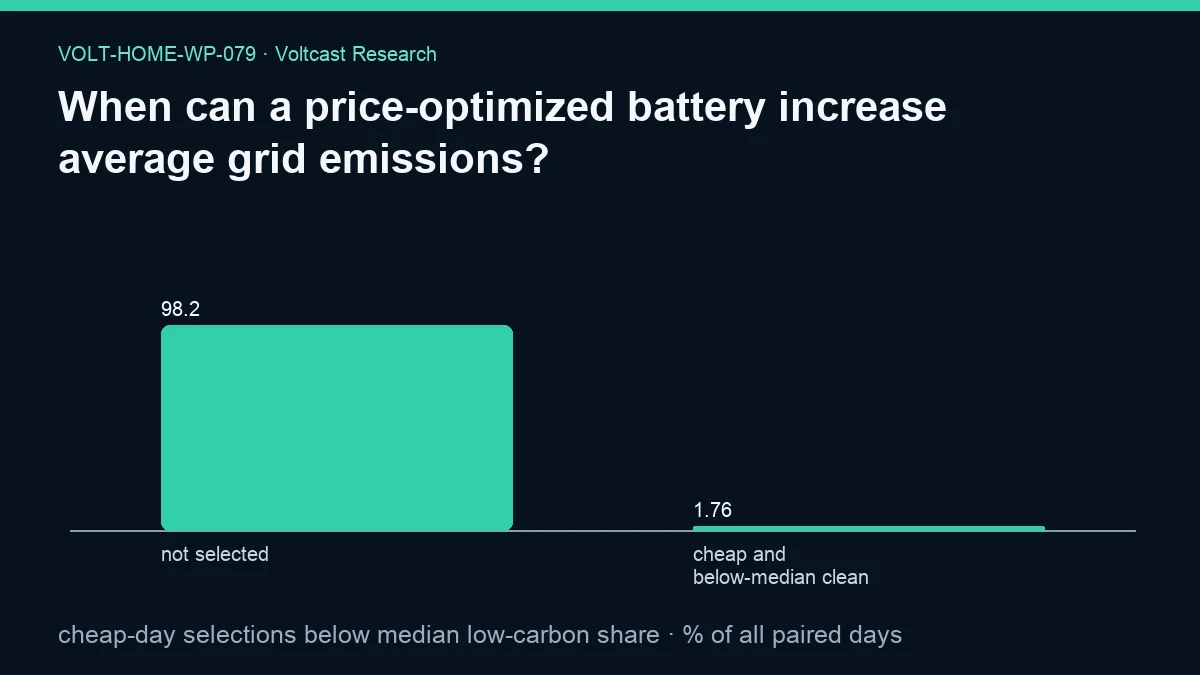
The study finds a small but real category of rows where cheap does not mean cleaner under the chosen proxy. Exactly 1.7642955194995162% of the 44,437 paired zone-days were in the cheapest price decile and also at or below the median low-carbon generation share.
That category is a reason for caution when a battery optimizer uses price alone. It is not evidence that an actual battery charged on those days, discharged elsewhere, or increased emissions. The calculation does not model a battery at all. It only marks zone-days satisfying two daily conditions.
The environmental condition is also limited. Below-median operational low-carbon share is not a measured emissions increase, and the share is not lifecycle marginal emissions. The practical answer is that price-only scheduling can choose periods that do not rank highly on this proxy; whether emissions rise requires a different study.
Research question
The registered question asks when a price-optimized battery can increase average grid emissions. The measured question is narrower: what proportion of all paired zone-days are both cheap, defined by the pooled cheapest decile of daily mean price, and not cleaner than the sample median, defined by low-carbon generation share at or below its pooled median?
This is a necessary warning screen, not a sufficient emissions test. A battery-emissions study would need charging and discharging times, energy balance, efficiency losses, state of charge, capacity and power constraints, and an emissions measure at both sides of the cycle. The primary metric has none of those.
The study is observational and classification-based. It cannot determine that a battery action caused a change in dispatch, price, or emissions. It also does not measure average grid emissions despite the title’s wording.
Data and provenance
The public evidence JSON linked in frontmatter is the canonical aggregate. The family source contracts are generation_mix, day_ahead_prices, capture_stats, res_accuracy, and zone_temp_weighted. The primary screen uses daily mean prices and finite low-carbon generation shares from paired zone-day rows.
The evidence records daily prices from 2021-01-01 through 2026-08-29, detailed intervals from 2025-10-01 through 2026-08-29, and long history from 2015-01-01 through 2026-08-29. The frozen publication cutoff is 2026-08-30T00:00:00Z. Data extraction was read-only with a statement timeout of 180 seconds.
The snapshot is bound to SHA-256 7e97489fc8528c8cc8c38830e05b48d949ce1f67b98575dff26f5d7c321e4c67. Analysis code is 57c57de79cdab2b5b6d6c54c485cb5162598c5ba0b0bfe995da40d75e6c52ba9, protocol is adb36bf6b447af9f96339249b8becaefc20422499cca1977242866347a97bd4b, the paper registry is 7bcb91d7476d0a69fe9fa75a5c7782f8117e0153f82f9112b7e1d307d3943717, and the source registry is 07949550ac443ff673fda5c0209b99f137544f3ffecf6775f109bb9d09663bd6.
No battery telemetry, household load, customer bill, or measured household emissions are part of the primary evidence. The five registered source links are reproduced without importing unregistered findings.
Method
The analysis assembles paired zone-day records containing daily mean price and low-carbon generation share. It computes the pooled cheapest-decile threshold for price and the pooled median for low-carbon share. Each paired row receives an indicator equal to one hundred when price is at or below the cheap threshold and share is at or below the low-carbon median; otherwise it receives zero. The reported percentage is the mean of this indicator across all paired rows.
The denominator is all 44,437 paired observations, not only cheap rows. This matters for interpretation: 1.7642955194995162% is the joint category’s share of the entire paired panel. The metric does not report the proportion within the cheapest decile.
No battery optimization occurs. The method does not identify intervals, pair a charge with a discharge, enforce state of charge, or include round-trip losses. Calling the selected rows “battery dispatch” would be inaccurate. They are a screening set that a hypothetical price-only rule might encounter.
Low-carbon share is an operational proxy. It is not lifecycle marginal emissions and cannot identify the emissions response of additional charging. A below-median share is a relative classification, not proof of high absolute emissions.
Results
The primary result is 1.7642955194995162% of all paired days, with a primary-result sample size of 44,437. The frozen interpretation states that price-only dispatch can select low-price days that are not cleaner than the sample median.
The result establishes non-equivalence between cheap selection and the low-carbon-share ranking. It does not say how frequently a feasible battery would charge in the selected set because feasibility and interval timing are absent. It also does not report what happens at discharge, which is essential for any net battery-emissions assessment.
No average-grid-emissions value is present. The operational share does not yield lifecycle marginal emissions, and no causal dispatch response is measured. The result should therefore be cited as a joint price-and-share screening statistic, not as evidence that batteries increase measured emissions.
The figure labels are “not selected” and “cheap and below-median clean,” with values 98.23570448050049% and 1.7642955194995162%, rendered as 98.2 and 1.76. The bars partition all paired rows under the stated screen; they are not battery-emissions outcomes. The evidence reports no bootstrap interval and names the interval method “not reported for this estimand.”
Robustness and placebo checks
The evidence states that within-family Holm control applies to inferential claims and classifies this result as descriptive without an unadjusted significance claim. It records no secondary results or paper-specific placebo. We do not claim that the joint share is statistically significant or stable across thresholds.
A complete robustness analysis could vary the price quantile and share threshold, compute within-zone categories, stratify by season, and use interval rather than daily data. A battery study would test efficiencies, durations, charge/discharge constraints, and alternative environmental signals. A placebo might randomize price-day and share-day pairing.
None of these outcomes appears in the frozen JSON. The completed checks are lineage controls: read-only extraction, cutoff, and immutable hashes for registry, protocol, code, and snapshot. They make the simple screen reproducible but do not fill in missing battery physics.
Limitations
The primary metric is not a battery simulation. It has no capacity, power, efficiency, degradation, state of charge, initial condition, or discharge rule. It cannot calculate a battery’s net energy movement or emissions consequence.
Daily aggregation is especially restrictive. A price-optimized battery responds to intervals and spreads, not only daily means. A low-price day can contain a range of operational mixes, and a below-median daily share cannot describe the charging interval.
The environmental proxy is not lifecycle marginal emissions. Imports are not fully allocated and marginal response is unobserved. Below-median share does not mean that adding load caused high emissions. No measured household emissions are present.
The screen also observes only one side of the battery cycle. Even if a charging interval had a lower operational low-carbon share, the net environmental comparison would depend on what generation is displaced when stored energy is later discharged and on energy lost between those actions. Without those linked counterfactuals, neither the sign nor the scale of a battery-emissions effect is identified.
The pooled threshold and equal-row denominator can mask zone, seasonal, and coverage differences. Retail tariffs, network charges, taxes, and actual household behavior are absent. This is not a household bill study, makes no causal claim, and is not trading advice.
Practical implication
Price-only optimizers should not advertise an automatic emissions benefit. A user interface can state plainly that cheap periods may not have an above-median low-carbon operational share. If an environmental objective is offered, it should be an explicit second objective with a documented data source and accounting boundary.
For batteries, environmental evaluation must cover the full cycle. Charging conditions alone are insufficient; discharging displacement and efficiency losses matter. If the intended claim concerns causal emissions, an average share proxy is also insufficient. Low-carbon share is not lifecycle marginal emissions.
The reported percentage can serve as a quality-assurance case: test how a controller behaves when price and the proxy disagree. It cannot provide household savings, a bill estimate, or measured emissions.
Reproducibility
Open the evidence for VOLT-HOME-WP-079 and verify slug, measured status, metric, unit, source tables, publication cutoff, and all five provenance hashes. Build paired zone-day rows, calculate the pooled cheapest price decile and median low-carbon share, mark rows meeting both conditions, and average the indicator over all pairs.
The expected result is 1.7642955194995162% over 44,437 paired observations. Changing the denominator to cheap rows, using interval prices, adding a battery dispatch, or replacing the proxy with marginal or lifecycle emissions creates a different study and must be separately registered.
The public evidence and figure are aggregate artifacts. Licensing of underlying records is governed by the exact registered Voltcast source.
Disclosure
Analysis and drafting were model-assisted. This working paper is not peer reviewed, not a battery-dispatch study, not a household bill study, and not trading advice. Volt has no live traders or live capital. It makes no causal claim and reports no measured household emissions. Low-carbon generation share is an operational proxy, not lifecycle marginal emissions.
References
- International Energy Agency — Electricity 2026
- ACER and CEER — Rewarding flexibility: How retail contract choice can help unlock consumer flexibility
- International Energy Agency — Scaling Up Demand Flexibility
- European Commission — Communication from the Commission on the Citizens Energy Package
- Voltcast — Voltcast data licensing and redistribution