Are negative electricity prices always low-carbon?
Are negative electricity prices always low-carbon. Negative wholesale prices often coincide with abundant low-marginal-cost output, but are not themselves a carbon measure.
Are negative electricity prices always low-carbon?
Abstract
Negative wholesale prices and low-carbon electricity can coincide, but they are not equivalent measurements. This working paper asks what share of observed negative-price days had an operational low-carbon generation share at or above the sample median. The evidence reports 61.57415670176691% across a sample size of 5,603 and intentionally reports no bootstrap interval for this estimand. The answer is therefore “often in this sample, but not always.”
The low-carbon share is an operational generation proxy. It summarizes recorded generation composition; it is not a lifecycle greenhouse-gas assessment, a marginal-emissions estimate, or proof that consuming an additional unit of electricity would reduce emissions. Negative price is itself only a wholesale market outcome. The two can respond to overlapping system conditions without one measuring the other. This paper keeps those concepts separate, reports the frozen descriptive comparison, and avoids converting it into household carbon savings, bill savings, or trading advice.
Plain-language answer
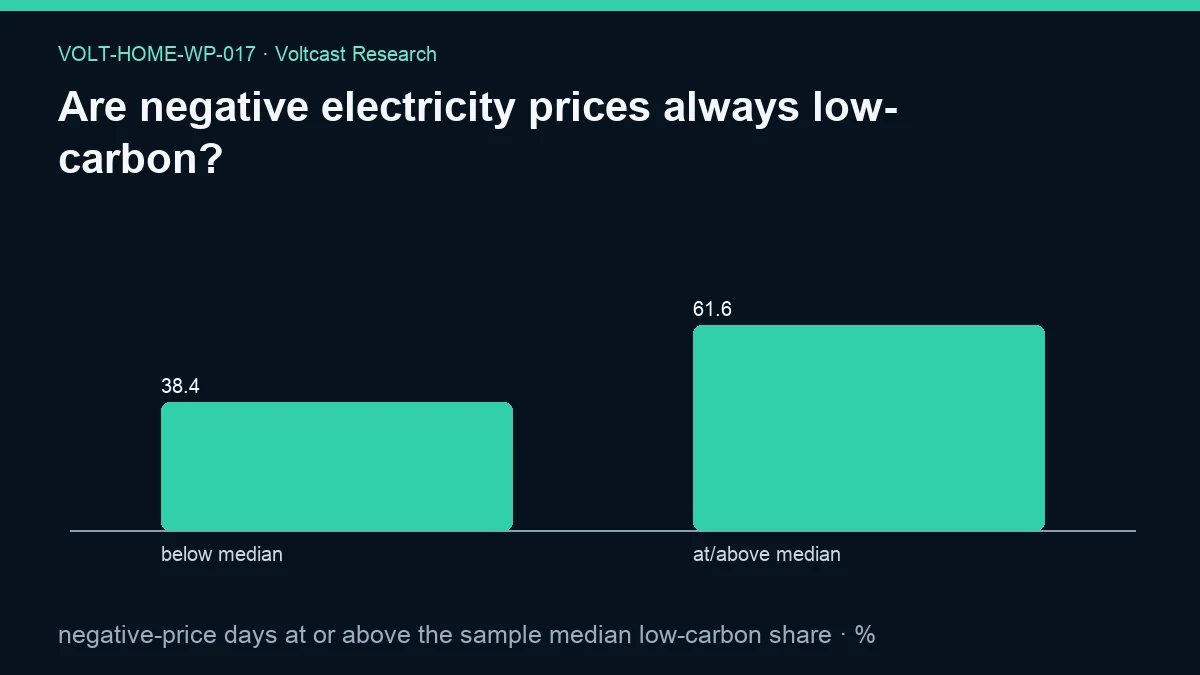
No. In the recorded sample, 61.57415670176691% of negative-price days were at or above the sample median operational low-carbon share. The figure’s complementary machine-readable bars are 38.42584329823309% below median and 61.57415670176691% at/above median. A negative day-ahead price therefore cannot be used as a universal clean-electricity label.
“Operational low-carbon share” means the share derived from observed generation operations under the analysis classification. It is a proxy because it does not measure full lifecycle emissions from construction, fuel supply, maintenance, or decommissioning. It also does not measure marginal emissions: the generator that changes output because one household charges can differ from the average generation mix. A price-optimized schedule and a carbon-optimized schedule can therefore be different.
Research question
The primary question is: among observed days with at least one negative day-ahead price event under the analysis contract, what percentage have operational low-carbon generation share at or above the sample median? The result is a relative classification within the sample, not a threshold tied to a fixed emissions intensity.
This framing tests whether negative-price days usually fall on the higher side of the sample’s operational low-carbon distribution. It does not ask whether every negative interval is low-carbon, whether the exact negative interval overlaps the day’s cleaner generation, or whether shifting consumption into it changes emissions. Those would require interval alignment and a marginal or consequential emissions method not present in the evidence.
Data and provenance
The evidence declares daily price coverage from 2021-01-01 through 2026-08-29, detailed interval coverage from 2025-10-01 through 2026-08-29, and long-history coverage from 2015-01-01 through 2026-08-29. The registered result is day-level and has a sample size of 5,603. The public JSON does not further label that count, so this paper does not invent whether it represents zone-days or another exact eligibility unit.
The source tables are day_ahead_prices, generation_mix, border_flows, risk_accuracy, and zone_holidays. Prices identify negative-price days, while generation mix supports the operational low-carbon proxy. The other family tables do not turn that proxy into lifecycle or marginal emissions. Border flows can affect the relationship between local generation and consumption, which is another reason not to call an operational generation share a complete consumption-based footprint.
The current public-evidence JSON SHA-256 is d9f4f2e202687020723185adff7467419c19e6e6d2e3ed8775271da2a5a7418b. The publication cutoff is 2026-08-30T00:00:00Z. The analysis was read-only with a 180-second statement timeout. Analysis-code SHA-256 is 57c57de79cdab2b5b6d6c54c485cb5162598c5ba0b0bfe995da40d75e6c52ba9; protocol SHA-256 is adb36bf6b447af9f96339249b8becaefc20422499cca1977242866347a97bd4b; registry SHA-256 is 7bcb91d7476d0a69fe9fa75a5c7782f8117e0153f82f9112b7e1d307d3943717; snapshot SHA-256 is 7e97489fc8528c8cc8c38830e05b48d949ce1f67b98575dff26f5d7c321e4c67; and source-registry SHA-256 is 07949550ac443ff673fda5c0209b99f137544f3ffecf6775f109bb9d09663bd6. No assumptions are registered.
Method
The analysis identifies negative-price days from the day-ahead price series and computes or retrieves the corresponding operational low-carbon generation share. It then determines the sample median of that proxy and classifies each eligible negative-price day as below the median or at/above it. The primary statistic is the percentage in the at/above group.
This is a rank-relative design. “At or above the median” means higher than the middle of this sample’s operational-share distribution, not necessarily high under an external climate standard. The median can vary with zone coverage, period, missing categories, and classification rules. The method therefore supports a within-snapshot statement rather than a timeless label.
The evidence’s interpretation says negative wholesale prices often coincide with abundant low-marginal-cost output but are not themselves a carbon measure. That is consistent with the method: it observes co-occurrence and does not identify a causal effect. The family applies Holm control to inferential claims, while this result is descriptive and makes no unadjusted significance claim. No household or synthetic emissions scenario is included.
Results
The primary result is 61.57415670176691% of eligible negative-price days at or above the sample median operational low-carbon share. The sample size is 5,603. The corrected evidence records bootstrap_95_interval as null and the interval method as “not reported for this estimand.” The figure exactly partitions the plotted observations into 38.42584329823309% below median and 61.57415670176691% at/above median.
This result rejects an absolute equation between price sign and low-carbon status. If negative prices were always associated with the higher-side classification, the measured percentage would cover every eligible day. Instead, the evidence shows frequent but incomplete overlap. Because the threshold is the sample median, the result says nothing about a fixed grams-of-carbon-dioxide-equivalent intensity.
The finding also remains daily. A day can contain both negative and positive price intervals and a changing generation mix. A daily at/above-median classification does not prove that the specific negative interval was the day’s cleanest interval. Nor does the statistic show the marginal generator responding to an added household load.
Robustness and placebo checks
No bootstrap interval is reported for the percentage. This is an intentional uncertainty-handling choice. A future supported interval would need to identify its resampling unit and retain clustering by zone or date if the source panel contains repeated observations. The two figure bars are composition values, not confidence limits.
Robustness should test interval-level alignment, alternative transparent low-carbon classifications, complete-generation-category subsets, and separate zone or seasonal estimates. A useful placebo would compare negative-price days with matched non-negative days sharing calendar and demand conditions. None of those numerical results is supplied here, so no such pass is claimed.
The strongest conceptual check is metric separation. Price sign, operational low-carbon share, lifecycle emissions, average consumption-based intensity, and marginal emissions are different quantities. Calling the proxy “carbon” without qualification would erase those differences. The paper therefore repeats the operational-proxy limitation in the abstract, method, results, and practical interpretation.
Limitations
The evidence explicitly states that low-carbon share is an operational generation proxy, not lifecycle emissions. The proxy does not account for embodied emissions or fuel-chain effects. It also does not establish a marginal response to flexible consumption. These are not minor wording caveats; they define which household carbon claims are unavailable.
The result uses a sample median. If the sample’s zone composition or generation coverage changes, the threshold can change. Generation category completeness may vary, and cross-border flows complicate the relationship between local production and consumed electricity. The public result does not provide zone-specific thresholds, interval alignment, or category definitions.
The study includes no household retail tariff, load profile, charging efficiency, device constraints, or counterfactual schedule. It is not a household bill study and does not estimate carbon avoided by a household action. It is model-assisted and not peer reviewed. The result is descriptive market research, not a forecast guarantee, environmental certification, or trading signal.
Practical implication
A home-energy controller should use a carbon signal if the goal is lower-carbon operation and a price signal if the goal is lower wholesale-linked cost. A negative-price flag can be informative, but the measured 61.57415670176691% overlap shows it is not a reliable substitute for the operational low-carbon proxy even at daily scale. An interval-level carbon-aware controller would need fresh, appropriately defined data and transparent fallback behavior.
Interfaces should label the metric precisely. “Operational low-carbon share” is preferable to “clean electricity,” and the application should disclose that it is not lifecycle or marginal emissions. Users balancing price and carbon can be shown both objectives rather than receiving an unsupported claim that they always align. The evidence does not select a weighting between those objectives and does not promise bill or emissions savings.
Reproducibility
A reproduction should verify the five SHA-256 identifiers, apply the 2026-08-30T00:00:00Z cutoff, and document the exact negative-day rule and operational low-carbon category mapping. It should calculate the sample median on the intended eligible population, classify each negative-price day relative to that median, and reproduce a sample size of 5,603 and a percentage of 61.57415670176691.
The reproduction should preserve the intentionally null interval and reproduce figure values of 38.42584329823309% and 61.57415670176691% for below median and at/above median. The report should audit missing generation categories, zone coverage, revisions, timezone boundaries, and whether imports are represented. Any lifecycle or marginal-emissions extension must be published as a different method and must not be presented as a rerun of this operational proxy.
Research governance is provided by Voltcast’s Voltcast Research Content Plan. Assigned context is linked through Electricity 2026 from the International Energy Agency, Rewarding flexibility: How retail contract choice can help unlock consumer flexibility from ACER and CEER, EU electricity trading in the day-ahead markets becomes more dynamic from the European Commission, and Single Day-ahead Coupling (SDAC) from ENTSO-E. No unreported carbon finding is attributed to those references.
Disclosure
Analysis and drafting were model-assisted; sources, code, assumptions, and evidence hashes are disclosed. This public working paper has not been peer reviewed. Operational low-carbon share is a proxy, not lifecycle or marginal emissions. The paper is not a household bill study, does not estimate avoided emissions or savings, and is not trading advice. It recommends no tariff, device, investment, transaction, or environmental claim. No authors, credentials, dates, digital object identifiers, or findings were invented.
References
- International Energy Agency — Electricity 2026
- ACER and CEER — Rewarding flexibility: How retail contract choice can help unlock consumer flexibility
- European Commission — EU electricity trading in the day-ahead markets becomes more dynamic
- ENTSO-E — Single Day-ahead Coupling (SDAC)
- Voltcast — Voltcast Research Content Plan