How charging duration changes the value of smart EV scheduling
How charging duration changes the value of smart EV scheduling. Longer charging sessions consume more of the price-ranked window and change both gross and per-kWh value.
Abstract
An electric vehicle that needs more energy is connected for the same overnight window but must occupy more of that window. This paper measures how that change affects the wholesale scenario value of choosing lower-priced delivery intervals. The frozen scenario assumes an 18 kWh charging event, perfect charger efficiency, wholesale energy only, and local availability from 17:00 to 07:00. For the duration sensitivity itself, the analysis evaluates 9 kWh, 18 kWh, 27 kWh, and 36 kWh energy requirements using a 7.4 kW charger. Across a sample size of 3,330 observations, the incremental wholesale scenario value from 9 kWh to 36 kWh is €0.6727354700726536 per event. The result is descriptive. It shows that gross value and value per unit of energy need not move in the same way as the required charging duration grows. It does not estimate a retail outcome, device payback, or realized driver behavior.
Plain-language answer
Longer charging can create more total wholesale scenario value because more energy is exposed to differences between relatively cheap and relatively expensive intervals. It also consumes more of the price-ranked overnight window. The scheduler therefore moves beyond the very cheapest intervals and into progressively less attractive ones. That means a larger event can show a higher gross wholesale scenario value while delivering a weaker additional advantage for each extra unit of energy.
In the frozen comparison, moving from 9 kWh to 36 kWh changes the wholesale scenario value by €0.6727354700726536 per event. This is not a promise attached to a vehicle, charger, tariff, or country. It is the output of one declared wholesale scenario using recorded day-ahead prices and a common scheduling rule. The practical lesson is not that a long session is automatically “better.” It is that charging need is part of the economic problem: duration changes how many ranked intervals the optimizer must accept, so results from a short top-up should not be transferred unchanged to a larger refill.
Research question
The question is narrowly defined: under a fixed local availability window and charger power, how does the wholesale scenario value of price-aware EV scheduling change as the event energy requirement rises from 9 kWh through 18 kWh and 27 kWh to 36 kWh?
The comparison holds the scheduling environment constant. It does not ask whether drivers with different charging needs differ in travel patterns, tariffs, connection capacity, or willingness to automate. It asks what the same price-ranking mechanism does when required energy changes. That distinction matters because energy demand affects both feasible duration and the marginal price of the last selected interval. A schedule that can satisfy 9 kWh from a small set of cheap intervals may need a materially broader section of the overnight curve to satisfy 36 kWh. The estimand is therefore an incremental wholesale scenario value, not an estimate of adoption, welfare, or causation.
Data and provenance
The public evidence binds this paper to the day_ahead_prices, forecasts, forecast_accuracy, generation_mix, and zones source tables. The charging calculation is driven by recorded day-ahead price intervals and zone timezones; the wider contract keeps the paper in the same registered Smart EV charging family as the forecast- and generation-linked papers.
The evidence declares a daily-price window from 2021-01-01 through 2026-08-29, a detailed-interval window from 2025-10-01 through 2026-08-29, and a long-history window from 2015-01-01 through 2026-08-29. The publication cutoff is 2026-08-30T00:00:00Z. Extraction ran in a read-only transaction with a statement timeout of 180 seconds.
The frozen snapshot is identified by SHA-256 7e97489fc8528c8cc8c38830e05b48d949ce1f67b98575dff26f5d7c321e4c67. The protocol hash is adb36bf6b447af9f96339249b8becaefc20422499cca1977242866347a97bd4b, the registry hash is 7bcb91d7476d0a69fe9fa75a5c7782f8117e0153f82f9112b7e1d307d3943717, the source-registry hash is 07949550ac443ff673fda5c0209b99f137544f3ffecf6775f109bb9d09663bd6, and the analysis-code hash is 57c57de79cdab2b5b6d6c54c485cb5162598c5ba0b0bfe995da40d75e6c52ba9. These identifiers make the public aggregate traceable to one frozen run rather than a later database state.
Method
For each eligible zone-day, timestamps are interpreted in the zone’s local timezone. Candidate charging intervals are those at or after 17:00 or before 07:00. Prices are ranked from lowest to highest. The scheduler fills required energy into that ordering at no more than 7.4 kW, respecting each interval’s recorded duration. A partial final interval is allowed when it is needed to complete the event. Wholesale scenario cost is the sum of interval energy multiplied by the interval’s day-ahead price, with the usual conversion from kWh and EUR/MWh.
The comparison repeats that rule for 9 kWh, 18 kWh, 27 kWh, and 36 kWh. For each energy requirement, a reference wholesale scenario cost is formed from the mean price across the declared overnight availability window multiplied by the event energy. The price-aware wholesale scenario cost is then subtracted from that reference. The evidence’s primary metric is the difference between the resulting mean wholesale scenario value at 36 kWh and the corresponding mean at 9 kWh.
This construction isolates energy requirement while keeping charger power, price curve, efficiency assumption, and window definition fixed. It is constraint-aware in the limited sense that the scheduler cannot deliver more energy in an interval than the charger-power and interval-duration combination permits. It is not a battery-electrical model: the evidence explicitly assumes perfect charger efficiency and contains no state-of-charge taper, thermal derating, export, or vehicle-specific acceptance curve.
The registered method family is “constraint-aware charging simulation with paired schedule regret and scenario sensitivity.” Within that family, Holm control applies to inferential claims. This result is descriptive and makes no unadjusted significance claim.
Results
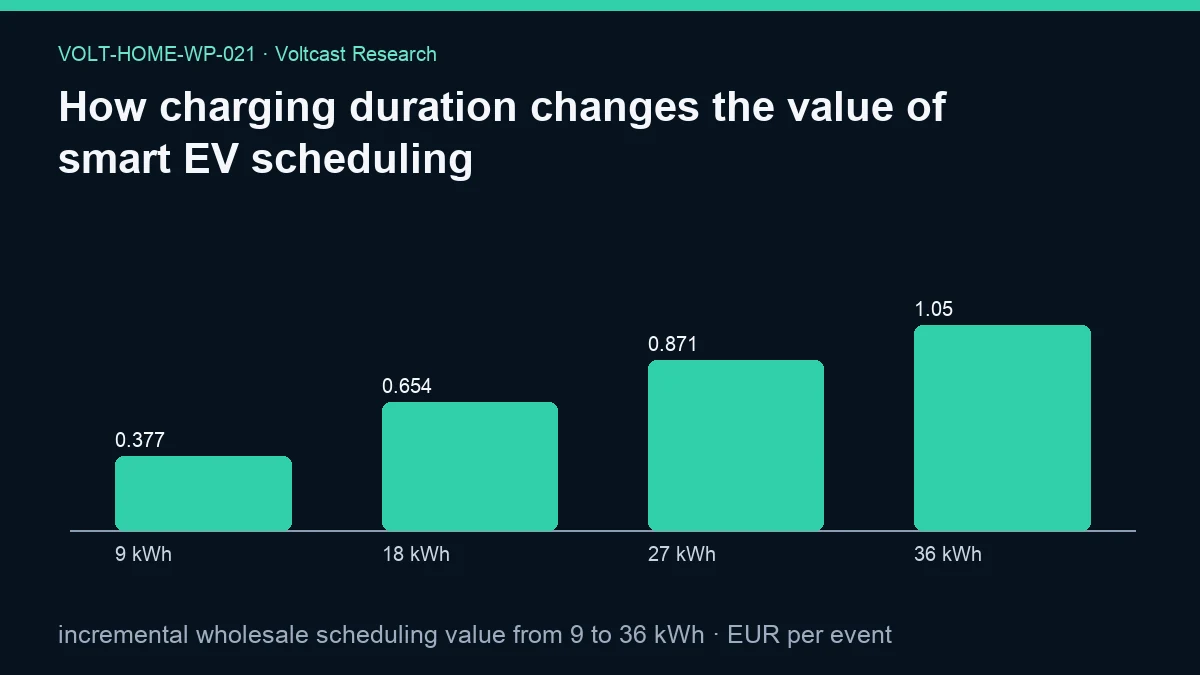
The measured primary result is an incremental wholesale scenario value of €0.6727354700726536 per event when the energy requirement moves from 9 kWh to 36 kWh. The sample size is 3,330. The sign is consistent with the mechanism encoded by the simulation: a larger event places more energy under the scheduling rule, so the gross difference between a mean-price reference and price-ranked charging can expand.
The result should not be read as saying every larger event has greater relative flexibility. As demand grows, the optimizer exhausts more of the cheapest section of the availability window. The result therefore combines two forces: more energy is available to shift, but each additional unit may be assigned to a less favorable ranked interval. The evidence’s own interpretation is that longer sessions change both gross and per-kWh value.
The regenerated evidence reports no interval for this estimand: bootstrap_95_interval is null and interval_method is “not reported for this estimand.” No confidence interval or uncertainty interpretation is therefore attached to the €0.6727354700726536 contrast. The figure publishes the scenario values directly: 9 kWh = 0.37703261748427463, 18 kWh = 0.653729955301065, 27 kWh = 0.8714531512867008, and 36 kWh = 1.0497680875569282 EUR per event.
Robustness and placebo checks
The central robustness feature is the within-curve scenario comparison. Every energy arm uses the same recorded price environment, local-time availability rule, charger power, and efficiency assumption. Changing only required energy prevents cross-zone tariff composition or different device assumptions from mechanically producing the contrast.
The sequence of 9 kWh, 18 kWh, 27 kWh, and 36 kWh provides a scenario-sensitivity path rather than a single arbitrary endpoint calculation. It allows the figure to reveal whether the relationship is smooth or dominated by an endpoint. The primary evidence nevertheless reports only the endpoint difference, so this paper does not invent unreported intermediate values.
There is no randomized placebo, causal intervention, or customer-level control in the evidence. The result is consequently described as a simulation contrast. The within-family multiplicity rule remains relevant if inferential claims are later made across the Smart EV charging papers, but this paper does not use the descriptive point estimate as a hypothesis-test result. The absence of an estimator-valid interval is preserved rather than filled with uncertainty from another quantity.
Limitations
The scenario excludes taxes, network charges, supplier margin, charger losses, battery losses, and tariff-specific transformations. Every euro amount in this paper is a wholesale scenario value. It is not an amount that can be transferred directly to a household account or used as a payback forecast.
Perfect charger efficiency is deliberately simplifying. Real delivery can be affected by conversion losses, standby consumption, temperature, battery state, and power tapering. The fixed 7.4 kW constraint also does not represent every vehicle or connection. The availability window of 17:00–07:00 is declared, not observed from drivers, and the event-energy arms are scenarios rather than a distribution of actual trips.
The mean-price reference across the availability window is a transparent benchmark, but it is not the only possible unscheduled behavior. A fixed start, immediate charging, a tariff timer, or a driver-specific habit would produce a different reference. The analysis also reports an aggregate across available zone-days. It does not publish zone-level or seasonal heterogeneity for this paper, so readers cannot infer that the aggregate applies uniformly across Europe.
Finally, the evidence does not report an interval for the transformed endpoint contrast. That prevents a defensible interval claim around €0.6727354700726536 from this evidence alone. The measured status means the descriptive aggregate exists; it does not remove these interpretation limits.
Practical implication
Controllers and comparative studies should treat requested energy as an explicit input, not a cosmetic scaling factor. If a scheduler is evaluated only on a small top-up, it may appear able to use only the best-priced intervals. A larger event can require a broader part of the curve, changing both total wholesale scenario value and the quality of the marginal interval. Reporting one result without the associated kWh requirement can therefore mislead even when the optimization itself is correct.
For automation design, the useful output is a feasible schedule tied to requested energy, available time, and charger power. The wholesale scenario result can inform which inputs deserve sensitivity testing. It cannot decide whether someone should buy a charger, switch tariff, delay travel, or expect a particular retail outcome. Those decisions require local tariffs, taxes, network charges, actual efficiency, vehicle limits, and behavior that are outside this evidence.
The result also argues for publishing curves or scenario grids where possible. A single headline average hides the saturation mechanism by which the cheapest intervals fill first. The figure’s 9 kWh through 36 kWh sequence is more informative than extrapolating linearly from one event size.
Reproducibility
Reproduction starts from the public evidence URL in the frontmatter. Verify the paper ID, slug, title, measured status, assumptions, data windows, primary metric, sample size, hashes, and figure metadata against that JSON. Confirm that the source registry entries listed below match the assigned source IDs exactly; they provide context and citation identity, not additional empirical inputs to the reported result.
The computational reproduction must use the snapshot identified by 7e97489fc8528c8cc8c38830e05b48d949ce1f67b98575dff26f5d7c321e4c67 and analysis code identified by 57c57de79cdab2b5b6d6c54c485cb5162598c5ba0b0bfe995da40d75e6c52ba9. Convert each timestamp to its zone timezone, retain intervals in the 17:00–07:00 window, rank them by price, and allocate 9 kWh, 18 kWh, 27 kWh, and 36 kWh subject to 7.4 kW and recorded interval duration. Compute the mean-price reference and price-ranked wholesale scenario cost for each arm, then subtract the 9 kWh mean wholesale scenario value from the 36 kWh mean.
An independent reproduction should return a sample size of 3,330 and the primary wholesale scenario value of €0.6727354700726536 per event. It should preserve missing or infeasible cases rather than silently filling them. It should report that no interval is available for this estimand. The current evidence and figure SHA-256 hashes are 1ffe47d592a78d36709f3af649f990f7e006f7fd29ff0341e1e01d2863100e63 and 7682d8534e8a1b10775b94061fcec6158b5b309a53418ca1ce4b883a4a69f258.
Disclosure
Analysis and drafting were model-assisted. The sources, code identity, assumptions, evidence URL, figure URL, and provenance hashes are disclosed. This is a public working paper with peer_reviewed: false; it is not peer reviewed.
The paper reports a synthetic wholesale scenario. It is not trading advice, investment advice, tariff advice, or a representation of realized driver behavior. The assigned references are reproduced from the source registry with their exact metadata. No external finding from those references is used to create or enlarge the empirical result.
References
nature-v1g-v2g-2026— Nature Energy. Coordinated planning of European charging infrastructure and energy system for optimal V1G and V2G deployment. Kind: peer-reviewed.applied-energy-smart-charging— Applied Energy. The value of smart charging at home and its impact on EV market shares. Kind: peer-reviewed.acer-retail-2025— ACER and CEER. Rewarding flexibility: How retail contract choice can help unlock consumer flexibility. Kind: official.iea-demand-flexibility— International Energy Agency. Scaling Up Demand Flexibility. Kind: official.ec-sdac-15m— European Commission. EU electricity trading in the day-ahead markets becomes more dynamic. Kind: official.