What does an earlier EV departure deadline cost?
What does an earlier EV departure deadline cost. A tighter departure deadline removes optional intervals and can raise minimum feasible cost.
Abstract
Departure time is a hard constraint in an EV charging schedule: energy delivered after the vehicle leaves is not useful. This paper compares the minimum wholesale scenario cost of an 18 kWh charging event when local availability ends at 07:00 with the corresponding cost when it ends at 05:00. Both scenarios begin at 17:00, use recorded day-ahead prices, assume perfect charger efficiency, and include wholesale energy only. Across a sample size of 3,338, moving the deadline from 07:00 to 05:00 raises the mean wholesale scenario value of cost by €0.00956492240862792 per event. The regenerated evidence reports no interval for this estimand. The effect is small on this declared scenario average, but its direction is mechanically meaningful: removing feasible intervals cannot improve the optimum when all other constraints remain fixed. The result is not a retail estimate and does not measure how actual drivers respond to earlier departures.
Plain-language answer
An earlier deadline gives the scheduler fewer intervals from which to choose. In this scenario, ending charging availability at 05:00 rather than 07:00 increases the average wholesale scenario value of cost by about €0.00956492240862792 for an 18 kWh event. Because bootstrap_95_interval is null and the interval method is “not reported for this estimand,” no uncertainty interval is claimed.
The small average should not be turned into a universal claim that departure time never matters. It describes the particular recorded curves in the frozen sample, the 17:00 start, the two declared deadlines, the 18 kWh requirement, and the optimizer used here. On many nights, the removed early-morning intervals may not have been selected anyway. On a night when they contain the cheapest feasible energy, the constraint can matter more. The result says the aggregate penalty is measurable under this setup; it does not provide the distribution by household, vehicle, zone, or season.
Research question
The research question is: how much additional wholesale scenario cost is created when an otherwise identical price-aware EV charging problem must complete by 05:00 instead of 07:00 local time?
This is a constraint-value question. The deadline does not itself consume energy or change market prices. It changes the feasible set. The full schedule can select from intervals beginning at or after 17:00 and before 07:00. The early-departure schedule can select from intervals beginning at or after 17:00 and before 05:00. If the optimum under the wider window already finishes without using the removed intervals, the wholesale scenario penalty is zero for that observation. If the wider optimum uses them, the tighter problem must substitute other available intervals and may pay a higher wholesale scenario cost.
The paper does not ask whether early-departing drivers have different energy needs or whether departure can be forecast. Those are separate behavioral and uncertainty questions. Here the deadline is known and the comparison isolates its opportunity cost.
Data and provenance
The evidence names day_ahead_prices, forecasts, forecast_accuracy, generation_mix, and zones as the source-table contract. Recorded price intervals and zone timezones are the direct inputs to this scheduling comparison. Forecast and generation tables belong to the registered family contract but are not used to claim forecast or carbon effects in this paper.
Three declared windows describe the frozen corpus: daily prices from 2021-01-01 through 2026-08-29, detailed intervals from 2025-10-01 through 2026-08-29, and long history from 2015-01-01 through 2026-08-29. The publication cutoff is 2026-08-30T00:00:00Z. The extraction was read-only and used a 180-second statement timeout.
The snapshot SHA-256 is 7e97489fc8528c8cc8c38830e05b48d949ce1f67b98575dff26f5d7c321e4c67. The registered protocol is identified by adb36bf6b447af9f96339249b8becaefc20422499cca1977242866347a97bd4b; the registry by 7bcb91d7476d0a69fe9fa75a5c7782f8117e0153f82f9112b7e1d307d3943717; the source registry by 07949550ac443ff673fda5c0209b99f137544f3ffecf6775f109bb9d09663bd6; and the analysis code by 57c57de79cdab2b5b6d6c54c485cb5162598c5ba0b0bfe995da40d75e6c52ba9. These hashes bind the prose to the public aggregate and prevent a later database refresh from silently changing the result.
Method
For each eligible zone-day, delivery timestamps are converted to the zone’s local timezone. The wider candidate set contains price intervals at or after 17:00 or before 07:00. The tighter candidate set contains intervals at or after 17:00 or before 05:00. Each set is sorted by price, and the scheduler allocates the 18 kWh requirement into the cheapest available intervals subject to a 7.4 kW power limit and each interval’s recorded duration.
The wholesale scenario cost of each allocation is calculated from energy delivered in an interval and that interval’s EUR/MWh day-ahead price. Perfect efficiency means the scenario does not add charger or battery losses. A candidate is retained only when both deadline variants can feasibly complete the 18 kWh requirement. The paired wholesale scenario penalty is the 05:00 optimum minus the 07:00 optimum for the same zone-day. The primary result is the mean of those paired penalties.
This paired design is important. Comparing unrelated days would mix deadline effects with different price levels and curve shapes. By solving both constraints against the same curve, the calculation attributes the difference to removal of the 05:00–07:00 portion of the feasible window within the model. That is still a simulation attribution, not a causal claim about drivers or markets.
The registered method family is constraint-aware charging simulation with paired schedule regret and scenario sensitivity. Within-family Holm control applies to inferential claims. The evidence characterizes this result as descriptive and makes no unadjusted significance claim.
Results
The mean increase in wholesale scenario cost is €0.00956492240862792 per 18 kWh event, based on 3,338 paired observations. The regenerated JSON reports no bootstrap interval for this estimand, so the paper makes no precision claim around that mean.
The positive sign means the tighter deadline is more expensive on average under the optimization assumptions. This is consistent with feasible-set nesting: every schedule that completes by 05:00 also completes by 07:00, while some schedules feasible by 07:00 are unavailable under the earlier deadline. The wider optimum therefore cannot have a higher minimum wholesale scenario cost than the tighter optimum when inputs are otherwise identical.
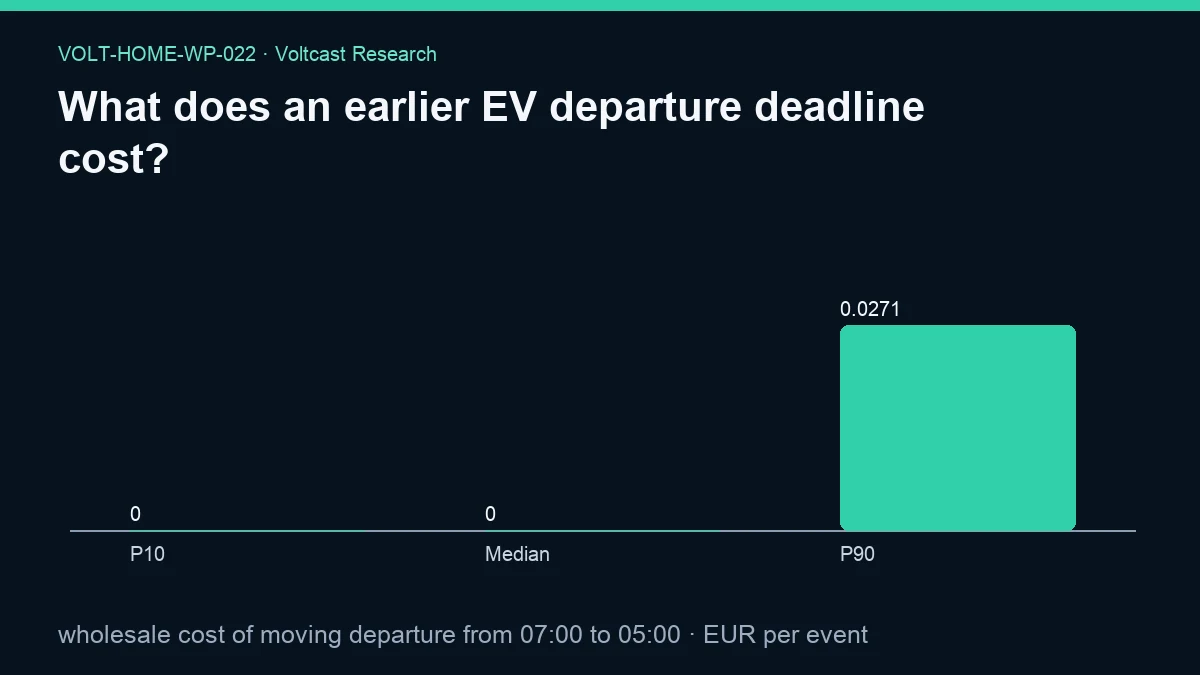
The result should be read at its actual magnitude and scope. It does not establish a meaningful retail effect, because the evidence excludes tariff transformations and non-energy charges. It also does not say the penalty is identical on every day. The figure publishes P10 = 0.0, median = 0.0, and P90 = 0.02711105000000003 EUR per event. Those distribution values are figure summaries, not an uncertainty interval for the mean.
Robustness and placebo checks
The strongest built-in control is the paired same-curve comparison. Price level, curve shape, timezone, energy requirement, charger power, and efficiency assumption are held fixed while only the departure boundary changes. This removes a large class of composition effects that would appear in an unpaired comparison.
The mathematical nesting of feasible sets provides a sign check. A negative penalty would indicate an implementation or comparability problem because adding intervals cannot make a minimum-cost solution worse. The measured positive aggregate passes that directional check. Requiring feasibility under both windows also avoids treating an incomplete event as a cheap schedule.
The evidence does not provide a behavioral placebo, alternative deadline grid, charger-loss sensitivity, or zone-stratified estimate. It also does not report an adjusted hypothesis-test result. Within-family Holm control is declared for inferential claims, while this result remains descriptive. Accordingly, robustness here means internal constraint consistency and paired calculation, not proof that every plausible charging environment yields the same magnitude.
Limitations
The model assumes an 18 kWh event, perfect charger efficiency, wholesale energy only, and availability beginning at 17:00. It excludes taxes, network charges, supplier margin, battery losses, connection-specific limits beyond the modeled charger power, and vehicle-specific charging taper. Every euro amount is a wholesale scenario value.
The two deadlines are scenarios. They are not drawn from a driver diary or telemetry distribution. The analysis therefore cannot estimate how common either departure is, whether users accurately communicate a deadline, or what happens when departure changes after a schedule has begun. It also assumes the complete price curve is available to the optimizer and does not model publication delays or revisions.
The mean can conceal nights on which the removed window has no value and nights on which it matters more. The figure publishes P10 = 0.0, median = 0.0, and P90 = 0.02711105000000003 EUR per event, but it does not provide zone, weekday, season, or price-regime breakdowns. Those omissions limit transfer from the aggregate to a particular location or routine.
Finally, a higher minimum wholesale scenario cost is not the same as inconvenience, welfare loss, or battery degradation. Those concepts require additional data and assumptions absent from the evidence.
Practical implication
A charging controller should treat departure as a hard feasibility input and allow it to be set explicitly. Defaulting every user to the same morning endpoint can create technically valid but operationally useless schedules. The result also shows why the value of extending a deadline should be measured rather than assumed: in this frozen scenario, the mean wholesale scenario difference between 05:00 and 07:00 is positive but small.
For evaluation, deadline comparisons should use the same price curve and energy requirement. Otherwise, an apparent deadline effect may simply reflect that different users charge on different days or in different zones. Controllers should also distinguish a declared deadline from an uncertain one; this paper treats the deadline as known, while uncertain arrival or departure requires a robust or adaptive policy.
No purchasing or tariff conclusion follows from €0.00956492240862792. A real decision would need retail price construction, efficiency, actual departure behavior, and device constraints. The useful implication is methodological: expose time-window assumptions beside every reported wholesale scenario value.
Reproducibility
Start with the evidence URL in the frontmatter and verify its paper ID, slug, title, measured status, assumptions, source tables, windows, primary result, interval, sample size, and figure metadata. Verify the assigned reference metadata against the source registry; the references provide registered context and are not used as sources of additional empirical numbers.
Use the snapshot hash 7e97489fc8528c8cc8c38830e05b48d949ce1f67b98575dff26f5d7c321e4c67 and analysis-code hash 57c57de79cdab2b5b6d6c54c485cb5162598c5ba0b0bfe995da40d75e6c52ba9. Convert prices to each zone’s local clock. Build the 17:00–07:00 and 17:00–05:00 candidate sets, solve the cheapest feasible 18 kWh allocation at 7.4 kW in each, and subtract wider-window cost from tighter-window cost.
Retain only paired feasible observations. The independent aggregate should contain 3,338 observations and return €0.00956492240862792 per event, with no interval reported for this estimand. Missing data or infeasible schedules must not be replaced with zero. The current evidence and figure SHA-256 hashes are b49bc2a597dbe91b8914d1794e1cd8aab567490e8b17b7fc2fa6f317bfd72692 and dc1a408383e0f0c19684b9b13e92bf6ae7b58c1b89a355da4ef42d7d4b42c879.
Disclosure
Analysis and drafting were model-assisted; sources, code identity, assumptions, and evidence hashes are disclosed. This is a public working paper, is not peer reviewed, and carries peer_reviewed: false.
It is not trading advice, investment advice, tariff advice, or a prediction of driver behavior. All monetary results are wholesale scenario values. The assigned references are reproduced using exact source-registry metadata, and no external findings have been introduced.
References
nature-v1g-v2g-2026— Nature Energy. Coordinated planning of European charging infrastructure and energy system for optimal V1G and V2G deployment. Kind: peer-reviewed.applied-energy-smart-charging— Applied Energy. The value of smart charging at home and its impact on EV market shares. Kind: peer-reviewed.acer-retail-2025— ACER and CEER. Rewarding flexibility: How retail contract choice can help unlock consumer flexibility. Kind: official.iea-demand-flexibility— International Energy Agency. Scaling Up Demand Flexibility. Kind: official.ec-sdac-15m— European Commission. EU electricity trading in the day-ahead markets becomes more dynamic. Kind: official.