How forecast uncertainty changes a preheating decision
How forecast uncertainty changes a preheating decision. The ratio bounds how often forecast noise could overwhelm the daily thermal-shift signal.
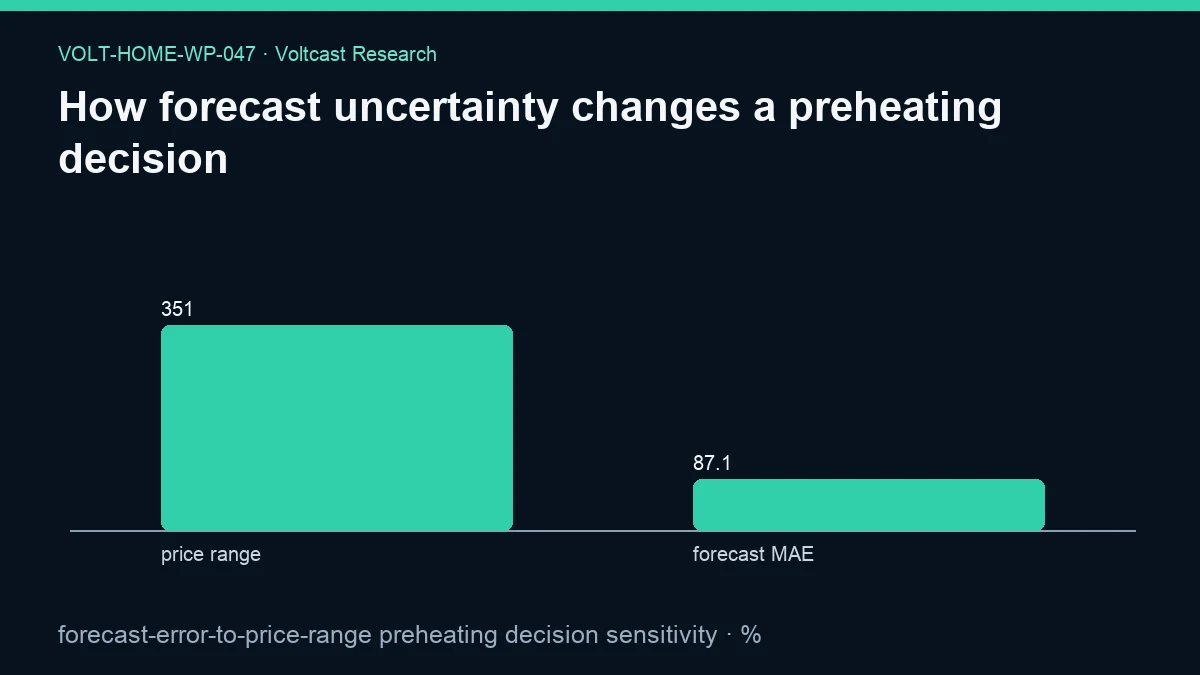
How forecast uncertainty changes a preheating decision
Abstract
Preheating decisions depend on forecast prices, so forecast error can erase an apparent cheap-versus-expensive interval contrast. This working paper compares the mean absolute error of lineage-matched forecast records with the observed mean daily day-ahead price range in the frozen heat-pump evidence panel. The mean price range is 350.516569 EUR/MWh and the corresponding mean lineage-matched forecast MAE is 87.141379 EUR/MWh. Their ratio is 24.860844291250885%, the registered primary result, based on 17,750 forecast-accuracy rows with non-null MAE and matched serving lineage. No uncertainty interval is reported for this estimand. The 24.86% result is a relative error scale, not an observed probability that one quarter of preheating decisions flip. No interval-level heating schedule or counterfactual decision was executed. The result says that forecast error is material relative to the available daily price range and should be incorporated into control margins. The reduced-order synthetic scenarios are not building simulations, customer telemetry, savings claims, or retail bills.
Plain-language answer
The forecast error scale is about one quarter of the observed daily wholesale price-range scale. In round numbers, the analysis compares a mean MAE of 87.14 EUR/MWh with a mean daily range of 350.52 EUR/MWh, giving 24.86%.
That does not mean exactly 24.86% of preheating choices were wrong. The study does not replay choices interval by interval. It means a forecast’s typical absolute error is large enough to matter when deciding whether a predicted discount is real. A cautious controller should require a price advantage that exceeds an uncertainty margin and should avoid aggressive preheating when candidate intervals are close. The Energy and Buildings study gives assigned context for price-sensitive thermal flexibility, while the Nordic cost–comfort study gives assigned context for preserving comfort when uncertainty changes the economic ranking.
Research question
The registered question asks how forecast uncertainty changes a preheating decision. We operationalise uncertainty as recorded mean absolute error from forecast-accuracy rows that are explicitly matched to serving lineage. We compare that error scale with the observed mean daily wholesale price range.
The primary outcome is a screening ratio, not a decision-regret backtest. The analysis does not identify which forecasted interval a controller selected, whether preheating occurred, or whether indoor comfort was maintained. It asks whether forecast error is small or large relative to the price variation that motivates load shifting. The registered method family remains a transparent reduced-order thermal scenario, and no trading claim is permitted.
Data and provenance
The evidence has a publication cutoff of 2026-08-30T00:00:00Z. It declares daily-price coverage from 2021-01-01 through 2026-08-29, detailed intervals from 2025-10-01 through 2026-08-29, and long-history coverage from 2015-01-01 through 2026-08-29. The registered source-table contract is day_ahead_prices, zone_temp_weighted, zone_load, generation_mix, and forecasts.
The denominator comes from daily price summaries paired with non-null population-weighted temperature context, whose mean maximum-minus-minimum price range is 350.51656949725395 EUR/MWh. The numerator comes from 17,750 forecast-accuracy rows with a non-null mae and a true lineage-matched flag. The lineage filter matters: it avoids treating an accuracy row from a model that was not the relevant served lineage as though it informed the same decision context.
The analysis was SELECT-only with a 180-second statement timeout. The snapshot SHA-256 is 7e97489fc8528c8cc8c38830e05b48d949ce1f67b98575dff26f5d7c321e4c67; analysis-code SHA-256 is 57c57de79cdab2b5b6d6c54c485cb5162598c5ba0b0bfe995da40d75e6c52ba9; protocol SHA-256 is adb36bf6b447af9f96339249b8becaefc20422499cca1977242866347a97bd4b; registry SHA-256 is 7bcb91d7476d0a69fe9fa75a5c7782f8117e0153f82f9112b7e1d307d3943717; and source-registry SHA-256 is 07949550ac443ff673fda5c0209b99f137544f3ffecf6775f109bb9d09663bd6. The evidence and figure hashes are aa2af5a586d696f848a26678d7cf894ce1c4ca37157c90875e4680b16a9b26f3 and 167cbe7ef357bd7d9da5876e567d544264d1adb057e5203a450ec836b2863df6.
The dynamic-tariff viability source supplies assigned context for household energy management and tariff economics. ACER and CEER and the registered European Commission communication supply contract and policy context. They do not contribute forecast errors or preheating outcomes to the calculation.
Method
The analysis selects every forecast record whose mae is non-null and whose serving-lineage match is true. It takes the arithmetic mean of those MAE values. Separately, it calculates the arithmetic mean of daily max_price - min_price values in the matched thermal-context panel.
The registered sensitivity is 100 × mean(forecast MAE) / max(mean(daily price range), 1), capped at 100%. The denominator floor protects against division by a near-zero range, and the cap prevents a displayed value above 100. Neither guard binds here. Substituting the frozen values gives 100 × 87.1413785577465 / 350.51656949725395 = 24.860844291250885%.
The assumptions are synthetic heat demand, no customer telemetry, COP sensitivity declared per paper, and wholesale energy only. No COP is used in the ratio. No thermal inertia duration, comfort band, network charge, tax, supplier margin, or household energy amount is modelled.
The regenerated evidence reports no uncertainty interval and names the interval method as “not reported for this estimand.” It therefore provides no interval for the mean error scale, the ratio, or decision-flip frequency. Within-family Holm control applies to inferential claims; this descriptive result makes no unadjusted significance claim.
Results
The forecast-error-to-price-range preheating sensitivity is 24.860844291250885%. The underlying mean price range is 350.51656949725395 EUR/MWh, and the derived mean forecast MAE is 87.1413785577465 EUR/MWh. The forecast-error sample contains 17,750 lineage-matched rows.
The evidence records no interval for the forecast-error input or the ratio. This paper therefore does not manufacture ratio bounds or a decision-flip probability from stale analysis output.
The result establishes that forecast error is not negligible relative to the market signal used to justify preheating. It does not establish that a forecast-aware controller performs worse than a simple controller, or that 24.86% of decisions reverse. No decision count, schedule regret, comfort violation, or realised heating cost appears in the evidence.
Robustness and placebo checks
The strongest integrity control is serving-lineage matching. It prevents a retrospective analyst from selecting accuracy rows from a model that was not tied to the relevant serving record. This reduces survivorship and model-substitution risk in the numerator.
No bootstrap interval is reported for the 17,750 error observations. The denominator floor and 100% cap are explicit implementation guards. Neither changes the observed result, which is useful as a mechanical robustness check, but neither supplies uncertainty.
There is no decision-level placebo. The study does not compare forecast-aware preheating with no preheating, perfect foresight, persistence, randomized prices, or a comfort-first thermostat. It also does not stratify by forecast horizon, zone, season, or price-spread quartile in this paper. Those checks were not run and are not represented as passed.
Within-family Holm control applies if inferential claims are later made. Here, the ratio is descriptive. A future causal or operational test would need to freeze candidate schedules before prices realise, record the selected and fallback actions, and compare realised complete-tariff cost and comfort. That is outside the evidence.
Limitations
MAE is an average magnitude, not a directional uncertainty distribution. A controller needs joint errors across intervals because a common upward or downward shift may preserve the ranking, while a smaller relative error can swap two close intervals. The ratio cannot distinguish those cases.
The numerator and denominator are aggregates from related but not necessarily one-to-one matched decision records. The design does not pair each forecast error with the exact day, zone, horizon, and heating choice whose price range it might affect. Therefore, the ratio is a scale comparison rather than realised regret.
Daily temperature and price summaries cannot reproduce a building-specific thermal state. The model contains no comfort trajectory, heat demand, COP curve, compressor limit, or rebound. Wholesale energy excludes network charges, taxes, VAT, supplier margin, and fixed components, all of which can alter the decision margin.
The reduced-order synthetic scenarios are not building simulations, customer telemetry, savings claims, or retail bills. The 24.86% figure is not a service-level guarantee, error probability, savings haircut, or recommended reserve margin. It cannot be used to claim that forecast-aware heating saves money.
Practical implication
A controller should use uncertainty-aware decision rules. For example, it can require the predicted complete-tariff advantage to exceed a conservative error margin before preheating, retain a comfort-first fallback, and reduce shifting when forecast lineage or freshness is missing. It should explain when two candidate intervals are effectively tied.
The ratio also suggests that deterministic “pick the cheapest forecast interval” logic is too brittle for close calls. Probabilistic prices, scenario comparison, or robust optimisation can be more honest, provided they are validated prospectively. Contract choice remains important because uncertainty should be assessed against the price the household actually pays, not wholesale alone.
Reproducibility
The canonical evidence is /research-data/home-papers/how-forecast-uncertainty-changes-a-preheating-decision.json; the matching figure is /research-media/home-papers/how-forecast-uncertainty-changes-a-preheating-decision.webp. The JSON freezes the lineage requirement, sample size, primary value, explicit null interval, assumptions, table contract, data windows, interpretation, limitations, and provenance hashes.
To reproduce the numerator, select forecast records with non-null MAE and matched serving lineage and take their mean. To reproduce the denominator, calculate daily maximum-minus-minimum day-ahead prices in the matched temperature-price panel and take their mean. Apply the registered percentage formula, denominator floor, and cap. Preserve the publication cutoff and hashes. A horizon-stratified or decision-matched ratio is a new analysis.
Licensing and attribution details are documented at /legal/data-licensing and Voltcast data licensing and redistribution. Reproduction should preserve the distinction between a forecast-error scale and an observed decision-flip rate.
Disclosure
Analysis and drafting were model-assisted; sources, code, assumptions, and evidence hashes are disclosed. This working paper is not peer reviewed. It makes no trading claim and is not trading advice. Volt has no live traders or live capital. The paper is not a forecast warranty, retail recommendation, or instruction to override heating safety and comfort controls.
References
- Energy and Buildings. “Assessment of the thermal energy flexibility of residential buildings with heat pumps under various electric tariff designs.” https://doi.org/10.1016/j.enbuild.2023.113257
- Energies. “Exploring Cost–Comfort Trade-Off in Implicit Demand Response for Fully Electric Solar-Powered Nordic Households.” https://doi.org/10.3390/en18215568
- ACER and CEER. “Rewarding flexibility: How retail contract choice can help unlock consumer flexibility.” https://www.ceer.eu/wp-content/uploads/2025/11/ACER-CEER-2025-Retail-monitoring.pdf
- European Commission. “Communication from the Commission on the Citizens Energy Package.” https://eur-lex.europa.eu/legal-content/EN/TXT/?uri=CELEX%3A52026DC0115
- Advances in Applied Energy. “Assessing the conditions for economic viability of dynamic electricity retail tariffs for households.” https://doi.org/10.1016/j.adapen.2024.100174