Is domestic hot water more flexible than space heating?
Is domestic hot water more flexible than space heating. Separate storage and comfort constraints make domestic hot water more shiftable in this declared scenario.
Is domestic hot water more flexible than space heating?
Abstract
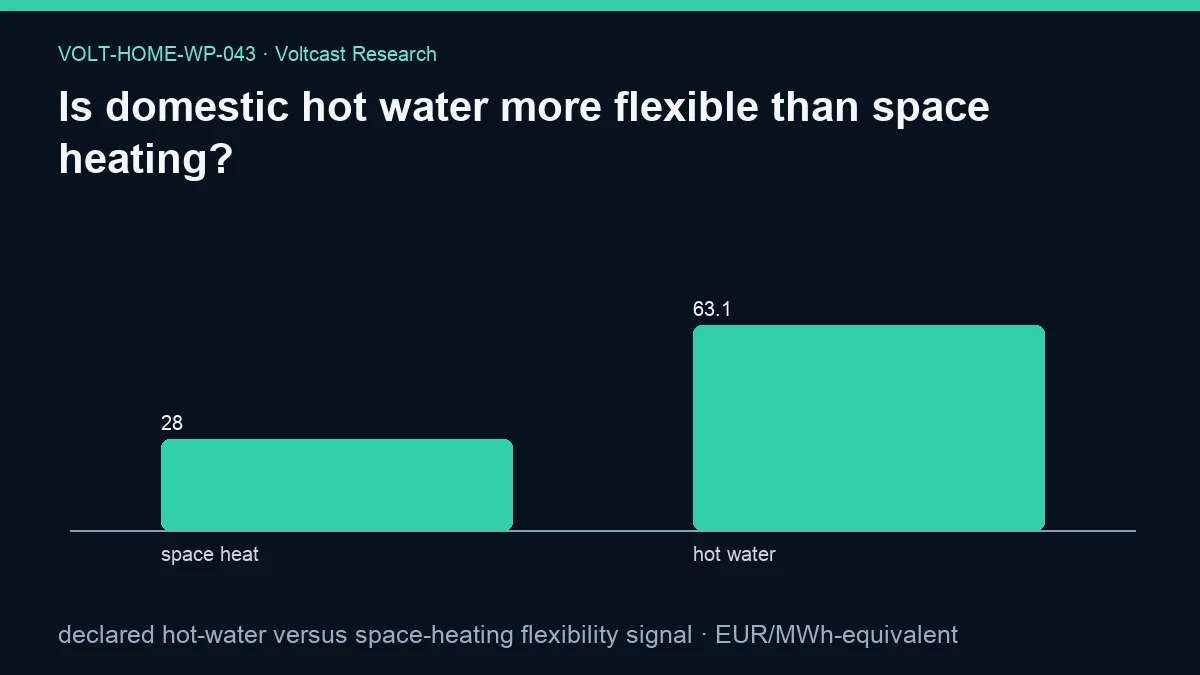
Domestic hot water and space heating have different physical and comfort constraints, but this working paper does not pretend to model those systems in detail. It asks what follows when two explicit shiftable-share assumptions are applied to the same observed daily wholesale price ranges. The frozen scenario assigns an 18% shiftable share to hot water and an 8% shiftable share to space heating. Across 2,367 matched temperature-price observations, the corresponding mean signals are 63.092983 and 28.041326 EUR/MWh-equivalent. Their difference, 35.05165694972539 EUR/MWh-equivalent, is the registered primary result. The ordering is caused by the declared 18%-versus-8% assumptions; it is not an empirical estimate of household appliance flexibility. No uncertainty interval is reported for this estimand. The result supports a design principle—model hot-water storage separately from room comfort—but not a general claim that every hot-water system is more flexible. The reduced-order synthetic scenarios are not building simulations, customer telemetry, savings claims, or retail bills.
Plain-language answer
In this declared scenario, yes: domestic hot water has the larger flexibility signal because 18% of its energy is assumed shiftable, compared with 8% for space heating. Against the same mean price range, those shares produce 63.09 and 28.04 EUR/MWh-equivalent, respectively. The gap is 35.05.
That is a conditional answer, not a measured fact about homes. A well-insulated hot-water cylinder with adequate volume may decouple heating time from draw time. Space heating may be more tightly bound by indoor comfort and outdoor losses. But a small cylinder, hygiene cycle, high hot-water use, or an unusually thermally massive building can change the ordering. The Energy and Buildings paper is relevant context for building thermal flexibility, and the Nordic cost–comfort paper is relevant context for treating comfort explicitly. Voltcast’s measured number comes only from the declared shares and frozen price panel.
Research question
The registered question is whether domestic hot water is more flexible than space heating. We make “more flexible” measurable as a larger share of energy exposed to the observed daily wholesale price range under two predeclared scenario coefficients: 18% for hot water and 8% for space heating.
The comparison is intentionally transparent. It does not estimate tank capacity, standing losses, draw profiles, legionella-prevention cycles, room-temperature response, weather compensation, or heat-pump power. It also does not infer behaviour from smart-home users. Its purpose is to show the consequence of separating two thermal services instead of treating all heating energy as one interchangeable load. The paper belongs to the registered “Heat pumps and thermal storage” cluster and makes no trading claim.
Data and provenance
The public evidence freezes a publication cutoff at 2026-08-30T00:00:00Z. Its declared windows are 2021-01-01 to 2026-08-29 for daily prices, 2025-10-01 to 2026-08-29 for detailed intervals, and 2015-01-01 to 2026-08-29 for long history. The family-level source tables are day_ahead_prices, zone_temp_weighted, zone_load, generation_mix, and forecasts.
The calculation uses the 2,367 daily observations for which a day-ahead price summary is paired with a non-null population-weighted zone temperature. For each matched row, the underlying market quantity is the day’s maximum price minus its minimum price. The observed mean of that daily range is 350.51656949725395 EUR/MWh. No customer meter, thermostat, hot-water draw, or indoor-temperature record is present.
The evidence was produced through a read-only transaction with a 180-second statement timeout. Its frozen snapshot SHA-256 is 7e97489fc8528c8cc8c38830e05b48d949ce1f67b98575dff26f5d7c321e4c67; analysis-code SHA-256 is 57c57de79cdab2b5b6d6c54c485cb5162598c5ba0b0bfe995da40d75e6c52ba9; protocol SHA-256 is adb36bf6b447af9f96339249b8becaefc20422499cca1977242866347a97bd4b; registry SHA-256 is 7bcb91d7476d0a69fe9fa75a5c7782f8117e0153f82f9112b7e1d307d3943717; and source-registry SHA-256 is 07949550ac443ff673fda5c0209b99f137544f3ffecf6775f109bb9d09663bd6. The evidence and figure hashes are 1277f07353001b4334a8e0cb96ce2f3115f5c5b3cfd45cf38c038b1ff5aa964a and 243dd1acec79b1edffed6a20a81a0ccaefe887e0f9c3492352eeec5fdaa2bee8.
The assigned sources provide the research and policy setting. ACER and CEER discuss retail contract choice and consumer flexibility. The registered European Commission communication concerns retail prices and flexibility. The dynamic-tariff viability paper addresses conditions under which household flexibility can be economic. Their numerical findings are not copied into this scenario.
Method
Let (R) be the observed daily day-ahead price range. The hot-water signal is defined as (0.18R), and the space-heating signal is (0.08R). The primary metric is their difference, (0.10R), evaluated at the mean of the 2,367 daily ranges.
That gives 350.516569 multiplied by 0.18 for hot water and by 0.08 for space heat. The method has no hidden optimizer: the result follows directly from the input range and the two assumptions. “Hot-water shiftable share 18%; space-heating share 8%” is preserved exactly from the evidence. The common assumptions are synthetic heat demand, no customer telemetry, COP sensitivity declared per paper, and wholesale energy only.
No COP value is applied in this paper, so both services are compared on the same price-range basis rather than converted into electrical consumption for a particular heat pump. No energy quantity is specified, and EUR/MWh-equivalent must not be read as euros saved by a household. Taxes, network charges, supplier margins, fixed charges, VAT, equipment losses, and retail tariff terms are excluded.
The regenerated evidence stores no uncertainty interval and names the interval method as “not reported for this estimand.” Since the two service signals are deterministic multiples of the mean range, no stale interval for the underlying range may be relabelled as an interval for the 35.051657 difference. The analysis is descriptive; within-family Holm control applies to inferential claims, and no unadjusted significance claim is made.
Results
The declared hot-water signal is 63.09298250950571 EUR/MWh-equivalent. The declared space-heating signal is 28.04132555978032 EUR/MWh-equivalent. Subtracting the latter from the former gives the primary result of 35.05165694972539 EUR/MWh-equivalent.
The hot-water value is 2.25 times the space-heating value because 18% is 2.25 times 8%. That ratio is entirely assumption-driven. Likewise, the difference is exactly 10% of the observed mean daily price range. These identities make the result auditable and also sharply limit what may be inferred from it.
The sample size is 2,367 matched zone-days. The evidence reports no interval, so it does not quantify sampling variation in the market input or uncertainty in actual tank or building flexibility. The proper conclusion is conditional: if hot water can shift 18% and space heating only 8%, then hot water has the larger market signal by 35.05 EUR/MWh-equivalent in this panel.
Robustness and placebo checks
The clearest robustness check is the common-input design. Both thermal services use the same daily price ranges, so the comparison cannot be attributed to different dates, zones, or price samples. The only distinction is the declared shiftable share. This isolates the consequence of the assumption but does not validate the assumption.
An equality placebo follows directly: if both shares were set to the same value, the difference would be zero. That confirms that the implementation is a share comparison rather than a hidden preference for hot water. A reversed-share placebo would reverse the result. These are algebraic checks, not observed counterfactual households, and the frozen evidence does not report separate placebo estimates.
No bootstrap interval is reported. There is no customer-level resampling, no randomised tariff assignment, and no causal test of hot-water behaviour. The within-family Holm statement is retained for governance, but no p-value is used. Robustness to storage losses, hygiene constraints, occupancy, and weather is not measured. Those missing checks are reasons to keep the result scenario-bound, not reasons to imply that they passed.
Limitations
Domestic hot water is not intrinsically flexible. Its useful flexibility depends on tank volume, starting temperature, draw timing, heat loss, reheating power, minimum safe temperatures, and user needs. Space-heating flexibility depends on envelope performance, thermal mass, emitter characteristics, outdoor temperature, solar gains, occupancy, and comfort limits. None of these variables is estimated here.
The 18% and 8% shares are declared scenario inputs. They are not distributions measured from customer telemetry, and they should not be transferred to a specific household. Daily price extrema may also occur at times when neither service can feasibly consume.
The result is wholesale-only. Retail bills include other variable and fixed components. A network time-of-use charge can narrow or reverse the apparent wholesale opportunity. A dynamic tariff can also expose households to risk, which is why the ACER/CEER and European Commission sources are relevant context and why the full tariff must be modelled before action.
The reduced-order synthetic scenarios are not building simulations, customer telemetry, savings claims, or retail bills. The figures cannot be multiplied by annual hot-water or space-heating demand to claim monetary savings. No conclusion about health, comfort, equipment life, or optimal cylinder control is supported.
Practical implication
Home-energy systems should represent domestic hot water and space heating as separate services. Each should have its own safe temperature range, deadline, storage state, power limit, and fallback. Combining them into one “heating” load can overstate flexibility and obscure which comfort or hygiene constraint is being used.
The declared comparison suggests a useful priority for measurement: estimate the actually shiftable hot-water share and space-heating share from the home’s own response before optimising. If hot water has more decoupled storage, it may be the less intrusive source of flexibility. If it does not, the controller should not force the registry’s 18% assumption onto the home.
Reproducibility
The canonical evidence is /research-data/home-papers/is-domestic-hot-water-more-flexible-than-space-heating.json. The matching figure is /research-media/home-papers/is-domestic-hot-water-more-flexible-than-space-heating.webp. The evidence JSON records all assumptions, the three data windows, source tables, status, primary metric, sample size, explicit null interval, interpretation, disclosure, and provenance hashes.
To reproduce the values, join daily price summaries to available population-weighted zone temperatures by zone and day. Compute each daily max_price - min_price, then take the arithmetic mean across 2,367 rows. Multiply that mean by 0.08 and 0.18. Subtract the 8% result from the 18% result. Keep the original cutoff and snapshot hash. Changing the shares, adding a COP model, or applying a household demand quantity produces a new scenario and must not be presented as reproduction.
The evidence points to /legal/data-licensing and Voltcast data licensing and redistribution for source conditions. Any reuse should retain the distinction between aggregate market evidence and unobserved household behaviour.
Disclosure
Analysis and drafting were model-assisted; sources, code, assumptions, and evidence hashes are disclosed. The paper is not peer reviewed. It is not trading advice, contains no trading claim, and does not authorize equipment control. Volt has no live traders or live capital. The two flexibility shares are explicit analytical assumptions, not recommendations or measured customer facts.
References
- Energy and Buildings. “Assessment of the thermal energy flexibility of residential buildings with heat pumps under various electric tariff designs.” https://doi.org/10.1016/j.enbuild.2023.113257
- Energies. “Exploring Cost–Comfort Trade-Off in Implicit Demand Response for Fully Electric Solar-Powered Nordic Households.” https://doi.org/10.3390/en18215568
- ACER and CEER. “Rewarding flexibility: How retail contract choice can help unlock consumer flexibility.” https://www.ceer.eu/wp-content/uploads/2025/11/ACER-CEER-2025-Retail-monitoring.pdf
- European Commission. “Communication from the Commission on the Citizens Energy Package.” https://eur-lex.europa.eu/legal-content/EN/TXT/?uri=CELEX%3A52026DC0115
- Advances in Applied Energy. “Assessing the conditions for economic viability of dynamic electricity retail tariffs for households.” https://doi.org/10.1016/j.adapen.2024.100174