Should an EV charge for the lowest price or the lowest carbon?
Should an EV charge for the lowest price or the lowest carbon. Daily generation is too coarse to identify the cleanest interval; this reports alignment, not an interval carbon optimum.
Abstract
Low wholesale price and low operational carbon are different objectives. This paper tests whether days with more price-scheduling value also tend to have a higher daily operational low-carbon generation share. The frozen charging scenario uses an 18 kWh event, wholesale energy only, perfect charger efficiency, and local availability from 17:00 to 07:00. Across 3,329 paired observations, the Pearson correlation between wholesale price-scheduling value and daily low-carbon share is 0.05135286473407647. This is a weak positive descriptive association, not evidence that the cheapest interval is the cleanest. Daily generation is too coarse to identify an interval carbon optimum. The regenerated evidence reports no interval for this estimand, so no uncertainty claim is made for Pearson r. The study therefore does not choose one objective; it shows that price optimization cannot be treated as a reliable carbon optimizer from this evidence.
Plain-language answer
The evidence does not support treating “cheapest” and “cleanest” as interchangeable. The observed association is Pearson r = 0.05135286473407647, which is positive but weak. It concerns differences between days: days with more wholesale price-scheduling value were only weakly associated with a higher daily low-carbon generation share.
The carbon input is a daily proxy. It cannot tell which quarter-hour inside an overnight window had the lowest operational carbon. A price-aware schedule selects intervals, while this paper pairs that monetary scheduling result with one generation-share value for the day. Consequently, the result can describe broad alignment but cannot determine whether a particular selected interval reduced operational emissions.
The practical answer is to keep objectives separate. A controller optimized for wholesale scenario value should be labeled price-aware. A carbon-aware claim needs interval-matched carbon evidence that is not present here.
Research question
The question is: across observed zone-days, how strongly is the wholesale scenario value of price-aware EV scheduling associated with the daily operational low-carbon share of generation?
The estimand is Pearson correlation, not a monetary contrast and not a causal effect. The price side compares a habitual evening reference with the cheapest feasible schedule for an 18 kWh event within the declared 17:00–07:00 window. The carbon side is the share of non-negative generation assigned to the evidence’s declared low-carbon production categories, aggregated by day.
This design asks whether day-level conditions align. It does not compare a price-optimal interval schedule with a carbon-optimal interval schedule. The paper title is therefore answered as an objective-design question rather than a winner-takes-all recommendation.
Data and provenance
The evidence binds the paper to day_ahead_prices, forecasts, forecast_accuracy, generation_mix, and zones. Price intervals, zone timezones, and daily generation by production type support the measured association. Forecast tables are part of the registered family contract but are not used to make a forecast claim here.
The daily-price window is 2021-01-01 through 2026-08-29, detailed intervals span 2025-10-01 through 2026-08-29, and long history spans 2015-01-01 through 2026-08-29. The publication cutoff is 2026-08-30T00:00:00Z. The snapshot was extracted read-only with a 180-second statement timeout.
Snapshot SHA-256 is 7e97489fc8528c8cc8c38830e05b48d949ce1f67b98575dff26f5d7c321e4c67. Protocol, registry, source-registry, and analysis-code hashes are adb36bf6b447af9f96339249b8becaefc20422499cca1977242866347a97bd4b, 7bcb91d7476d0a69fe9fa75a5c7782f8117e0153f82f9112b7e1d307d3943717, 07949550ac443ff673fda5c0209b99f137544f3ffecf6775f109bb9d09663bd6, and 57c57de79cdab2b5b6d6c54c485cb5162598c5ba0b0bfe995da40d75e6c52ba9.
Method
For each eligible zone-day, timestamps are converted to the zone timezone. The price-aware schedule selects the cheapest intervals at 7.4 kW needed to deliver 18 kWh between 17:00 and 07:00. Its wholesale scenario cost is compared with a reference formed from the mean recorded price between 18:00 and 24:00 multiplied by 18 kWh. Reference minus optimized cost is the day’s wholesale price-scheduling value.
Daily generation rows are grouped by zone and UTC date. Negative generation values are floored at zero. The low-carbon numerator sums generation in the analysis’s registered low-carbon production categories; the denominator sums generation across all available categories. The resulting fraction is the daily operational low-carbon share proxy.
Zone-days with finite values on both sides are paired. Pearson r is calculated from deviations around the two sample means and normalized by their joint dispersion. The primary result is the correlation across 3,329 pairs.
This is an observational association. No intervention assigns generation mix or prices, and no confounder adjustment is claimed. The registered method family is constraint-aware charging simulation with paired schedule regret and scenario sensitivity. Holm control applies to inferential family claims, while this result is descriptive and makes no unadjusted significance claim.
Results
The measured Pearson correlation is 0.05135286473407647 across 3,329 paired observations. The sign is positive, but the magnitude indicates only weak day-level co-movement between wholesale price-scheduling value and the daily low-carbon share proxy.
The evidence explicitly warns that daily generation is too coarse to identify the cleanest interval. The result therefore cannot say whether the intervals chosen by the price optimizer have lower operational carbon than alternatives. It also cannot establish whether changing a charging schedule changes generation or emissions.
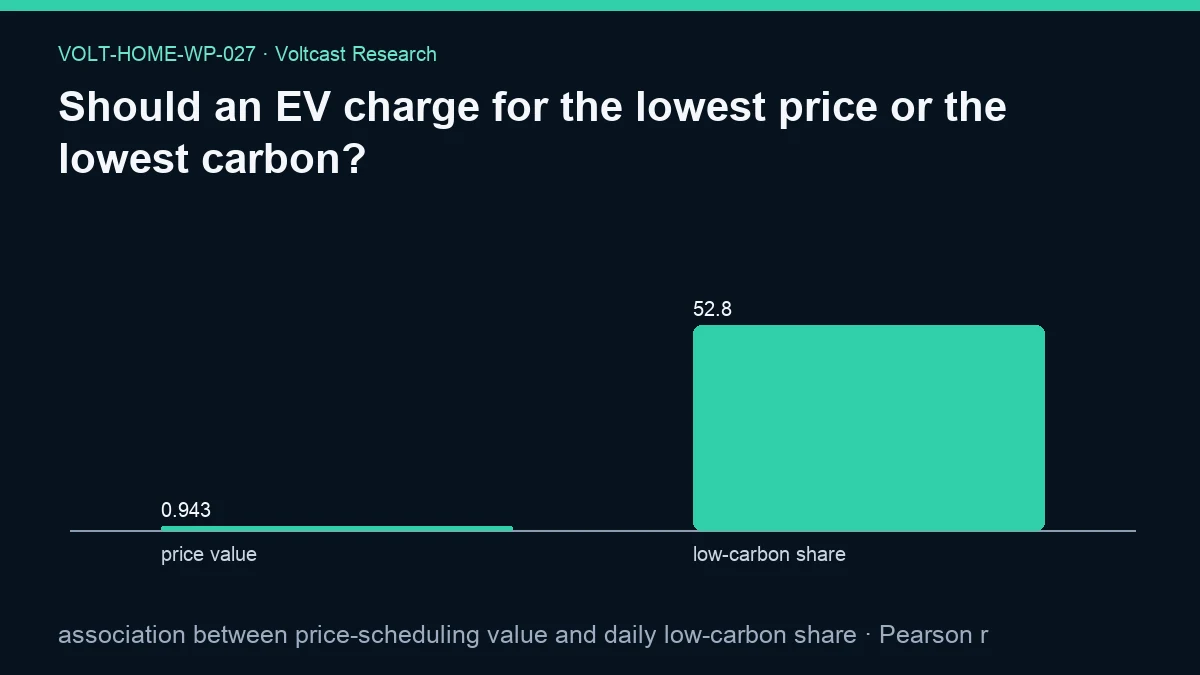
The JSON reports bootstrap_95_interval: null and “not reported for this estimand” as the interval method. The paper therefore makes no confidence-interval claim for the correlation. The figure values are price value = 0.9427491540502653 and low-carbon share = 52.77016333684911; they are differently scaled descriptive figure inputs and are not the reported Pearson r.
Robustness and placebo checks
The pairing requires both a price-scheduling observation and a generation-share observation for the same key. That is stronger than correlating unrelated aggregate series. The use of Pearson r is transparent and symmetric, and the descriptive interpretation avoids causal overreach.
The principal falsification is conceptual: a day-level carbon proxy cannot validate interval-level carbon optimality. Rather than treating the weak positive sign as proof, the paper preserves this resolution mismatch as a limit. The absence of an estimator-valid interval is likewise preserved instead of being filled from another quantity.
No lag test, seasonal stratification, alternative carbon-factor model, marginal-emissions estimate, or interval-matched placebo appears in the evidence. No significance claim is made. Within-family Holm control remains the declared guardrail if inferential extensions are later registered.
A stronger same-resolution control would compare price-ranked and carbon-ranked candidate intervals inside the identical 17:00–07:00 window. It would hold delivered energy and charger power constant, then report both wholesale scenario cost and the chosen carbon measure. That calculation is not present, so it is described only as a future evidentiary requirement, not as an unreported result.
The weak aggregate sign is also not used as a directional guarantee. If a subgroup has a different generation mix or price-formation regime, its relationship could differ from the pooled estimate. The public evidence contains no registered subgroup values with which to test that possibility.
Limitations
Carbon is represented only by a daily operational low-carbon generation-share proxy. It is not interval carbon intensity, marginal emissions, lifecycle emissions, imports-adjusted consumption, or causal displacement. The analysis cannot rank individual charging intervals by carbon.
The monetary side assumes 18 kWh, perfect efficiency, wholesale energy only, and 17:00–07:00 availability. Synthetic charging scenarios are not customer bills and exclude taxes, network charges, supplier margin, and battery losses. Every euro amount involved in constructing the correlation is a wholesale scenario value.
Correlation does not identify cause. Both price opportunities and generation mix may move with weather, load, season, outages, and cross-border conditions. The evidence does not adjust for them. UTC-date generation pairing and local-time charging windows can also differ at date boundaries.
The aggregate gives no zone-specific relationship, and no uncertainty interval is reported for Pearson r. A weak aggregate correlation can coexist with stronger positive or negative relationships in subgroups not reported here.
The low-carbon category set is operational and technology-based. The proxy sums non-negative generation in those categories and divides by total represented generation. It does not account for lifecycle differences within a category, storage charging history, imported power attributes, curtailment, or the marginal generator responding to demand.
There is also a clock-resolution issue. Charging eligibility is defined in local time, while daily generation is grouped by UTC date in the frozen implementation. Around the boundary, an overnight schedule can span portions associated with different daily generation records. The evidence does not quantify that mismatch.
Practical implication
Price-aware and carbon-aware charging should be separate, explicit controller objectives unless interval-matched evidence justifies combining them. A low day-ahead price can be useful for one objective without proving low operational carbon. Conversely, a high daily low-carbon share does not identify the cheapest interval.
Systems should expose which signal drives a schedule and what resolution that signal has. If only daily generation is available, the honest output is a day-level context indicator, not an interval carbon optimum. Multi-objective control would need declared weights and interval-compatible measures.
The r of 0.05135286473407647 is a warning against proxy substitution. It is not a recommendation to ignore either price or carbon; it shows that one should not be silently relabeled as the other.
For public communication, the appropriate label is equally important. “Low-price charging” describes the measured optimizer. “Low-carbon charging” would require a separate objective and evidence. Keeping those names precise avoids turning a weak day-level association into an environmental performance claim.
Reproducibility
Verify the JSON’s title, slug, status, assumptions, limitation, windows, source tables, metric, value, sample size, figure metadata, and hashes against this paper. Verify the five reference entries exactly against the source registry.
Using snapshot 7e97489fc8528c8cc8c38830e05b48d949ce1f67b98575dff26f5d7c321e4c67 and code 57c57de79cdab2b5b6d6c54c485cb5162598c5ba0b0bfe995da40d75e6c52ba9, reproduce each day’s 18 kWh price-scheduling wholesale scenario value and daily low-carbon share. Pair finite keys and compute Pearson correlation.
The reproduction should yield 3,329 pairs and r = 0.05135286473407647, with no interval reported for this estimand. The current evidence and figure SHA-256 hashes are f630d48f01e66b49ef59e179c885609fb5af0c9b3721026d535b5deb490cb0d3 and a212299ad4333e95cc468181547190e1345b1d25a7b4018bf71ac37be3582b0c.
Disclosure
Analysis and drafting were model-assisted. This working paper is not peer reviewed. Evidence, assumptions, code identity, hashes, and source metadata are disclosed.
It is not trading, investment, tariff, or carbon-accounting advice. Monetary inputs are wholesale scenario values. References use exact registry metadata, and no external findings were introduced.
References
nature-v1g-v2g-2026— Nature Energy. Coordinated planning of European charging infrastructure and energy system for optimal V1G and V2G deployment. Kind: peer-reviewed.applied-energy-smart-charging— Applied Energy. The value of smart charging at home and its impact on EV market shares. Kind: peer-reviewed.acer-retail-2025— ACER and CEER. Rewarding flexibility: How retail contract choice can help unlock consumer flexibility. Kind: official.iea-demand-flexibility— International Energy Agency. Scaling Up Demand Flexibility. Kind: official.ec-sdac-15m— European Commission. EU electricity trading in the day-ahead markets becomes more dynamic. Kind: official.