When do 15-minute charger commands beat hourly control?
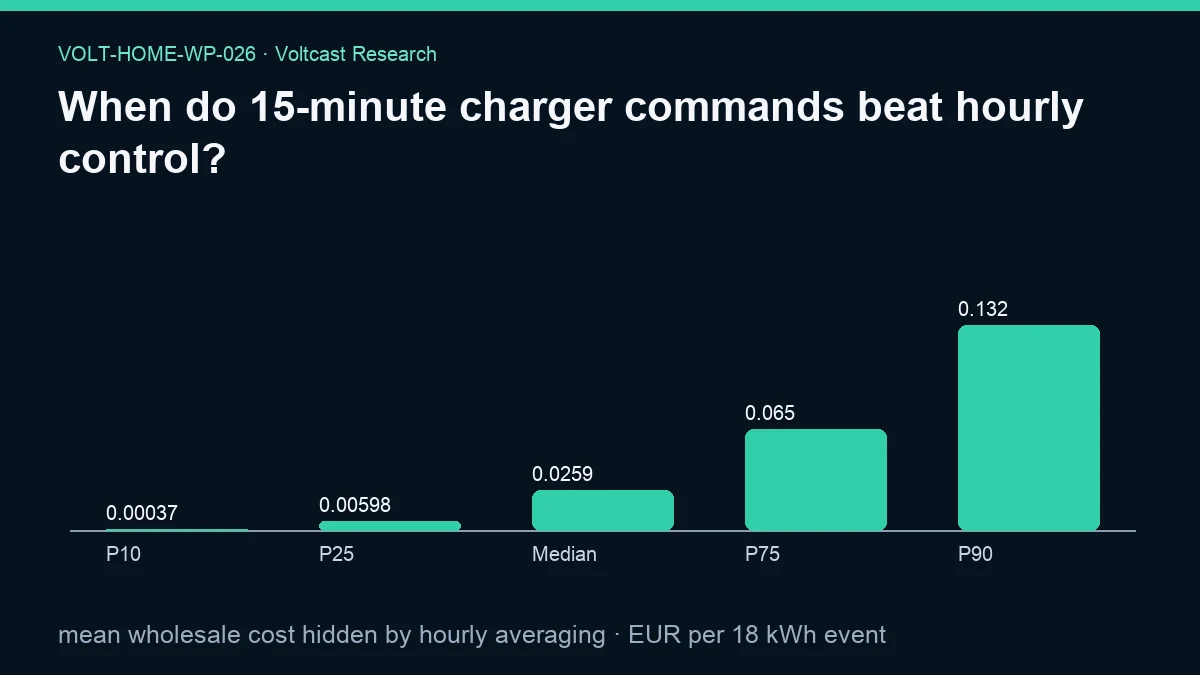
When do 15-minute charger commands beat hourly control. Positive values mean native quarter-hour selection found a cheaper schedule than hourly averaging.
Abstract
Hourly averaging can conceal price differences inside an hour that a quarter-hour-capable charger could use. This paper compares the minimum wholesale scenario cost of an 18 kWh event at 7.4 kW using native quarter-hour prices with the cost obtained after averaging those prices into local hourly blocks. The scenario assumes perfect day-ahead foresight and excludes taxes, supplier margin, and network charges. Detailed interval evidence covers ten representative European bidding zones from 2025-10-01 through 2026-08-29. Across 3,330 observations, hourly averaging hides a mean wholesale scenario value of €0.051148916066066016 per 18 kWh event. The bootstrap field is €0.046650004370138845 to €0.052657298059027725. Positive values mean native selection found a cheaper schedule. The result measures information and control resolution jointly; it is not a retail estimate and does not prove that every charger can execute quarter-hour commands reliably.
Plain-language answer
Quarter-hour control beats hourly control when meaningful price variation exists inside the hour and the event constraints allow the charger to select the cheaper quarter-hours. In this evidence, native scheduling lowers wholesale scenario cost by €0.051148916066066016 per 18 kWh event on average. The reported bootstrap field is €0.046650004370138845 to €0.052657298059027725.
If all quarter-hours inside an hour have the same price, averaging loses nothing. If prices differ but the charger must run through the whole hour, the extra information may also have little value. The measured difference therefore depends on both market resolution and physical scheduling flexibility. It should not be interpreted as an amount on a household invoice.
Research question
The question is: how much wholesale scenario cost is hidden when native quarter-hour day-ahead prices are averaged to hourly prices before optimizing an 18 kWh, 7.4 kW EV event?
This isolates a representation choice. Both optimizers see the same underlying day and must deliver the same energy. One can rank native intervals; the other ranks local-hour averages. The comparison does not ask whether quarter-hour markets caused volatility, only whether preserving native resolution changes the feasible price-aware schedule.
Data and provenance
The source contract is day_ahead_prices, forecasts, forecast_accuracy, generation_mix, and zones. The direct inputs are interval prices, recorded resolution, and zone timezone. The evidence limitation specifies ten representative European bidding zones for detailed interval analysis from 2025-10-01.
Declared windows are daily prices from 2021-01-01 to 2026-08-29, detailed intervals from 2025-10-01 to 2026-08-29, and long history from 2015-01-01 to 2026-08-29. Cutoff is 2026-08-30T00:00:00Z. Extraction was read-only with a 180-second timeout.
Snapshot SHA-256 is 7e97489fc8528c8cc8c38830e05b48d949ce1f67b98575dff26f5d7c321e4c67; protocol is adb36bf6b447af9f96339249b8becaefc20422499cca1977242866347a97bd4b; registry is 7bcb91d7476d0a69fe9fa75a5c7782f8117e0153f82f9112b7e1d307d3943717; source registry is 07949550ac443ff673fda5c0209b99f137544f3ffecf6775f109bb9d09663bd6; and code is 57c57de79cdab2b5b6d6c54c485cb5162598c5ba0b0bfe995da40d75e6c52ba9.
Method
Eligible days must contain native 15-minute intervals and sufficient completeness for the frozen calculation. The native solver ranks recorded intervals by price and fills 18 kWh subject to 7.4 kW and interval duration.
For the hourly arm, native prices are grouped by local clock hour and averaged. Each hourly mean becomes a 60-minute scheduling block timestamped from the earliest native interval in that local hour. The same cheapest-first allocation then solves the 18 kWh event against those blocks. Wholesale scenario cost is allocated energy times EUR/MWh price with unit conversion.
This construction changes both the information set and the granularity of feasible allocation. In the native arm, a 7.4 kW charger can consume energy from a 15-minute interval according to that interval’s duration. In the hourly arm, the optimizer sees one mean price and one 60-minute block. The result therefore answers the implemented end-to-end question: what is lost when quarter-hour observations are collapsed before scheduling?
Local-clock grouping is material. Delivery intervals are market products tied to local operating routines, while their stored timestamps can be represented in UTC. Grouping without the zone timezone could place intervals into the wrong hour around ordinary offsets or clock transitions. The frozen calculation uses each zone’s timezone before assigning an hour.
The paired outcome is hourly wholesale scenario cost minus native wholesale scenario cost. Positive values indicate information lost through averaging. Local-hour grouping matters because the control question concerns the delivery clock experienced in each bidding zone.
The method family is constraint-aware charging simulation with paired schedule regret and scenario sensitivity. Within-family Holm control applies to inferential claims; this paper reports a descriptive result without an unadjusted significance claim.
Results
The mean wholesale scenario value hidden by hourly averaging is €0.051148916066066016 per 18 kWh event across 3,330 observations. The bootstrap field is €0.046650004370138845 to €0.052657298059027725.
The positive mean says native quarter-hour selection was cheaper than optimization on hourly averages in the frozen panel. It does not say every observation was positive. The figure publishes P10 = 0.0003698499999999895, P25 = 0.005978874999999884, median = 0.02586880555555554, P75 = 0.06498558333333315, and P90 = 0.1322851 EUR per event.
The result is specifically about an optimizer. It combines the informational loss from averaging with the coarser block size presented to the scheduler. It does not measure metering, settlement, or command-delivery errors.
Robustness and placebo checks
The same-day paired design holds energy and underlying price data fixed. Hourly prices are constructed directly from the native intervals rather than taken from a different provider, reducing source-composition confounding.
A zero-within-hour-variation case is the conceptual placebo: native and hourly representations should coincide in price information. The evidence does not publish this subgroup separately, so no placebo statistic is claimed. The positive-sign interpretation follows the frozen metric, while actual observation-level signs are not reported.
The evidence does not test command latency, missed commands, alternate hourly aggregation, or charger efficiency. The ten-zone scope is explicit. Holm control governs family inference, but the paper remains descriptive.
Completeness is another guardrail. The frozen arm excludes short day panels and requires at least one recorded 15-minute interval. This avoids labeling an hourly-only day as evidence about native quarter-hour selection. It does not prove that every retained interval is free from all upstream error, so the result remains conditional on the frozen snapshot.
An alternative hourly representation could preserve four quarter-hour energy decisions while assigning the same hourly average price to each. That would isolate information resolution from command resolution. The evidence instead combines them. Because that alternative is not measured, this paper does not claim which component accounts for the €0.051148916066066016 wholesale scenario value.
Limitations
Every euro amount is a wholesale scenario value. Taxes, network charges, supplier margin, losses, and retail tariff transformations are excluded. Perfect foresight gives both arms complete knowledge of their respective curves.
Hourly averaging is only one form of coarse control. A real hourly controller might accept sub-hourly prices but change setpoints hourly, or it might face a different settlement rule. This simulation uses averaged prices represented as 60-minute blocks, so its result should not be generalized to every hourly implementation.
Detailed interval analysis covers ten representative European bidding zones from 2025-10-01. The evidence does not identify zone-specific results or justify representativeness for every market. It also omits command reliability and device constraints.
Perfect day-ahead foresight removes forecast error from both arms. A deployed native controller may change its schedule as forecasts or published prices change, while an hourly controller may be less sensitive simply because it has fewer decisions. That stability tradeoff is outside this paper.
The method uses arithmetic mean prices within local hours. Other aggregation rules could preserve energy weighting or deal differently with incomplete hours. No such sensitivity is published. The figure quantiles provide a distributional view of this outcome, but they do not identify zone or subgroup effects.
Practical implication
Home-energy software should preserve native market intervals end to end. Averaging before optimization can remove information that cannot be recovered later. Schedules should carry timestamps, durations, and prices at their source resolution.
Quarter-hour commands are useful only if the device can execute them safely and the tariff transmits a compatible signal. The €0.051148916066066016 aggregate does not by itself justify more frequent switching or new hardware.
Evaluation should compare native and coarse representations on the same curves, disclose interval construction, and report wholesale scenario values separately from retail economics.
The result also matters for data pipelines. Once four distinct prices have been replaced by one hourly mean, downstream optimization cannot reconstruct their ordering. Resolution should therefore be retained at ingestion and reduced only at a clearly documented boundary. A user interface may display an hourly summary while the scheduler continues to consume native intervals.
Any operational implementation should combine native resolution with feasibility checks, timezone-safe timestamps, command idempotency, and a fallback when an interval is missing. Those engineering requirements are not measured by this paper, but they prevent the numerical opportunity from being confused with a safe control policy.
Reproducibility
Verify all frontmatter, assumptions, windows, source tables, metric, sample size, interval, figure metadata, and hashes against the public JSON. Verify the five citations against the source registry.
Using snapshot 7e97489fc8528c8cc8c38830e05b48d949ce1f67b98575dff26f5d7c321e4c67 and code 57c57de79cdab2b5b6d6c54c485cb5162598c5ba0b0bfe995da40d75e6c52ba9, solve native and local-hour-averaged 18 kWh schedules at 7.4 kW. Subtract native from hourly cost for paired feasible days.
The result should contain 3,330 observations, return €0.051148916066066016, and preserve the day/row-block mean bootstrap interval €0.046650004370138845 to €0.052657298059027725. Do not impute missing intervals. The current evidence and figure SHA-256 hashes are 1e3c02d1ea97d380cd200cf0648e99325289a49d0cc8128b2b316c66e4570846 and ff1ac2b5b40ee3a6fafdb42f96920bab69286aa698aff89d87ac1c9e95e35498.
Disclosure
Analysis and drafting were model-assisted. This is not peer reviewed. Evidence, assumptions, hashes, code identity, and source metadata are disclosed.
It is not trading, investment, tariff, or purchasing advice. All monetary amounts are wholesale scenario values. No external findings were introduced.
References
nature-v1g-v2g-2026— Nature Energy. Coordinated planning of European charging infrastructure and energy system for optimal V1G and V2G deployment. Kind: peer-reviewed.applied-energy-smart-charging— Applied Energy. The value of smart charging at home and its impact on EV market shares. Kind: peer-reviewed.acer-retail-2025— ACER and CEER. Rewarding flexibility: How retail contract choice can help unlock consumer flexibility. Kind: official.iea-demand-flexibility— International Energy Agency. Scaling Up Demand Flexibility. Kind: official.ec-sdac-15m— European Commission. EU electricity trading in the day-ahead markets becomes more dynamic. Kind: official.