Why weekends and holidays change negative-price risk
Why weekends and holidays change negative-price risk. Calendar composition is associated with negative-price incidence; national holidays are not uniformly available.
Why weekends and holidays change negative-price risk
Abstract
Calendar labels can help organize negative-price observations, but they must not be confused with causal explanations. This working paper compares the share of day-ahead delivery intervals priced below zero on weekends and weekdays. In the frozen evidence, the weekend share is 0.03229980546564459, the weekday share is 0.008829521737459415, and their ratio is 3.6581602521699508 across a registered sample size of 26,668. The descriptive result is that negative intervals occupied a larger share of weekend observations in the analyzed sample.
The title also names holidays, yet the evidence explicitly says holiday effects are not isolated where the public holiday contract is absent. Accordingly, this paper does not invent a holiday coefficient or merge holidays silently into a weekend explanation. The analysis covers daily prices from 2021-01-01 through 2026-08-29 under a shared negative-price research contract. It reports calendar association, not a causal demand mechanism, household savings, or forecast performance. The corrected evidence intentionally reports no bootstrap interval for the ratio estimand.
Plain-language answer
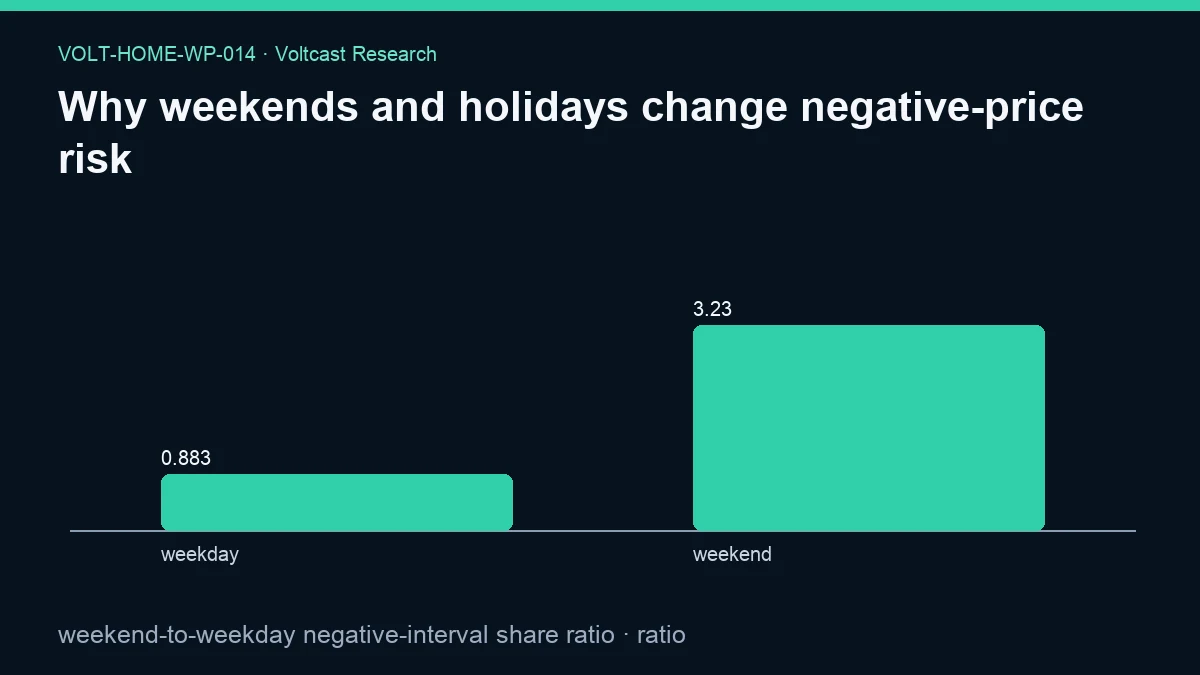
Negative day-ahead intervals were more common on weekends than on weekdays in this dataset. The weekend negative-interval share was about 3.23%, while the weekday share was about 0.88%. Dividing the underlying recorded fractions gives a weekend-to-weekday ratio of 3.6581602521699508. This describes the observations in the frozen sample; it does not mean any given weekend will contain a negative interval.
The evidence cannot give an equally direct answer for national holidays. Holiday calendars are not uniformly available under the public data contract, and holidays differ by country and sometimes by region. A weekday public holiday may behave differently from an ordinary weekday, but the supplied result does not isolate that contrast. The defensible conclusion is therefore stronger for weekends than for holidays.
Research question
The primary question is: how does the observed share of negative day-ahead intervals differ between weekends and weekdays? The registered outcome is a ratio, with the weekend share in the numerator and weekday share in the denominator. The companion question—whether national holidays show a distinct effect—can only be answered where an appropriate holiday contract is available and aligned to the relevant bidding zone.
This is a descriptive calendar classification. It does not identify the mechanism behind a difference. Lower demand, generation conditions, network availability, market coupling, outages, weather, and bidding decisions may differ across the calendar. Demonstrating that one of those factors causes the weekend contrast would require a different design with measured controls or a credible intervention. The present paper keeps the measured ratio separate from possible explanations.
Data and provenance
The evidence declares daily prices from 2021-01-01 through 2026-08-29, detailed intervals from 2025-10-01 through 2026-08-29, and long-history coverage from 2015-01-01 through 2026-08-29. The public result has a sample size of 26,668. The JSON does not label that count more narrowly than the metric context, so this paper calls it the registered analysis sample and does not invent whether it represents days, zone-days, or another eligible unit.
The source-table contract lists day_ahead_prices, generation_mix, border_flows, risk_accuracy, and zone_holidays. Price intervals and calendar classification are central to this paper. The limitation on holiday availability means the presence of zone_holidays in the contract is not proof that every included market has a complete national or regional calendar. The other tables are part of the family contract but do not establish a controlled explanation for the weekend ratio.
The current public-evidence JSON SHA-256 is 8a351d14fa48612143e568dbe57e48e37a0773c83d13c14fbdc16b4c8e9d411f. The read was performed in a read-only transaction with a 180-second statement timeout and a publication cutoff of 2026-08-30T00:00:00Z. Recorded hashes are: analysis code 57c57de79cdab2b5b6d6c54c485cb5162598c5ba0b0bfe995da40d75e6c52ba9; protocol adb36bf6b447af9f96339249b8becaefc20422499cca1977242866347a97bd4b; registry 7bcb91d7476d0a69fe9fa75a5c7782f8117e0153f82f9112b7e1d307d3943717; snapshot 7e97489fc8528c8cc8c38830e05b48d949ce1f67b98575dff26f5d7c321e4c67; and source registry 07949550ac443ff673fda5c0209b99f137544f3ffecf6775f109bb9d09663bd6. No assumptions are registered.
Method
Each eligible native day-ahead interval is classified as negative when its price is below zero. It is also classified by the local calendar as weekend or weekday. Within each class, the analysis calculates the fraction of intervals that are negative. The primary statistic divides the weekend fraction by the weekday fraction.
Using a ratio makes the comparison easy to state, but it requires retaining the two component shares. A large ratio can arise when the denominator is small, so readers should see both 0.03229980546564459 and 0.008829521737459415 rather than the ratio alone. The calculation describes relative incidence; it does not estimate the absolute number of negative intervals a future household will encounter.
Holiday analysis requires more than a weekday/weekend flag. A valid holiday field must identify the jurisdiction, effective local date, and relevant zone mapping. The evidence warns that this contract is absent in some places. Those rows cannot be treated as confirmed non-holidays. The registered method family includes matched calendar controls, but the public JSON supplies no separate holiday estimate or control contrast. Within-family Holm control applies to inferential claims; this result is explicitly descriptive and carries no unadjusted significance claim.
Results
The measured weekend negative-interval share is 0.03229980546564459, equivalent to roughly 3.23% when expressed as a percentage. The measured weekday share is 0.008829521737459415, or roughly 0.88%. The registered weekend-to-weekday ratio is 3.6581602521699508, based on a sample size of 26,668.
This result supports a calendar association: negative intervals occupied a greater share of weekend observations. It does not establish that “weekend” itself changes prices. Weekend status can stand in for a bundle of recurring system conditions, and the current result does not separate them. Nor can it quantify holidays, because no holiday-specific result appears.
The corrected evidence stores bootstrap_95_interval as null and identifies the interval method as “not reported for this estimand.” No unsupported uncertainty interval is attached to the weekend-to-weekday ratio. The figure is separately machine-readable: weekday is 0.8829521737459415 and weekend is 3.2299805465644593, expressed on the plotted percentage scale.
Robustness and placebo checks
Publishing both component shares is a basic robustness safeguard against ratio-only interpretation. It reveals the scale of the numerator and denominator and makes the registered ratio independently checkable. Native interval classification should also prevent days with different market time units from being reduced to misleading equal row counts, provided the underlying implementation weights intervals consistently.
A suitable matched-calendar robustness design would compare like seasons, zones, and nearby dates, or shuffle weekend labels within constrained calendar blocks. A holiday placebo would require complete holiday calendars and could compare unmatched dates only after excluding weekends and handling regional holidays. The evidence JSON does not report outputs for those checks. They remain methodological recommendations rather than completed findings.
The family multiplicity policy applies Holm adjustment to inferential claims. Because this paper reports no corrected p-value and explicitly describes the ratio, it avoids significance language. The intentionally unreported interval is not replaced by the figure values: those values describe the weekday and weekend bars, not uncertainty around the ratio.
Limitations
The most direct limitation is holiday coverage. Where the public holiday contract is absent, the analysis cannot reliably distinguish an ordinary weekday from a public holiday. Holiday definitions may also vary across national and regional boundaries, while electricity bidding zones do not always map neatly to one civil calendar. No uniform holiday effect is therefore established.
The weekend comparison may pool markets and periods with different negative-price frequencies. Without public zone-specific estimates, the pooled ratio can hide heterogeneity. The sample-unit label is also not explicit in the evidence field. Reproduction should resolve whether 26,668 represents eligible days, zone-days, or another analysis unit before making finer-grained claims.
This paper does not model demand, generation, storage, imports, exports, constraints, outages, or weather. It does not show why the weekend difference arose. It also lacks retail tariffs, taxes, network charges, device availability, and counterfactual household load, so it is not a household bill study. The work was model-assisted, is not peer reviewed, and should not be interpreted as trading advice.
Practical implication
Calendar information can improve the presentation of a negative-price alert, but it should not replace the actual published price curve. A home controller could treat weekends as a context feature while still requiring a fresh interval-level price and the household’s real retail terms. The measured ratio does not justify pre-charging, discharging, or changing comfort settings solely because a day is Saturday or Sunday.
Holiday support should fail closed. If the zone’s holiday calendar is missing, software should label the holiday state unavailable rather than ordinary. This distinction matters for explanations and later evaluation. A robust household schedule should also respect timezone, daylight-saving changes, appliance constraints, and user preferences. The evidence provides a calendar association, not a complete control policy or savings promise.
Reproducibility
A reproduction should verify the snapshot hash and publication cutoff, select the declared price window appropriate to the registered analysis, and preserve native interval start and end times. Every interval should receive a below-zero indicator and a local weekend/weekday label under an explicit timezone. The reproducer should calculate the two fractions on the same eligibility rules, then verify 0.03229980546564459 for weekends, 0.008829521737459415 for weekdays, and 3.6581602521699508 for their ratio.
The report must define the sample unit behind 26,668, document missing intervals and revisions, and audit daylight-saving days. Holiday rows should only be analyzed where calendar coverage is proven; unknown holiday status must not be coded as false. It should preserve the intentional null interval and reproduce the machine-readable figure values 0.8829521737459415 for weekday and 3.2299805465644593 for weekend.
The methodological governance source is Voltcast’s Voltcast Research Content Plan. Registered contextual sources are Electricity 2026 from the International Energy Agency, Rewarding flexibility: How retail contract choice can help unlock consumer flexibility from ACER and CEER, EU electricity trading in the day-ahead markets becomes more dynamic from the European Commission, and Single Day-ahead Coupling (SDAC) from ENTSO-E. This paper does not assign unreported numerical findings to those sources.
Disclosure
Analysis and drafting were model-assisted; sources, code, assumptions, and evidence hashes are disclosed. The paper is not peer reviewed. Its result is a descriptive wholesale-price calendar comparison, not a household bill study, forecast guarantee, or explanation of causality. It is not trading advice and does not recommend a tariff, transaction, appliance, or investment. No authors, credentials, source dates, digital object identifiers, or external findings were invented.
References
- International Energy Agency — Electricity 2026
- ACER and CEER — Rewarding flexibility: How retail contract choice can help unlock consumer flexibility
- European Commission — EU electricity trading in the day-ahead markets becomes more dynamic
- ENTSO-E — Single Day-ahead Coupling (SDAC)
- Voltcast — Voltcast Research Content Plan